
Guides
19 Nov 2026

How to Purge Air From a Radiant Floor Heating Loop
Radiant floor loop not heating? Learn what purging air involves, how to tell whether air is the cause, and when to call a heating professional.
Boiler running but baseboards still cold? Check thermostat settings, affected zones and common circulation problems—and know when to call a professional.
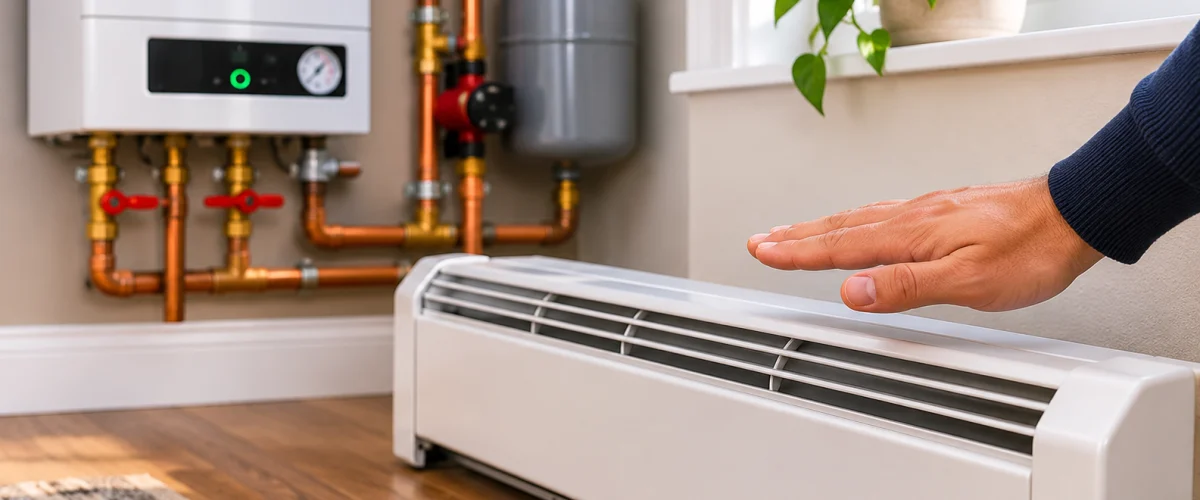
Please note: This is general information about hot-water baseboard heating, not a diagnosis of your system. Your boiler and equipment instructions come first, and a heating professional should handle anything involving electrical controls, pumps, boiler settings or pressurised hot water.
This guide is about hot-water (hydronic) baseboards: the finned pipe along the wall that a boiler heats with circulating water. It isn’t about electric baseboards or steam radiators, which fail in different ways.
The short answer: a boiler that’s running doesn’t prove hot water is reaching your baseboards. A hydronic system has to do three jobs: heat the water, move it around the house, and deliver it to the rooms that need it. Caleffi’s troubleshooting guidance describes the same three functions and recommends working through them in order rather than guessing. Its example is a replaced circulator pump when the real culprit was a thermostat with dead batteries.
What’s cold, and where, is your best first clue. These are clues, not diagnoses.
1. All the baseboards are cold
Points toward something every zone shares: settings, power or fuel, the boiler or a shared circulator.
2. One zone is cold while the others heat
Points toward that zone’s thermostat, valve or control, or air or restricted flow in that loop.
3. One room or section is cooler than the rest
Could mean less heat reaches that part of the loop, or the baseboard there can’t release it.
If the trouble began after draining, repairs or a seasonal restart, air or the pressure and fill settings are worth raising with whoever did the work.
✏️ Our Take
| What you notice | What it could suggest | Safe next check |
|---|---|---|
| Every baseboard is cold | Hot water may not be reaching any zone: a shared control, circulator or boiler-side issue | Check thermostat mode, setpoint and batteries. Note any boiler display message and the gauge reading. |
| One zone is cold, others are warm | The zone isn’t calling, its valve or control isn’t responding, or air or restricted flow in that loop | Check that zone’s thermostat settings and batteries. Note any indicator lights on the zone control. |
| Gurgling or trickling sounds, especially after draining or repairs | Air in the loop may be interfering with flow | Read our bleeding guide. If your baseboard has no bleeder, call a professional. |
| One room stays cooler than the others although its zone is heating | The baseboard may not be releasing heat well: blocked airflow, a closed damper or a dusty element | Look for blocked airflow or a closed damper where one is fitted. Don’t touch the element or bend the fins. |
| The gauge looks different from usual, or you see a leak | A pressure or water-supply issue that needs attention | Write down the reading and photograph it. Stop and call a professional if there is a leak. |
Start here, because it costs nothing. Check that the thermostat is set to heat, the setpoint is above the room temperature, no schedule or setback is holding it down, and the batteries are fresh if it takes them. A zone thermostat only asks for its own zone, so the boiler may be running for another zone while yours never calls.
Many systems put a motorised zone valve on each zone. When the thermostat calls, the valve opens, and its switch tells the boiler and circulator to start. Caleffi notes that some zone valves with thermal motors can need up to three minutes to open fully, so give a zone a few minutes before deciding it isn’t responding.
Taco’s zone-control manual describes status lights that separate a call for heat from a valve that has opened and closed its end switch. What those lights mean depends on the controller you actually have, so check your own manual or labels rather than assuming. Opening electrical covers, testing wiring or forcing a valve is for a professional. If a valve is later diagnosed as faulty, see our guide to zone valves for baseboard heating.
The circulator is the pump that moves hot water through the pipes. A running boiler, a warm pump casing, vibration or a hum doesn’t prove water is flowing properly, so don’t use them as a test. Pump testing, wiring and replacement belong with a professional. If the pump is later found to be at fault, our hydronic circulator guide covers the options.
Closed hydronic systems are meant to run with very little air. With too much, the circulators won’t provide proper flow, you’ll likely hear gurgling or swishing, and in the extreme case a large pocket of air can block flow completely (Caleffi’s troubleshooting guide). That’s why recent draining or repeated gurgling is relevant, though noise isn’t proof and a quiet system isn’t guaranteed to be air-free.
If your baseboard has a manual bleeder, our guide to how to bleed air from hydronic baseboard heaters shows the careful way to use it. Loops without one are purged from the boiler with a water supply, which is a job for a professional. If air keeps returning, ask about the cause; our comparison of an air separator and an air scoop is for after that diagnosis.
Your boiler has a pressure gauge. Look at it, note the reading, and note whether the system was cold or hot, since the reading usually changes as the water warms. Compare it with your own boiler’s instructions, because the right range depends on the system. Don’t add water, adjust the fill valve or use a fast-fill lever to chase a number. Caleffi has technicians record “as found” pressures and temperatures before changing anything.
The baseboards themselves are usually not the underlying cause of poor heating, but with everything else normal they can be. Caleffi’s fin-tube checklist asks whether the housing dampers are fully open, whether the element is reasonably clean rather than heavily coated with dust, whether the fins are badly deformed, and whether furniture, boxes, drapes or shelves block airflow in or out.
Safe checks are looking, not touching: see whether furniture, boxes or drapes block airflow in front of or above the baseboard, and whether a damper, where one is fitted, has been left closed. Moving things out of the way is fine. Leave the element and its fins alone, since they can be hot and bend easily. Otherwise, watch the room temperature and whether warm air is rising from the baseboard over a longer period. If the room stays cool while the zone keeps calling for heat, that points to a professional, not to more tinkering.
Some rooms need more heat than others, so every loop doesn’t necessarily need the same flow. A heating professional can check whether balancing, restricted flow or another problem is leaving that room cold.
Notes make a service call faster. Write down:
Call a professional
Stop and call a heating professional if you see a leak, a pressure reading that looks abnormal for your system, an electrical or burning smell, or a boiler fault or lockout. Don’t keep resetting a lockout, open electrical controls, jumper terminals, force valves, change boiler limits or release hot, pressurised water.
Gas smell or carbon monoxide alarm: these are emergencies, not troubleshooting. CPSC says that if you smell or hear gas leaking, you should leave your home immediately, contact local gas authorities from outside, and not operate lights or phones before leaving. If a carbon monoxide alarm sounds, CPSC says to move outside to fresh air, call 911 or the fire department, and not re-enter until responders say it’s safe.
Each zone has its own thermostat and its own path for water, so the cause is usually in that zone: its settings, valve or control, air in the loop, or its baseboards. Start with its thermostat. If that’s right and the zone stays cold, note any indicator lights and call a professional rather than opening the controls.
Only if the signs point to air, such as gurgling or recent draining, and your baseboard has a bleeder. Bleeding doesn’t guarantee the heat will come back. If there’s no bleeder, or air keeps returning, have a professional find out why. Our guide on how to bleed air from hydronic baseboard heaters covers the method.
Yes. The boiler may be serving another heating zone or making domestic hot water. Seeing or hearing it run doesn’t confirm that heated water is reaching your baseboards.
Work out the pattern, check the thermostats, and write down what you see. If the cold persists, give a heating professional those notes and ask for a diagnosis before you buy any part.
✍️ About This Guide
PTR Editorial Team — Plumbing Guides. We compare manufacturer specifications, installation requirements, compatibility and available product documentation to help homeowners choose suitable tools and parts. How we review →
Radiant floor loop not heating? Learn what purging air involves, how to tell whether air is the cause, and when to call a heating professional.
Learn how to find and use a manual bleeder on a hot-water baseboard heater, and what to do if the heater has no bleeder or stays cold.
What a compression sleeve puller is for, what its maker documents about 1/2 in (5/8 in OD) fit, and what to check before you choose one.

