
Guides
19 Nov 2026

How to Purge Air From a Radiant Floor Heating Loop
Radiant floor loop not heating? Learn what purging air involves, how to tell whether air is the cause, and when to call a heating professional.
Learn how to find and use a manual bleeder on a hot-water baseboard heater, and what to do if the heater has no bleeder or stays cold.
Please note: Product availability and information are based on our research at time of writing and are subject to change. Always check Amazon for the latest details before purchasing. Reviews remain editorially independent.
Does one baseboard stay cool while the rest of the house warms up? Or do you hear water gurgling through the pipes when the heat kicks on? Trapped air is one possibility. If your baseboard has a manual bleeder, you can release the air there. If you can’t find a bleeder, the heating loop may need to be purged at the boiler.
This guide is for hot-water baseboards connected to a boiler. If you have electric baseboards or aren’t sure what type of heat you have, check before opening anything.
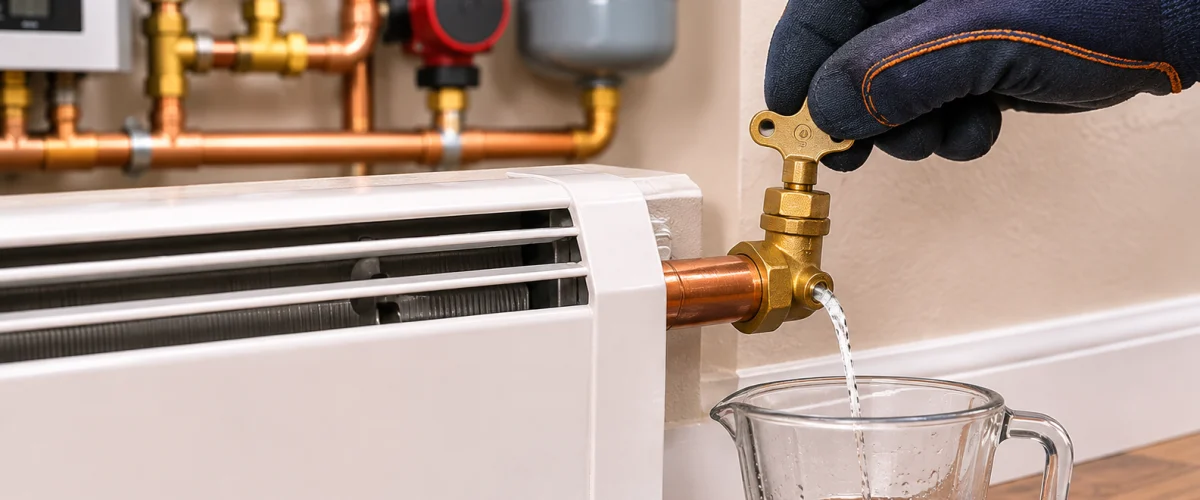
Look near the end of the baseboard, where the pipe connects to the heating element. A manual bleeder often has a small square or slotted screw with an outlet beside it. Some baseboards have a hinged end cover for access. If you can’t identify the bleeder, leave the fittings alone. Further reading: Caleffi’s guide to air separation in hydronic systems.
Before you start
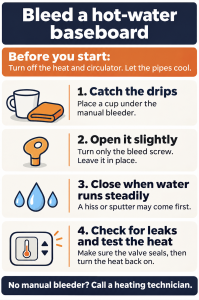
Have a shallow cup, a towel, and the key or screwdriver that fits your bleeder. Follow your system’s instructions for shutting off the heat and circulator, and let the baseboard and piping cool. The loop can still be pressurized when it’s cool, so keep your face and hands clear of the outlet.
How to bleed a baseboard with a manual bleeder
Put a towel under the valve and hold a shallow cup beneath the outlet.
Use the right key or screwdriver and turn only the bleed screw. Leave the screw in place. If it won’t move easily, stop rather than forcing it.
You may hear a hiss or see a little sputtering. Close the bleeder as soon as a small, steady stream of water appears. If water comes out steadily right away, close it. If neither air nor water comes out, close it and have the system checked.
Wipe the area dry and make sure the bleeder seals. Restore the heat and give the zone time to warm up. If the valve keeps dripping or the room still stays cold, call a heating technician.
Some systems release air through equipment elsewhere on the loop. A heating technician can identify the right purge valves and check whether the loop needs to be flushed with water to carry trapped air out. That job depends on the piping and the boiler’s fill controls. Leave the boiler drain, relief valve and fill controls alone while looking for a baseboard bleeder. Further reading: Caleffi’s hydronic troubleshooting guide.
If the heater warms up after bleeding but starts gurgling again soon after, ask a technician to check why. Low system pressure, a leak or a problem with the air-removal equipment can all warrant a closer look. If you got a steady stream right away and the baseboard remains cold, the problem could be elsewhere, such as the zone valve or circulator. Further reading: Caleffi’s guide to common hydronic performance problems.
If you’ve already identified a vent that needs replacing, our boiler air vents and air eliminators roundup explains the difference between a small point vent and an inline separator. If the problem is isolated to one heating zone, see our hydronic zone valve guide for help identifying the valve and its power head.
Sometimes a job is too big for DIY. To find local plumbers, you can search PlumberArchive.com, a plumber directory.
✍️ About This Guide
PTR Editorial Team — Plumbing Guides. We compare manufacturer specifications, installation requirements, compatibility and available product documentation to help homeowners choose suitable tools and parts. How we review →
Radiant floor loop not heating? Learn what purging air involves, how to tell whether air is the cause, and when to call a heating professional.
Boiler running but baseboards still cold? Check thermostat settings, affected zones and common circulation problems—and know when to call a professional.
What a compression sleeve puller is for, what its maker documents about 1/2 in (5/8 in OD) fit, and what to check before you choose one.

