Comparisons
2 Oct 2026

Pop-Up Drain vs Grid Drain: Which Should You Choose?
Pop-up drains seal to hold water; grid drains never close but resist clogs better and cost less. Here's how to choose between them for your bathroom sink.
Wood vs plastic toilet seats: what molded wood really is, how each is cleaned and how each fails, and how to choose, based on manufacturer guidance.
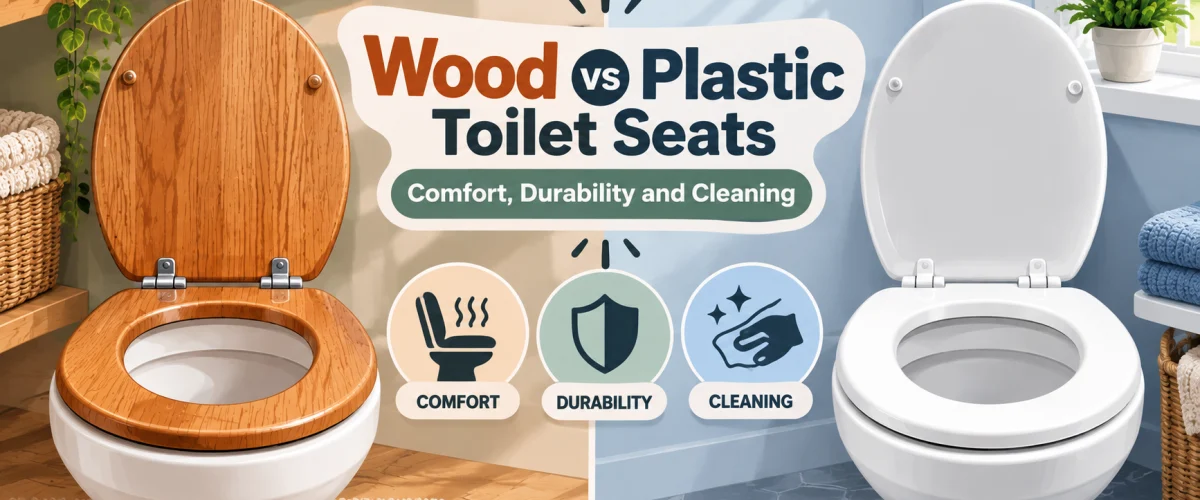
Please note: This comparison is based on our research at time of writing and describes toilet seat materials by category. Construction, finishes, and care instructions vary by brand and model, so always follow the care instructions that came with your specific seat.
Walk down the toilet seat aisle and the first choice you meet is material: molded plastic or wood. The shelf-tag version of the advice is usually a single line: wood feels warmer and looks better, plastic is tougher and easier to keep clean. Some of that is half true, and some of it is hard to check. The real differences tend to show up months later, in how the seat gets cleaned and how its finish holds up.
This comparison goes past the one-paragraph version. It explains what a “wood” seat actually is (often not solid wood), what can and can’t be said about warmth and moisture, how manufacturers’ own care instructions differ, and what has actually been documented going wrong with each material. Where the evidence is thin, we say so rather than smoothing it over.
✏️ Our Take
For most bathrooms, the choice between wood and plastic matters less than the care routine that follows it. A plastic seat has no finish layer to protect, so it asks less of you, and at least one major manufacturer’s care guidance allows a wider range of cleaners on it. A molded-wood seat can be a solid-feeling, good-looking choice, but its protective coating does the moisture-resisting, so it rewards gentle cleaning and a watchful eye for chips. The practical answer is to read the instructions for your specific seat and choose the material whose care rules you’ll actually follow.
IN THIS GUIDE
The table below sets molded wood, the most common kind of wood seat, beside plastic across the factors that matter over time. The sections that follow explain the reasoning and the evidence behind each row, including where it is thin.
| Factor | Wood (Molded) | Plastic |
|---|---|---|
| Construction | Compressed wood fibers and resin, finished with a protective coating | Typically a single molded plastic, often polypropylene or similar, with no separate finish layer to maintain |
| Feel | Can feel more substantial; some people find the first touch less cold (subjective) | Lighter; some people find the first touch cooler (subjective) |
| Moisture handling | The coating does the moisture-resisting; a chipped or worn finish can expose the fiber core | No finish layer to fail, but not immune to damage from abrasives and harsh chemicals |
| Cleaning requirements | Depends on the brand: some allow only mild soap and a soft cloth on all seats, and Kohler specifies this for wood | Depends on the brand: Kohler allows broader cleaners; Bemis applies the same mild rule to plastic |
| Typical cost tier | Overlaps with plastic; features often move price more than material | Overlaps with wood; features often move price more than material |
| Best for | Ventilated bathrooms, users who like a heavier seat and will keep to gentle cleaning | Households with varied cleaning habits (check the brand’s rules), or humid, poorly ventilated bathrooms as a precaution |
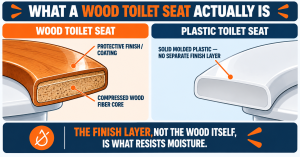
The word “wood” on a toilet seat covers more than one construction. Many of the wood seats sold at retail, including the Bemis seat in our roundup, whose listing describes molded-wood construction, are molded wood. That means compressed wood fibers combined with resin or adhesive, pressed into shape in a mold under heat and pressure, then finished with multiple layers of paint or a high-gloss protective coating. It’s an engineered wood product rather than a carved or laminated plank.
Solid wood and natural-finish wood seats exist too, but they’re a different category. Kohler’s own care documentation, for example, sorts toilet seats into three groups: plastic or molded, painted wood, and wood finish. The wood-finish group gets furniture-style care instructions, such as dusting, controlling indoor humidity, and occasional waxing. A glossy enameled seat is closest to the painted-wood group, although the document doesn’t say so explicitly, and it doesn’t define what “molded” means in the first group.
Plastic seats are simpler. They’re typically a single molded material, commonly polypropylene or a similar plastic, though product listings usually just say “plastic.” There’s no separate paint or coating layer that has to stay intact.
The most repeated claim in this category is that wood seats feel warmer. It’s a real impression for some people, so we don’t dismiss it, but it’s easy to overstate.
Retail descriptions often call wood seats “warmer” to the touch, and some people do notice a less cold first contact. That’s a subjective impression that varies from person to person and from bathroom to bathroom.
The material data doesn’t back the stronger version of the claim, that wood “holds heat” better. In a cold bathroom, both kinds of seat sit at room temperature, and neither stores warmth for you. What could differ, at most, is how quickly heat leaves your skin on first contact, which depends on thermal conductivity. Published engineering reference tables put common woods at roughly 0.12 to 0.16 W/mK and polypropylene at roughly 0.1 to 0.22 W/mK, and those ranges overlap substantially. We couldn’t find a reliable published figure for molded-wood composites themselves, so we can’t say where they fall. The honest summary is that any difference in first-touch feel is likely small and subjective, not a meaningful material advantage.
Weight is more concrete. Molded-wood seats can feel more substantial in the hand. The Bemis molded-wood seat in our best toilet seats roundup is listed at 7 pounds, against roughly 4 to 6 pounds for the KOHLER and Delta plastic seats we checked.
Bathrooms are humid, so moisture is where wood-versus-plastic advice tends to get dramatic. The evidence supports a narrower point than the usual claims.
A molded-wood seat’s protective coating is what does the moisture-resisting. Manufacturers describe the coated finish as resisting chips and scratches, and the fiber-and-resin core underneath is a wood product rather than a sealed plastic. While the finish is intact, the core is protected. If the finish is chipped or worn through, that core can be exposed to moisture, which is why finish care matters more for a wood seat.
A solid plastic seat has no finish layer that can chip through in the same way, and that’s a genuine advantage. It isn’t the same as being immune. Manufacturer care guidance shows plastic seats have their own vulnerabilities: Kohler says strong abrasive cleaners scratch and dull the surface, and Bemis warns that harsh chemicals can damage the finishes on seats, metal hinges, and dull plastic seats. Plastic trades one kind of care for another.
Documented, long-term data comparing how wood and plastic seats hold up in humid bathrooms is thin. We found no manufacturer warning against wood seats in humid bathrooms and no published testing that compares the two materials over years. What’s well supported is the finish-integrity point above. Claims that go further, such as specific climates where one material fails, are not something we could verify, so we don’t make them.
For a wood seat, finish care means what manufacturers already ask for on any seat: wipe up splashes, keep cleaners gentle, dry the seat, and watch for chips. Kohler’s guidance says to let the seat air dry so the hinge area dries completely, and Bemis’s care sheet says to rinse and dry thoroughly with a clean cloth. A chip that exposes the core is a reasonable point to consider replacing the seat, since the finish is what protects it.
Cleaning is where this comparison gets genuinely useful, because the rules come from the manufacturers and they don’t all agree.
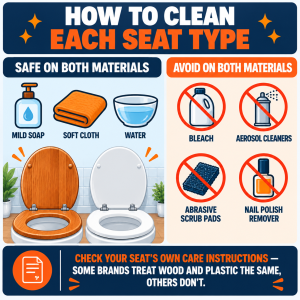
Kohler and Bemis both say to keep aerosol products, abrasive chemicals, and cosmetics such as fingernail polish and aftershave away from the seat, because they can damage the finish.
Bemis’s care guidance treats its plastic and wood seats the same way. Clean with mild soapy water and a soft cloth or sponge, rinse, and dry thoroughly. Bemis says not to use bleach, pine oils, essential oils, chlorine, acid, disinfectants, aerosol products, hard brushes, or abrasive scouring powders or pads, and it warns that harsh chemicals can rub away or corrode paint finishes on seats, metal hinges, and dull plastic seats. A Bemis FAQ adds that bleach- or alcohol-based cleaners can damage both the surface and the hinges, and that damage from harsh cleaners isn’t covered by its warranty. Warranty terms can vary by market, so check the paperwork that came with your seat.
Kohler’s care documentation does distinguish between materials. For plastic or molded seats it allows mild soap and water, lists a range of general-purpose bathroom cleaners for heavier soiling, and says soft abrasive cleaners can be used when necessary, while warning that strong abrasives scratch and dull the surface. For painted wood seats it says they need special care and to use only a mild detergent such as dishwashing soap, and its newer care guide repeats that for wood seats, specifying a soft cloth. Natural wood-finish seats get furniture-style care instead.
| Guidance | Plastic | Wood |
|---|---|---|
| Bemis | Mild soapy water and a soft cloth only; no bleach, disinfectants, or abrasives | Same as plastic |
| Kohler | Mild soap and water; general-purpose cleaners allowed for heavier soiling; soft abrasives if needed; strong abrasives scratch and dull | Mild detergent such as dishwashing soap and a soft cloth only |
The takeaway isn’t a universal rule. It’s to read the care instructions for your specific seat, because some manufacturers treat every material the same and others allow more on plastic. If you can’t find instructions, mild soapy water and a soft cloth is the option both manufacturers we checked accept for both materials.
Here we stick to what manufacturers and care documents actually describe. That list is shorter than most seat-buying advice implies, and it’s dominated by cleaning.
Buying advice often lists other failure modes: plastic seats cracking or yellowing over time, and moisture damage at the seams or edges of molded-wood seats. These are plausible, and cleaner-related staining is documented, as above. Beyond chemical damage, though, we found no manufacturer or trade documentation showing how often either happens or how quickly, so we don’t present them as established failure modes.
Whether a hinge loosens, wears, or corrodes is a separate question from the seat’s material, and Bemis notes that harsh cleaners can pit chrome hinges. If a hinge fails before the seat does, our roundup of toilet seat hinges and replacement hardware covers your options.
The best-documented way to shorten a seat’s life, whatever it’s made of, is the wrong cleaner. The rest is habit: dry it, keep it gentle, and deal with damage promptly.
There’s no universally better material. Work through these questions in order:
Price doesn’t reliably separate the two materials. In our best toilet seats roundup, the molded-wood seat sits in the lowest price tier and the plastic seats we reviewed sit one tier up, but those plastic seats include features such as slow-close hinges that the wood seat’s listing doesn’t mention. In that lineup, features appear to move price more than material does. Compare seats with the features you want in both materials before deciding.
When the new seat arrives, our guide to installing a toilet seat walks through the swap step by step.
Cost tiers here are general comparisons and can change over time. Check current pricing before you buy.
If a seat won’t stay tight, the bowl or bolt holes look damaged, or the toilet is giving you other trouble, a licensed plumber can sort out what a new seat won’t. Find a licensed plumber in your area at PlumberArchive.com — the US plumber directory with 12,151+ verified local plumbers across all 50 states.
Get weekly plumbing tips, honest tool reviews and DIY guides delivered to your Facebook feed.
Often not. Many wood seats are molded wood: compressed wood fibers combined with resin or adhesive, pressed under heat and pressure, and finished with a protective coating. Solid and natural-finish wood seats exist as a separate category with different care needs.
Some people report a less cold first touch, but it’s a subjective impression, not an established material advantage. Published thermal conductivity figures for common woods and for polypropylene overlap, and neither material holds heat in a cold room.
It depends on the manufacturer. Bemis says not to use bleach or disinfectants on its seats, plastic or wood. Kohler’s guidance allows a wider range of general-purpose cleaners on plastic seats but says wood seats should get only a mild detergent and a soft cloth. Check your seat’s instructions. If you can’t find them, mild soapy water and a soft cloth is accepted by both.
The documented risk centers on the finish. A molded-wood seat’s coating does the moisture-resisting, and if it’s chipped or worn through, the fiber core can be exposed to moisture. We found no manufacturer warning against wood seats in humid bathrooms and no long-term testing that compares the two materials, so we can’t say how often problems occur. Keeping the finish intact and the seat dry is the practical answer.
Wood and plastic toilet seats differ less than the shelf-tag advice suggests, and more in the details nobody advertises. “Wood” usually means a molded, coated product whose finish does the moisture-resisting. Plastic has no finish to fail, but it isn’t immune to abrasives and harsh chemicals. The warmth claim is a first-touch impression at best. And the cleaning rules come from the manufacturer, so they differ by brand.
The sensible approach is to choose the material whose care rules fit your household, then follow the instructions that came with your seat. For specific models in both materials, see our best toilet seats roundup, and if you’re swapping a seat, our installation guide covers the steps.
✍️ About This Comparison
Written by Sarah Mitchell, Home Improvement Editor at PlumbingToolsReview — specializing in helping homeowners make smart buying decisions without overspending. Learn how we test →
Pop-up drains seal to hold water; grid drains never close but resist clogs better and cost less. Here's how to choose between them for your bathroom sink.
Test strips, digital meters or send-to-lab testing? Match the method to your situation — screening, ongoing monitoring, or a real health concern.
25-foot vs 50-foot drain snake: compare handling, the cable diameter trade-off and the jobs that justify extra length, plus where 50 feet stops.

