Comparisons
20 Sep 2026

Utility Pump vs. Sump Pump (2026) — Which Do You Need?
Utility pump vs sump pump: one is portable for occasional jobs, the other a permanent install for ongoing water. See which your basement needs.
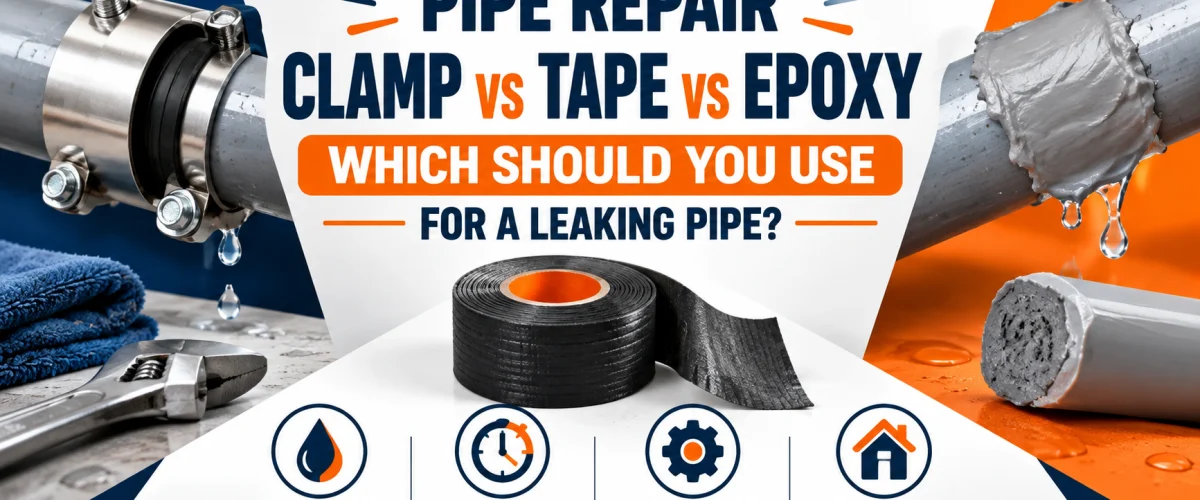
Pipe repair clamp, tape, or epoxy — which should you use for a leaking pipe? Compare how each works, durability, and when to reach for which.
Please note: This comparison is based on our research at time of writing and is for general informational purposes only. A leaking pipe can indicate a larger issue, and any repair discussed here is meant to stop or manage a leak — always confirm with a licensed plumber whether a more serious repair or pipe replacement is actually needed before treating a patch as a permanent fix.
A pipe is leaking, water is spreading, and the first real decision isn’t which brand to buy — it’s which kind of repair to reach for. The three mechanisms homeowners actually use are a repair clamp or coupling (a mechanical fix), self-fusing silicone tape (a wrap-on fix), and epoxy putty (a chemical fix). Each works in a genuinely different way, and each is better suited to a different kind of damage. Bundled repair kits usually combine two or more of these mechanisms into one box for readers who’d rather have options on hand than commit to one in advance, and a related but distinct product — spray-on rubber coating — trades precision for broader surface coverage. This comparison walks through how each mechanism actually works, what it’s best at, and which one fits your specific leak.
IN THIS GUIDE
At a Glance
Clamp / Coupling
Tape
Epoxy
How Each Mechanism Actually Works
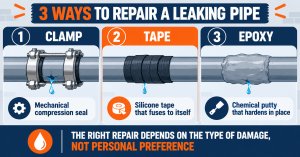
A repair clamp or coupling is a purely mechanical fix. A metal band, often lined with a rubber gasket, wraps around the outside of the pipe directly over the damaged area; tightening the bolts compresses the gasket against the pipe until it forms a watertight seal. Some clamps are designed to bridge a crack or split in an existing pipe, while couplings are built to join two cut pipe ends together, effectively replacing a short section. Nothing about a clamp depends on chemistry or curing — it works as soon as it’s tightened to spec, which is a big part of why it’s the mechanism most often treated as a lasting repair. Our roundup of the best pipe repair clamps covers specific options sized for different pipe diameters and materials.
Self-fusing silicone tape works completely differently. It doesn’t bond to the pipe itself — it bonds to itself. As you stretch and wrap the tape tightly around the leak, the silicone layers fuse together into a single, seamless, rubber-like sleeve that’s under its own tension, which is what creates the seal. No adhesive residue, no cure time in the traditional sense; the fusing happens within a few minutes as you wrap it. That mechanism is also why tape works well on an active drip — it doesn’t need a clean, dry bonding surface the way a glue-based product would. See our best pipe repair tape picks for specific products.
Epoxy putty is a chemical fix. It ships as two separate compounds — typically a resin and a hardener — that stay inert until they’re kneaded together by hand. Once mixed, you have a limited working window to press the putty over the damaged area and shape it before it begins to cure into a hard, solid patch. Unlike tape, epoxy does bond to the pipe surface itself, which is why proper surface prep (cleaning, roughing up, and drying the area as much as possible) matters so much to how well it holds. Because it hardens into a rigid shell rather than a flexible wrap, epoxy is particularly good at filling irregular damage that a clamp’s gasket can’t seat evenly against. Our plumbing epoxy roundup has specific product picks and cure-time comparisons.
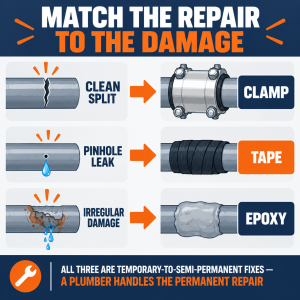
The type of damage you’re looking at is usually the single best predictor of which mechanism will actually work well. A clean split or crack in a straight run of pipe — the kind that happens from a hard freeze or physical impact — is exactly what a clamp or coupling is built for; the pipe’s surface is still round and regular, which is what a clamp’s gasket needs to seal properly. A pinhole leak or hairline crack, especially one that’s actively dripping when you find it, is where tape shines: it wraps around an irregular small leak without needing you to precisely target a single point, and it doesn’t require the area to be dry first. Irregular, pitted, or corroded damage — the kind you often find on an older galvanized pipe with a cluster of small perforations rather than one clean hole — is where epoxy has a real advantage, since it’s molded by hand to fill whatever shape the damage actually is, rather than depending on a uniform surface for a mechanical or wrap-based seal.
None of these are hard rules — a small pinhole leak can be clamped, and a straight crack can be taped or epoxied — but matching the mechanism to the damage type is the difference between a repair that holds and one you’re redoing next week.
Clamps and couplings are generally considered the most durable of the three mechanisms, and many are marketed and used as a genuinely long-term repair rather than a stopgap — a correctly sized clamp, properly tightened over sound pipe on either side of the damage, can remain in place indefinitely. That durability depends entirely on fit: an undersized or oversized clamp, or one used on a pipe material it wasn’t designed for, won’t hold nearly as well.
Tape’s durability runs a wider range, from genuinely temporary (get you to the hardware store or through the weekend until a plumber arrives) to reasonably semi-permanent, depending on the specific product’s silicone formulation, how many layers were wrapped, and how much tension was applied during wrapping. It’s rarely the first choice for a repair you intend to leave alone for years.
Epoxy’s reliability is the most prep-dependent of the three. A properly cleaned, dried, and roughened surface with a fully cured patch can be quite durable and hold for a long time. Skipping surface prep, working in a wet area without a wet-rated formulation, or not respecting the full cure time before pressurizing the line again are the most common reasons an epoxy repair fails early — the chemistry genuinely needs those conditions to bond correctly.
Tape is the fastest option by a wide margin — no tools, no mixing, no cure time to wait out. You cut a length, stretch it, and wrap it, and the seal is functional within minutes. That speed is a major reason it’s the go-to choice the moment a leak is discovered, even if a more durable fix follows later.
Clamps take longer, mostly because fit matters. You need to know your pipe’s outer diameter and material before buying (or have a multi-size kit on hand), position the gasket precisely over the damage, and tighten the bolts evenly so the seal compresses uniformly rather than pinching unevenly on one side. It’s still a job most homeowners can do with basic hand tools, but it’s a 15-to-30-minute job rather than a two-minute one.
Epoxy is the slowest to become trustworthy, even though the application itself — kneading and pressing the putty on — only takes a few minutes. The real time cost is cure time: most epoxy putties need anywhere from a few minutes of initial set to several hours of full cure before the manufacturer considers the repair load- or pressure-rated, and repressurizing the line too early is one of the most common ways an epoxy repair fails.
If you can’t shut off the water immediately — a shutoff valve that’s stuck, hard to reach, or simply not close enough to act fast — tape is generally your most reliable option on a pipe that’s actively dripping or spraying, since its self-fusing mechanism doesn’t depend on a dry bonding surface the way epoxy does. Some epoxy putties are specifically formulated for wet or underwater application and will say so on the packaging; a standard formulation generally will not bond reliably to a wet or actively weeping surface. Clamps sit in between: most manufacturers recommend the pipe be dry and the leak stopped (even temporarily, with tape or a shutoff) before installing one, though some clamp products are specifically rated for wet application — this varies enough by product that it’s worth checking the specific listing rather than assuming.
If you’d rather have options on hand than commit to one mechanism before you know what kind of leak you’re dealing with, a bundled pipe repair kit is worth considering instead of a single-mechanism product. Rather than being its own distinct repair type, a kit is really a packaging choice — most combine two or more of the mechanisms covered here (commonly a length of tape alongside a clamp or coupling) so you’re not caught without the right tool for whatever damage you actually find. Our roundup of the best pipe repair kits breaks down exactly what mechanisms each kit includes, which is worth checking before assuming “kit” means any one specific type of repair.
Spray-on rubber coating is a related but genuinely distinct fourth option, worth a brief mention even though it’s not a primary focus of this comparison. Rather than targeting a single point of damage the way a clamp, tape, or epoxy patch does, a spray coating builds up a flexible rubberized layer across a broader surface area — useful for a pipe with general surface deterioration or several small weep points spread across a section, rather than one clean leak. It trades precision for coverage, and it’s the least common of the four approaches for a single, well-defined leak.
Tape is consistently the least expensive entry point of the three, which lines up with its role as the fastest, most temporary-leaning fix — a single roll covers multiple small repairs and costs little enough that price is rarely the deciding factor. Clamps and epoxy sit in a similar price range to each other, generally a step above tape, with cost scaling by size (a larger-diameter clamp or a bigger tub of epoxy costs more than a small one) rather than by mechanism. None of the three requires a significant investment relative to a plumber’s service call, which is exactly why they exist as the DIY first response rather than a substitute for one.
The table below covers the situations that come up most often; treat it as a starting point for the decision, not a substitute for looking at your actual pipe and damage.
| Situation | Recommended Mechanism |
|---|---|
| Pinhole leak, need an immediate stopgap | Tape — fastest to apply, works on a wet or dripping surface |
| Clean split or crack in a straight section | Clamp or coupling — built for exactly this kind of regular, mechanical seal |
| Irregular, pitted, or corroded damage | Epoxy — molds by hand to fill an uneven shape a clamp can’t seat against |
| Want multiple options on hand without choosing in advance | A bundled repair kit spanning two or more mechanisms |
| Active drip that can’t be shut off right away | Tape first (or a wet-rated epoxy if you have one); reassess once the water’s off |
| Permanent fix before drywall or a finished wall closes up | Clamp/coupling for a clean break, or have the section professionally replaced — don’t close up a wall over tape or epoxy alone |
✏️ Our Take
It’s worth being honest about what these three products actually are: in most cases, all of them are temporary or semi-permanent repairs, not a substitute for proper pipe replacement. A clamp can last a very long time on sound surrounding pipe, but none of these products fix the underlying reason a pipe failed in the first place — age, corrosion, freezing, or physical damage. Use the right mechanism to stop the immediate problem and buy yourself time, then get a licensed plumber to look at whether the section needs to be properly replaced, especially if the damage is behind a wall or you’re seeing repeat leaks in the same area.
Prices and ratings may change. Always check Amazon for current prices.
If a repair keeps failing, the damage is extensive, or you’re not confident diagnosing the pipe yourself, search PlumberArchive.com — the US plumber directory with 12,151+ verified local plumbers across all 50 states.
Get weekly plumbing tips, honest tool reviews and DIY guides delivered straight to your Facebook feed.
Clamps, tape, and epoxy solve the same emergency in three genuinely different ways: one is mechanical, one is a self-fusing wrap, and one is a chemical fill. Match the mechanism to your actual damage — a clean split, a pinhole leak, or an irregular corroded patch — rather than grabbing whichever one happens to be in the garage, and you’ll get a repair that actually holds until a permanent fix is in place. If you’d rather stock one product that covers more than one of these bases, our best pipe repair kits roundup is the place to start; if you already know which mechanism you need, our pipe repair clamps, pipe repair tape, and plumbing epoxy roundups each cover specific picks in depth.
✍️ About This Comparison
Written by Sarah Mitchell, Home Improvement Editor at PlumbingToolsReview — specializing in helping homeowners make smart buying decisions without overspending. Learn how we test →
Utility pump vs sump pump: one is portable for occasional jobs, the other a permanent install for ongoing water. See which your basement needs.
Not sure if your home has a septic tank or a sewer connection? Learn how to tell which one you have, plus the maintenance and cost differences.
CSST vs black iron gas pipe compared: flexibility, installation time, the lightning/bonding safety consideration, cost, and code acceptance.

