Please note: Product availability and information are based on our research at time of writing and are subject to change. Always check Amazon for the latest details before purchasing.
Introduction
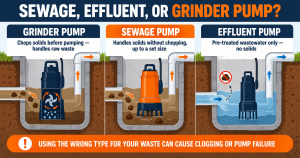
A sewage or effluent ejector pump sits in a sealed basin below your lowest drain line and lifts wastewater that cannot flow downhill on its own — from a basement bathroom or below-grade laundry — up to the main sewer or septic line where gravity takes over. If you are still deciding whether your project needs one instead of a standard sump pump, our guide to sump pumps vs sewage ejector pumps covers that first. What separates ejector pumps from one another is not horsepower but mechanism, and the three types are not interchangeable. A standard solids-handling sewage pump passes soft solids up to about two inches without cutting them. A grinder pump adds a rotating cutter that shreds waste into a thin slurry before moving it. A light-duty effluent pump handles only the clarified liquid that leaves a septic tank once solids have settled — it is not a sewage pump. Picking the wrong mechanism is the most common reason these installations fail early; the five pumps below cover all three types.
✏️ Our Take
There is no single best sewage ejector pump, because the pumps here are built for three different jobs. If a below-grade toilet discharges into the basin, you need a pump rated for raw sewage — a standard solids-handling model that passes two-inch solids, or a grinder that chops them first. If the basin only receives gray water or the settled effluent from a septic tank, a light-duty effluent pump is enough and costs less to run. Running an effluent pump on raw sewage, or a standard pump where a long, high discharge run or local code really calls for a grinder, is how these systems clog and burn out. Match the mechanism to what the basin collects, then size for lift height and flow.
Quick Comparison Table
Full Reviews — 5 Best Sewage & Effluent Ejector Pumps
1. Acquaer 3/4 HP Submersible Sewage Pump — Best Overall
🏆 Best Overall
★★★★★
Standard solids-handling · 3/4 HP · 2 in. solids · 2 in. discharge · cast iron
The Acquaer is a standard solids-handling sewage pump — a 3/4 HP submersible with an open, non-clog impeller that passes soft solids up to two inches without cutting them. It moves roughly 6,000 gallons per hour at low head, enough to lift a basement bathroom’s discharge to a first-floor sewer line. The body, volute and impeller are cast iron, so the wetted parts resist the abrasion that wears thermoplastic pumps down, and the 2-inch NPT discharge matches standard ejector-basin pipe. It ships with a tethered piggyback float switch that trips the pump as the basin fills; the pump plugs into the float’s piggyback plug, so you can bypass it to test the motor.
It takes the top spot by hitting the middle of every requirement for a residential ejector job: 3/4 horsepower and two-inch solids are the standard specification for a below-grade full bathroom, the cast iron build outlasts budget pumps in the same price tier, and the tethered float is what most plumbers fit in a standard basin. It is not a grinder, so wipes and hygiene products can still jam it, and it needs a vented basin. For a basement bathroom running to a gravity sewer, it is the one to fit.
✓ Pros
Cast iron body, volute and impeller resist abrasive wastewater far better than thermoplastic at this price
Two-inch solids handling and about 6,000 GPH at low head — enough for a full below-grade bathroom
Tethered piggyback float is easy to adjust and lets you bypass it to test the motor
✗ Cons
Not a grinder — flushed wipes and hygiene products can still jam it
Tethered float needs a wide basin to swing freely and can hang up in a crowded pit
🛒 Check Price on Amazon — $$$ →
2. Aquastrong 1 HP Sewage Grinder Pump — Best Grinder Pump
⚙️ Best Grinder Pump
★★★★☆
Grinder / macerator · 1 HP · cutter shreds solids · 1-1/4 in. discharge · cast iron
The Aquastrong 1 HP grinder is the only true macerating pump here. A hardened rotating cutter below the impeller shreds solids, paper and the wipes that clog a standard pump into a fine slurry before it moves. That shifts the hydraulics: a grinder trades flow for pressure, so volume is lower at around 2,000 to 3,000 gallons per hour, but it develops far more head and pushes slurry through a narrow 1-1/4-inch discharge over long runs or tall lifts that would stall a solids-handling pump. The casing and cutter housing are cast iron, and a compact vertical float switch needs little side clearance.
A grinder is the right call when code requires one for a pressurized sewer tie-in, when the run to the main is long, or when the bathroom sees users who flush what they should not — the cutter turns those into slurry instead of a service call. For a demanding run or a high-abuse bathroom, nothing else here keeps up, though 1 HP usually needs its own circuit and the cutter is a wear part.
✓ Pros
Hardened cutter macerates solids, paper and wipes that would jam a standard sewage pump
High head — moves slurry through a 1-1/4-inch line over long runs and tall lifts
Cast iron casing and cutter housing, with a compact vertical float for narrow basins
✗ Cons
Lower flow than a standard sewage pump, and 1 HP typically needs a dedicated circuit
Highest running cost here, and the cutter is a wear part that must be replaced over time
🛒 Check Price on Amazon — $$$ →
3. Red Lion RL-SC33V — Best Light-Duty / Effluent
💧 Best Light-Duty / Effluent
★★★★☆
Light-duty effluent · 1/3 HP · 3/4 in. solids only · 1-1/2 in. discharge · cast iron
The Red Lion RL-SC33V is an effluent pump, not a sewage pump, and that distinction is the point. At 1/3 HP it moves clarified liquid — the settled effluent leaving a septic tank for a drain field or mound, plus gray water from sinks, showers and laundry. It passes solids only up to 3/4 inch, so it must never see raw toilet waste; anything larger lodges in the impeller. In its lane it is efficient and quiet, moving up to about 3,500 gallons per hour at low head through a 1-1/2-inch discharge. The “V” is the vertical float switch, which snaps on and off over a short travel and suits the compact chambers effluent pumps live in. The body and impeller are cast iron.
This is the pump for a septic effluent chamber, a mound-system dose tank, or a below-grade laundry that never carries sewage. There the low horsepower is an advantage: it costs less, draws little power, and the short-throw float gives tight level control in a small tank. Put it on raw sewage from a toilet and it clogs and fails — not a defect, just the wrong application. Matched to pre-treated or gray water, it is a well-made, correctly sized pump.
✓ Pros
Purpose-built for septic effluent and gray water — efficient, quiet, low power draw at 1/3 HP
Short-throw vertical float gives precise, repeatable level control in a compact chamber
Cast iron body and impeller in a class where thermoplastic is common
✗ Cons
Passes only 3/4-inch solids — must never handle raw sewage or it clogs and fails
Lower head and flow than the sewage pumps here; not a substitute for a full ejector on a long lift
🛒 Check Price on Amazon — $$$ →
4. Superior Pump 93020 — Best Cast Iron System
🔩 Best Cast Iron System
★★★★☆
Standard solids-handling · 1/2 HP · 2 in. solids · 2 in. discharge · full cast iron
The Superior Pump 93020 is a standard solids-handling sewage pump built almost entirely of cast iron — body, base, volute and impeller — where rivals in its price range mix in thermoplastic. At 1/2 HP it sits below the Acquaer on power, moving around 4,800 gallons per hour at low head, but it keeps the same two-inch solids rating and 2-inch NPT discharge, so it handles a below-grade bathroom’s raw waste without cutting. A tethered piggyback float on a cord sets the on and off levels by tether length, and the piggyback plug lets you test the motor directly.
It earns the cast iron pick because all-iron construction is what you want for a pump that may run a decade in a corrosive basin, and Superior prices it under the bigger iron-bodied names. The 1/2 HP motor is the honest limit: it suits one below-grade bathroom on a short lift, not a long run or a high push to an upper floor. For a bathroom tying into a nearby gravity main, it is a lot of durable pump for the money.
✓ Pros
Full cast iron construction — body, base, volute and impeller — unusual at this price
Two-inch solids handling and 2-inch discharge for genuine raw-sewage duty
Tethered piggyback float is adjustable for on/off levels and easy to service
✗ Cons
1/2 HP is the lowest sewage-pump power here — best kept to one bathroom on a short lift
Tethered float needs a full-size basin to swing without catching on pipes
🛒 Check Price on Amazon — $$$ →
5. BOMGIE 3/4 HP Submersible Sewage Pump — Best Budget
💰 Best Budget
★★★★☆
Standard solids-handling · 3/4 HP · 2 in. solids · 2 in. discharge · cast iron
The BOMGIE 3/4 HP submersible is the lowest-cost route into a real solids-handling sewage pump. On paper it tracks the Acquaer: 3/4 HP, a two-inch solids rating, a 2-inch discharge, a cast iron pump body, high flow in the 5,000-plus GPH range at low head, and a tethered piggyback float. It is a standard sewage pump, not a grinder — the impeller passes soft solids, it does not chop them — so the same basin discipline applies.
It is the budget pick rather than a co-winner because of track record and support: it is a newer, less-established name than Red Lion or Superior, the parts and dealer pipeline is thinner, and long-term reliability data is limited. If the goal is a working below-grade bathroom for the least money, and you can treat the pump as a replaceable part rather than a 15-year fixture, its specs are honest and the cast iron wet end is the right material. For a rental or a second bathroom, it makes sense.
✓ Pros
Lowest price here for a genuine 3/4 HP, two-inch-solids sewage pump with a cast iron wet end
High flow at low head and a standard 2-inch discharge — drops into a typical ejector basin
Tethered piggyback float included, no separate control to buy
✗ Cons
Newer, less-established brand with a thinner parts and support network than the legacy names
Limited long-term reliability history — better as a replaceable part than a decade-long install
🛒 Check Price on Amazon — $$ →
Buying Guide
The first decision is mechanism, because the wrong choice clogs or burns out an otherwise fine pump. A standard solids-handling sewage pump (the Acquaer, Superior and BOMGIE) uses an open impeller that passes soft solids up to about two inches without cutting them — the default for a below-grade bathroom running to a nearby gravity sewer. A grinder pump (the Aquastrong) adds a rotating cutter that macerates solids, paper and wipes into a slurry and pushes it through a narrow line at high pressure; use one when code requires it, when the discharge run is long or the lift is tall, or when the bathroom takes heavy, careless use. A light-duty effluent pump (the Red Lion) is only for pre-treated liquid — the clarified effluent leaving a septic tank, or gray water. It passes only small solids and must never handle raw sewage; do that and it clogs within weeks. Using the wrong type is the usual cause of early failure.
Float switch type matters almost as much. A tethered piggyback float swings up on a cord and suits a wide basin, 18 inches or more across, where it has room to move; it is easy to adjust and lets you bypass it to test the motor. A vertical float rides a short rod and switches over a few inches of travel, so it fits narrow basins and chambers and gives tighter level control with less adjustment range. Match the float to your basin.
Installation is a professional job in almost every jurisdiction. The basin has to be the right volume and sealed, the discharge needs a correctly sized check valve — the same swing- or spring-type valves used on sump systems — to stop backflow refilling the basin, and the basin must be vented to the building’s vent stack so the pump is not fighting a vacuum. Get any of those wrong and the pump short-cycles or fails early. If the system discharges to a septic tank rather than a sewer, our guide to maintaining a septic system covers keeping that side healthy.
Need a Professional Plumber?
A sewage ejector install means a sealed basin, a gas-tight lid, a vent tied into the house plumbing, a check valve and usually an alarm — and in most places an inspection. If that is not a job you want to take on, search PlumberArchive.com — the US plumber directory with 12,151+ verified local plumbers across all 50 states.
Find a trusted plumber near you → PlumberArchive.com
Frequently Asked Questions
Q: What’s the difference between a sewage pump and an effluent pump?
A sewage pump moves raw wastewater containing solids — everything that leaves a toilet — passing soft solids up to about two inches through a heavy open impeller. An effluent pump is a lighter machine for liquid that has already been through primary treatment: the clarified effluent leaving a septic tank after solids settle, or gray water. It handles only small solids, usually 3/4 inch or less. The two are not interchangeable — an effluent pump on raw sewage clogs quickly, and an oversized sewage pump in a small effluent chamber tends to short-cycle.
Q: Do I need a grinder pump or a standard sewage pump?
For most below-grade bathrooms tying into a nearby gravity sewer, a standard solids-handling sewage pump is correct and cheaper to buy and run. Choose a grinder when your local code requires one, when the pump has to push waste a long distance or lift it high — to an upper floor or a street main above the house — or when the bathroom gets heavy, public-style use and things will be flushed that should not be. A grinder turns those into slurry instead of a blockage. When in doubt, ask the plumber pulling the permit which one the inspector will pass.
Q: How long do sewage ejector pumps last?
A cast iron sewage pump in a correctly built basin typically lasts around seven to ten years, sometimes longer. What shortens that is almost always the install or the habits around it: an undersized or unvented basin that makes the pump cycle constantly, a failed check valve that lets the basin refill and doubles the run time, or non-flushable items that jam the impeller. Thermoplastic pumps and abused basins run shorter. A spare pump on the shelf is cheap insurance.
Q: Can I install a sewage ejector pump myself?
In most places, not legally. A sewage ejector install involves a sealed basin, a gas-tight lid, a vent tied into the building’s plumbing vent, a check valve and often an alarm, and it is inspected — many jurisdictions require a licensed plumber to do the work and pull the permit. Even where a homeowner is allowed to, the venting and sealing are easy to get wrong in ways that let sewer gas into the house. Swapping a like-for-like pump into an existing, correctly built basin is a more reasonable DIY job; building the system from scratch is not.
Conclusion — Which Ejector Pump Should You Buy?
Start with what the basin collects, then pick the pump. If a below-grade toilet drains into it, you need a pump rated for raw sewage, and for the common case — a finished basement bathroom running to a nearby gravity main — the Acquaer 3/4 HP Submersible Sewage Pump is our Best Overall: the standard specification for the job (3/4 HP, two-inch solids, 2-inch discharge), a cast iron wet end that outlasts thermoplastic, and an easy-to-adjust tethered float at a mid-range price.
Step up to the Aquastrong 1 HP Sewage Grinder Pump when code calls for a grinder or the discharge run is long or high. Choose the Red Lion RL-SC33V only for septic effluent or gray water, never raw sewage. The Superior Pump 93020 is the all cast iron pick for one bathroom on a short lift, and the BOMGIE 3/4 HP is the budget way to get a below-grade bathroom working. Whichever you choose, have it installed with a properly sized basin, check valve and vent — the pump is rarely what fails first.
Prices and ratings may change. Always check Amazon for current prices.
✍️ About This Review
PTR Editorial Team — Product Reviews. We compare manufacturer specifications, installation requirements, compatibility and available product documentation to help homeowners choose suitable tools and parts. How we review →