Please note: Product availability and information are based on our research at time of writing and are subject to change. Always check Amazon for the latest details before purchasing.
Introduction
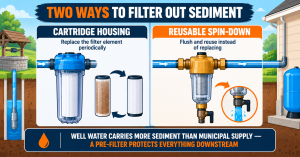
A sediment pre-filter is the first line of defense on a private well. It mounts on the main line where water enters the house and traps the sand, silt, grit and rust flakes that well water carries far more often than a municipal supply — particles that scour faucet cartridges, jam toilet fill valves, clog aerators and settle in the water heater. Screen that debris out at the point of entry and every fixture, appliance and downstream treatment stage lasts longer. These filters use two genuinely different mechanisms, and the choice between them shapes how you live with the unit. A replaceable-cartridge housing holds a filter element you swap out when it loads up, with a wide choice of micron ratings. A reusable spin-down filter uses a metal mesh screen you flush clean and never replace. If you are new to well ownership, our guides to well water vs municipal water and the 5 best well pressure tanks cover the rest of the system.
✏️ Our Take
There is no single best sediment pre-filter for every well, because the two filter types here solve the problem in opposite ways. A replaceable-cartridge housing offers a wide range of micron ratings and finer filtration, but you buy and swap elements for the life of the system. A reusable spin-down filter costs more up front and catches only coarser particles, but you flush it instead of feeding it cartridges, so it is cheaper over the years. Decide which mechanism fits how you want to maintain the system, then size the housing to your flow rate and match the micron rating to what your well actually pulls. Our how to choose and install a whole-house sediment pre-filter for well water guide walks through that sizing and installation process step by step.
Quick Comparison Table
| Product |
Rating |
Best For |
Price |
Culligan WH-HD200-C
BEST OVERALL |
★★★★★ |
Most well systems — proven cartridge housing, widely stocked filters |
$$$ |
| iSpring WSP-50 Spin Down |
★★★★☆ |
Owners who want a flushable, no-refill filter for sand and grit |
$$ |
| SimPure DB20P (20″) |
★★★★☆ |
Dirty wells and high flow — a 20-inch housing that fits any cartridge |
$$ |
| Culligan HF-360A |
★★★★☆ |
Small wells, cabins and tight budgets |
$ |
| A.O. Smith AO-WH-PRE |
★★★★☆ |
Buyers who want a familiar treatment brand and easy parts |
$$$ |
Full Reviews — 5 Best Whole House Sediment Pre-Filters
1. Culligan WH-HD200-C — Best Overall
🏆 Best Overall
★★★★★
Replaceable cartridge · 10″ × 4.5″ housing · 5-micron cartridge included · 1 in. NPT ports · built-in shut-off
The Culligan WH-HD200-C is a replaceable-cartridge housing — a heavy-duty 10-inch by 4.5-inch “Big Blue”-style sump that takes a swappable filter element. When the cartridge fills with sand, silt and rust you unscrew the sump and drop in a fresh one. It ships with a 5-micron pleated sediment cartridge, so it filters from day one rather than needing a separate purchase. The head has 1-inch NPT ports, a built-in shut-off so you can isolate the housing without cutting water to the whole house, and a pressure-relief button to bleed the sump before opening it. Rated flow is around 10 GPM.
It earns Best Overall by landing in the middle of every requirement for a private well: enough flow for a typical two-to-four-bathroom home, the universally stocked Big Blue cartridge so you are never locked into one brand’s refills, and a mid-range price below the premium names. Cartridge swaps come every one to three months depending on how much sediment your well pulls, and a wall-mount bracket and wrench are included. For an owner who wants a set-and-replace pre-filter that does not demand much thought, this is the one to fit.
✓ Pros
Includes a 5-micron cartridge, and the Big Blue 10″ × 4.5″ size is stocked everywhere — refills are cheap and never brand-locked
Built-in shut-off and pressure-relief button make a cartridge change a two-minute job with no draining of the house
Roughly 10 GPM flow and 1-inch ports suit a typical two-to-four-bathroom well system
✗ Cons
The cartridge is a consumable — plan on swapping elements every one to three months on a sediment-heavy well
A 10-inch sump holds less media than a 20-inch housing, so change intervals are shorter on dirty water
🛒 Check Price on Amazon — $$$ →
2. iSpring WSP-50 Spin Down — Best Reusable / Spin-Down
🔄 Best Reusable / Spin-Down
★★★★☆
Reusable spin-down · 50-micron mesh screen · flush, don’t replace · 1 in. MNPT (3/4 in. bushings) · clear housing
The iSpring WSP-50 is the other mechanism entirely: a reusable spin-down filter. Instead of a cartridge, water spins through a fine 50-micron stainless-steel mesh screen inside a clear polymer housing, and heavier particles drop into the bowl at the bottom. When the screen looks dirty you open the ball valve at the base and line pressure flushes the debris out to a drain or bucket in seconds. Connections are 1-inch MNPT with 3/4-inch reducer bushings in the box. There is no filter cartridge to buy, ever — the screen is the filter, and it is permanent.
The trade-off is filtration fineness. At 50 micron it catches sand, grit and coarse rust flakes — the material that chews up pump seals, valve cartridges and water-heater dip tubes — but it passes the fine silt and cloudiness a 5-micron cartridge removes. Many owners run it as a first stage ahead of a cartridge housing, so the spin-down takes the heavy load and the cartridge lasts far longer. Flow is high and pressure drop minimal because the screen is coarse and the bore wide. Upfront cost is higher than a basic cartridge housing, but with no refills it is cheaper over years.
✓ Pros
Reusable mesh screen — flush it with a valve instead of buying cartridges, so long-term cost is the lowest here
High flow and very low pressure drop, and the clear housing shows when a flush is due
Excellent as a first stage ahead of a cartridge filter, sharply extending cartridge life
✗ Cons
The 50-micron screen stops sand and grit but not fine silt or cloudiness — a coarse pre-filter, not a polishing filter
Higher upfront price than an entry-level cartridge housing, and it needs a nearby drain or catch bucket for flushing
🛒 Check Price on Amazon — $$ →
3. SimPure DB20P (20″) — Best Universal Housing
🔧 Best Universal Housing
★★★★☆
Replaceable cartridge · 20″ × 4.5″ housing · 5-micron cartridge included · 1 in. NPT ports · pressure-relief button
The SimPure DB20P is a replaceable-cartridge system like the Culligans, but built around the taller 20-inch by 4.5-inch sump instead of the 10-inch. That doubles the media length: more surface area means longer intervals between changes and lower pressure drop at the same flow. “Universal” refers to the cartridge fitment — it accepts any standard 20″ × 4.5″ Big Blue element from any maker, in whatever micron rating you choose, and a 5-micron cartridge is included to start. The housing has 1-inch NPT ports, a pressure-relief button, and ships with a bracket and wrench.
The 20-inch housing is the right call when your well runs dirty, when flow is high, or when you are tired of frequent cartridge swaps on a 10-inch unit. Because you can load it with anything from a coarse 20-micron string-wound cartridge down to a 1-micron pleated element, one housing covers both heavy sediment duty and fine polishing. The penalty is size: it needs roughly two feet of vertical clearance beneath the bracket to drop the cartridge out, which not every utility closet has.
✓ Pros
The 20-inch sump holds twice the media of a 10-inch housing — longer change intervals and lower pressure drop
Takes any standard 20″ × 4.5″ cartridge in any micron rating, so one housing does coarse or fine duty
Pressure-relief button, mounting bracket, wrench and a starter 5-micron cartridge all included
✗ Cons
Needs about two feet of clearance beneath the housing to remove the long cartridge
Still a consumable-cartridge system, and the larger elements cost more per swap than 10-inch ones
🛒 Check Price on Amazon — $$ →
4. Culligan HF-360A — Best Value
💰 Best Value
★★★★☆
Replaceable cartridge · 10″ × 2.5″ standard housing · 5-micron cartridge included · 3/4 in. NPT ports · clear sump
The Culligan HF-360A is the budget entry: a replaceable-cartridge housing that uses the slim 10-inch by 2.5-inch standard cartridge rather than the wider Big Blue size. Ports are 3/4-inch NPT. The sump is clear, so you can watch the cartridge darken and time the change by eye rather than waiting for pressure to fall. A 5-micron cartridge is included. There is no built-in bypass, so you will want a shut-off valve upstream for changes.
The slim cartridge is where the savings come from — the standard 10″ × 2.5″ filter is the cheapest, most widely sold size in plumbing. The trade-off is capacity and flow: the smaller element loads faster and tops out around 8 GPM, so on a sediment-heavy well or a high-demand house you will change cartridges more often than with a Big Blue housing. For a small system, a cabin, a single-bathroom home, or an inexpensive second stage after a spin-down, it is a lot of protection for little money.
✓ Pros
Lowest price tier here, and the standard 10″ × 2.5″ cartridge is the cheapest, most available filter size sold
Clear sump lets you eyeball the cartridge and change it on schedule
Compact — fits small wells, cabins and tight spaces where a Big Blue housing will not go
✗ Cons
The slim cartridge has less capacity and lower flow (around 8 GPM), so changes come around more often
No built-in shut-off or bypass — you have to add an isolation valve upstream
🛒 Check Price on Amazon — $ →
5. A.O. Smith AO-WH-PRE — Best Trusted Brand
🏅 Best Trusted Brand
★★★★☆
Replaceable cartridge · 10″ × 4.5″ housing · 5-micron cartridge included · 1 in. NPT ports · bypass shut-off
A.O. Smith’s whole-house sediment pre-filter is a replaceable-cartridge housing in the 10-inch by 4.5-inch Big Blue size, sold specifically as the guard stage ahead of a softener, carbon filter or other treatment system. It ships with a 5-micron sediment cartridge, has 1-inch NPT ports, and includes a bypass shut-off plus a pressure-relief button. Rated flow sits in the same whole-house range as the Culligan WH-HD200-C, so day to day it behaves much the same.
What you pay for over a generic housing is the brand’s support and parts pipeline: replacement cartridges are easy to find under a known part number and customer service is responsive. On performance it is a peer of the Culligan Big Blue unit — same size, same micron cartridge, same flow class — so the choice comes down to price at the time you buy and which refill you would rather stock. A solid, no-surprises pick if brand familiarity matters to you.
✓ Pros
Backed by a large water-treatment brand with easy-to-source cartridges and responsive support
Standard 10″ × 4.5″ Big Blue size with 1-inch ports, a bypass shut-off and a pressure-relief button
Purpose-built as a pre-filter to protect a downstream softener or carbon system
✗ Cons
Performance mirrors the Culligan Big Blue housing, often at a similar or higher price tier
The 10-inch sump means the same shorter change intervals as other Big Blue units on dirty water
🛒 Check Price on Amazon — $$$ →
Buying Guide
Start with the mechanism, because it is the decision you live with. A cartridge housing — the Culligan, SimPure and A.O. Smith units here — holds a disposable element. You pick the micron rating, from a coarse 20-micron cartridge down to a 1-micron one, and replace it every one to three months as it loads with sediment: fine filtration and flexibility, but an ongoing cost and a recurring chore. A spin-down filter — the iSpring — uses a permanent stainless mesh screen: you open a valve, line pressure flushes the trapped grit out, and nothing is thrown away. It costs more up front and the screen is coarser, around 50 micron, but there are no refills. A common setup pairs the two, spin-down first, cartridge second.
Micron rating is how fine the filter screens. Well-water sediment spans a wide range — coarse sand and pump grit around 100 to 500 micron, fine silt and clay near 1 to 5 micron, rust across the whole span. A 50-micron spin-down stops sand and grit but passes the fine material. A 5-micron cartridge, the size shipped with every housing here, catches most of what makes well water look cloudy while still flowing well. Going finer than 5 micron sharpens clarity but drops pressure faster and shortens cartridge life, so do it only for a specific fine-silt problem.
Housing size is about flow and change frequency, not fineness. A 10-inch sump suits a one-to-three-bathroom home; a 20-inch sump like the SimPure holds twice the media, dropping less pressure at high flow and running longer between changes. If your well produces heavy sediment or peak demand is high — several showers at once, irrigation — the 20-inch housing earns its footprint, provided you have the clearance to pull the longer cartridge.
Finally, remember what this is: a pre-filter protects plumbing and appliances from particles. It does nothing for dissolved minerals, hardness or biological contamination. If your well has never been tested — or you have had a flood, a new well, or a change in taste or smell — sediment filtration is no substitute for proper treatment. Start with our guide on how to test for bacteria in well water and deal with any contamination before relying on the system.
Need a Professional Plumber?
Cutting into the main line for a whole-house filter means shutting down the well, fitting a bypass loop, and making threaded or soldered connections that have to stay dry for years. If that is beyond what you want to take on, search PlumberArchive.com — the US plumber directory with 12,151+ verified local plumbers across all 50 states.
Find a trusted plumber near you → PlumberArchive.com
Frequently Asked Questions
Q: How often should I replace a sediment filter cartridge?
It depends on how much sediment your well produces. On a clean well a 5-micron cartridge in a 10-inch housing may last two to three months; on a well with heavy sand or seasonal turbidity, a few weeks. Do not rely on the calendar — watch fixture pressure, and change the cartridge when flow weakens or a clear sump shows it dark and packed. A 20-inch housing roughly doubles the interval, and a spin-down filter ahead of the cartridge can multiply it several times over.
Q: What’s the difference between a spin-down filter and a cartridge housing?
A cartridge housing holds a replaceable element — pleated paper or spun polypropylene — that traps particles until it clogs, then you swap it. It filters finely, down to 1 micron, but it is a recurring cost. A spin-down filter uses a fixed stainless-steel mesh screen, around 50 micron, that you never replace; when it fouls you open a valve and water pressure flushes the debris out. The spin-down is coarser and costs more up front but has no consumables. Many owners use both, spin-down first.
Q: Do I need a sediment filter if I already have a whole-house water softener?
Usually yes, and it belongs before the softener. Softeners exchange dissolved hardness minerals; they do not remove suspended sand, silt or rust, and that grit fouls the control valve and scores the resin bed. A sediment pre-filter upstream is standard practice to protect the softener and any carbon or reverse-osmosis stage after it. If your install skipped one, adding a pre-filter is a cheap way to extend the softener’s life.
Q: What micron rating do I need for well water?
For most private wells a 5-micron sediment cartridge is the right general-purpose choice — it removes the fine silt and rust behind cloudy water and appliance wear while still passing whole-house flow. If your well throws mainly coarse sand and grit, a 50-micron spin-down alone may be enough. If water stays hazy after a 5-micron filter, step down to 1 micron, but expect a faster pressure drop and more frequent changes. When unsure, run a 50-micron spin-down into a 5-micron cartridge.
Conclusion — Which Sediment Pre-Filter Should You Buy?
Choose the mechanism first. If you want the simplest, most flexible whole-house sediment protection and do not mind swapping a cartridge every couple of months, a replaceable-cartridge housing is the way to go — and the Culligan WH-HD200-C earns our Best Overall badge. It uses the universally stocked 10-inch by 4.5-inch Big Blue cartridge, so you are never locked into one brand’s refills; it includes a 5-micron element and a built-in shut-off; and it flows enough for a typical two-to-four-bathroom well system at a mid-range price.
Step up to the 20-inch SimPure DB20P if your well runs dirty or your flow is high, and drop to the Culligan HF-360A for a small system or a tight budget. Choose the A.O. Smith AO-WH-PRE if you would rather buy from a familiar treatment brand. If refills are what put you off, the iSpring WSP-50 spin-down flushes clean instead — best run as a first stage ahead of any cartridge unit. Whichever you fit, place it before your softener or treatment gear and use fixture pressure as your change indicator.
Prices and ratings may change. Always check Amazon for current prices.
✍️ About This Review
PTR Editorial Team — Product Reviews. We compare manufacturer specifications, installation requirements, compatibility and available product documentation to help homeowners choose suitable tools and parts. How we review →


