Please note: Information in this comparison is based on our research at time of writing and is general in nature. Plumbing code varies significantly by jurisdiction — always confirm current requirements with your local building department or a licensed plumber before choosing a method or attempting installation.
Introduction
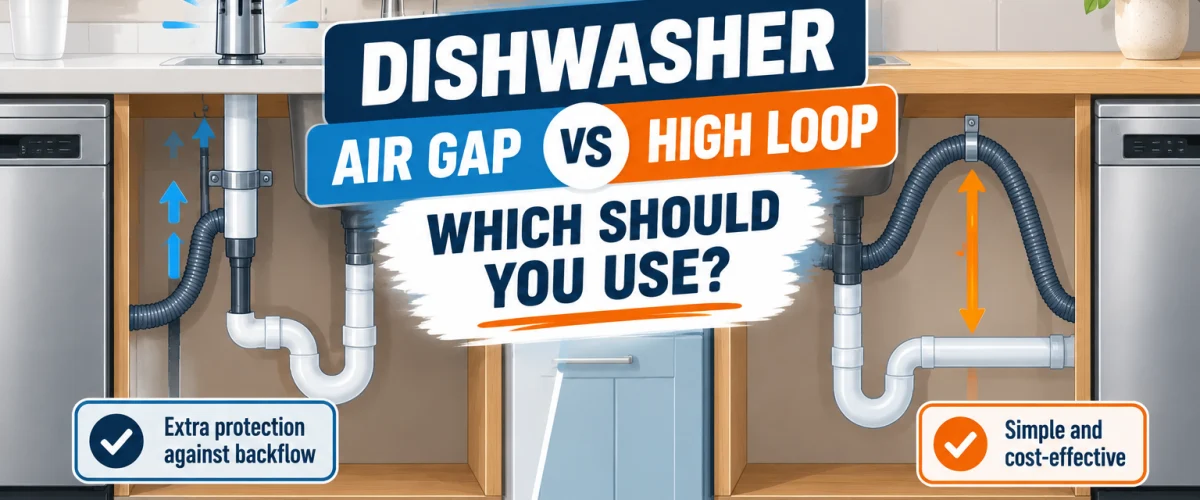
A dishwasher’s drain hose connects to the same branch of plumbing as the kitchen sink and, often, a garbage disposal — and that shared connection creates a real risk. If the sink drain backs up or the disposal clogs, dirty water sitting in that line can, under the wrong conditions, siphon backward through the dishwasher’s drain hose and into the machine itself, contaminating clean dishes with wastewater. An air gap and a high loop are the two accepted ways to prevent that from happening, and they work on completely different principles. An air gap is a small physical device, usually mounted through a hole in the countertop or sink deck, that creates a visible, open break in the air between the dishwasher’s drain line and the sink’s drain — water simply cannot siphon backward across open air. A high loop is not a device at all; it is a way of routing the drain hose itself, secured as high as possible under the sink before it drops down to the drain connection, so gravity and the height difference do the same job an air gap does mechanically. Neither is universally required, and neither is universally better — which one applies to your kitchen depends heavily on local code, which this comparison covers in detail below.
At a Glance
Air Gap
- What it is: a small chrome or plastic device mounted through a hole in the countertop or sink deck, creating a visible open-air break between the dishwasher line and the drain
- Requires a dedicated fitting? Yes — a physical device with its own mounting hole
- Visible above the counter? Yes — a small cap sits next to the faucet
- Code requirement by region: Required by many US plumbing codes, especially where the dishwasher drains through a garbage disposal or shared tailpiece — check local code
- Clog/backup risk: Can itself accumulate debris and needs occasional cleaning
- Installation difficulty: Moderate — needs an available or newly drilled hole
- Typical price range: $
High Loop
- What it is: the drain hose itself, secured high under the sink cabinet before it drops down to the drain connection — a routing technique, not a device
- Requires a dedicated fitting? No — no additional part beyond a zip tie, clip, or bracket to hold the hose’s height
- Visible above the counter? No — entirely hidden inside the cabinet
- Code requirement by region: Accepted in some jurisdictions, not universally code-compliant — check local code before relying on it alone
- Clog/backup risk: Fewer parts to clog, but effectiveness depends entirely on correct height and a secure loop that will not sag over time
- Installation difficulty: Low — hose routing only, no new holes
- Typical price range: $ (a hose clip or bracket, if not already included)
How Each One Actually Works
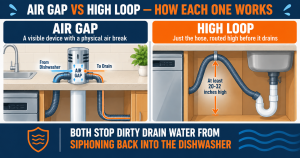
An air gap works through a genuinely open break in the plumbing. The dishwasher’s drain hose connects to one side of the air gap device, which sits above the flood rim of the sink; the water then drops through open air inside the device’s housing before continuing on to the sink drain or disposal on the other side. Because the two sides are never directly connected by a sealed pipe, there is no physical path for water to travel backward from the drain side to the dishwasher side — a backup in the drain line can rise, at worst, only as high as the air gap’s overflow slots, where it will spill visibly into the sink rather than reach the dishwasher.
A high loop relies on elevation and gravity instead of an open break. The drain hose is routed up as high as possible under the sink cabinet — typically as close to the underside of the countertop as the hose will reach — secured at that peak with a clip or zip tie, and then allowed to run back down to the drain connection. If the sink drain backs up, the water in the shared line has to rise higher than the peak of that loop before it could ever reach the dishwasher, and the loop’s elevation combined with the dishwasher’s own pump make that essentially impossible in a properly installed setup. Both methods solve the same siphoning problem; they just use a different piece of physics to do it.
Code Requirements
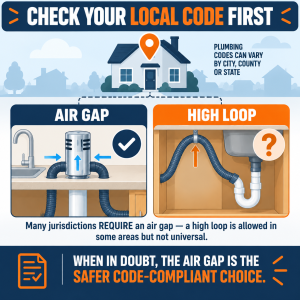
This is the factor that should drive your decision before any other consideration on this page. A number of US jurisdictions require a dedicated air gap by plumbing code, particularly in installations where the dishwasher’s drain line ties into a garbage disposal or a shared kitchen sink tailpiece — the reasoning being that an open-air break is considered a more foolproof and inspectable backflow method than a hose loop, which relies on correct installation that an inspector cannot always verify years later. Other jurisdictions permit a high loop as a code-compliant alternative, and some manufacturer installation instructions describe a high loop as acceptable specifically because the appliance’s own check valve provides additional protection.
We are not able to make a blanket statement about which method is legally required where you live, because this genuinely varies by state, and sometimes by local amendment within a state. What we can say clearly: if your dishwasher is a new installation, part of a kitchen remodel, or subject to a permit and inspection, check with your local building department or a licensed plumber before assuming a high loop will pass. If you are simply maintaining or replacing an existing setup that already has one method in place and has passed inspection before, matching what is already there is usually the lower-friction path.
US Regional Context: Some states and municipalities that follow stricter interpretations of the Uniform Plumbing Code lean toward requiring an air gap outright, while areas following the International Plumbing Code more often accept a high loop as a valid alternative — but individual state and city amendments to either base code are common, so neither code family guarantees a specific answer for your address. New construction and permitted remodels are checked at inspection; older homes with an existing high loop that has never been flagged are common and are not automatically a problem, but that is a different situation from installing new work today.
Visible Countertop Fitting vs. Under-Sink Only
An air gap has one clear downside that has nothing to do with plumbing performance: it requires a small chrome or plastic cap sitting on the countertop or sink deck, usually next to the faucet, with two short hose barbs underneath the counter. Some homeowners do not mind it at all; others find it an eyesore on an otherwise clean counter, especially on a higher-end countertop material where an extra hole feels like a compromise. There is no way to hide an air gap once it is installed — the cap has to remain accessible, both because it needs occasional cleaning and because covering it defeats its purpose as a visible overflow point if a backup ever does occur.
A high loop has no equivalent downside because there is nothing to see. The entire installation lives inside the sink cabinet, out of sight during normal use, and the only way to know a kitchen uses one is to open the cabinet doors and look. For anyone specifically motivated by keeping the countertop free of an extra fitting, and where local code allows it, that is a real point in the high loop’s favor — but it is a cosmetic consideration, not a substitute for checking whether it is actually permitted for your installation.
Clog and Maintenance Considerations
An air gap is a small chamber with narrow passages, and it can accumulate the same food particles, grease, and mineral buildup that affect any other drain fitting over time — a partially clogged air gap is a common cause of a dishwasher that drains slowly or leaves standing water in the tub. The cap lifts off by hand or with a quarter turn on most models, and the inside is straightforward to flush out or clear with a small brush; it is a five-minute job once you know it needs doing, but it is a maintenance point that a high loop simply does not have.
A high loop has no chamber to clog, since it is just a length of hose. Its failure mode is different and, in some ways, less obvious: if the hose is not secured high enough, if the clip or zip tie holding it up fails over time, or if the loop sags from the hose’s own weight or heat exposure, the protection it provides quietly degrades without any visible symptom until a backup actually occurs. Because there is nothing to inspect or clean on a routine basis, a high loop is easy to forget about entirely — which is fine as long as the original installation was solid, but there is no equivalent to popping a cap off to check that everything is still working as intended.
Installation Difficulty
Installing an air gap for the first time means finding a way to mount it through the countertop or sink deck, and that is the step that determines how easy the job actually is. Many kitchens already have a spare hole from a former sprayer, soap dispenser, or water filter faucet that is no longer in use, and an air gap can often go straight into that opening with no drilling at all. Where no spare hole exists, one has to be drilled through the countertop or the back edge of the sink itself — straightforward on stainless steel with the right bit, considerably more involved on granite, quartz, or another hard surface, where a specialist may be worth hiring rather than risking a crack. Once mounted, connecting the two short hose runs underneath is simple hand-tool work.
A high loop, by contrast, requires no new holes anywhere. The entire job is routing the existing drain hose up as high as it will comfortably reach inside the cabinet and securing it there with a zip tie, a hose clip, or the mounting bracket some dishwashers include for exactly this purpose — a task most homeowners can complete in a few minutes with no special tools. This difference becomes especially relevant during a garbage disposal conversion: if a disposal that previously received the dishwasher’s drain hose is removed and replaced with a plain basket strainer, the dishwasher’s drain connection has to be reworked into a dedicated branch tailpiece, and that is the moment a high loop or air gap decision comes up fresh rather than simply being inherited from the existing setup. Our comparison of a kitchen sink strainer vs garbage disposal flange covers that conversion scenario in full. Whichever method you choose, shut off the water to the dishwasher before disconnecting any hose — our guide to how to shut off water to a single fixture covers locating that valve.
Backflow Protection Effectiveness
Both methods are legitimate, functional backflow-prevention approaches when installed correctly, and neither is a compromise choice when it is the one your local code actually calls for. That said, they are not equally forgiving of an imperfect installation. An air gap’s protection comes from a fixed, visible, physical break — once it is mounted, its ability to stop backflow does not depend on getting a measurement or an angle exactly right, and a failure mode (a clog) is generally visible as slow draining rather than a silent loss of protection. A high loop’s protection depends entirely on the hose actually staying at the height it was installed at, which makes it slightly more sensitive to a shortcut installation, a loop that was never quite high enough to begin with, or a clip that lets go months later.
This is why an air gap is generally considered the more foolproof of the two, and why many codes lean toward requiring it specifically in higher-risk configurations, such as where the dishwasher shares a line with a garbage disposal rather than draining directly to its own branch. A correctly installed and properly maintained high loop is not an inferior method in principle — plenty of code-compliant kitchens use one successfully for years — but it carries a slightly higher dependence on the installer having gotten the height and security of the loop right the first time, since there is no easy way to verify that from the outside afterward.
Which Should You Choose?
Start with code, not preference. If your local jurisdiction requires an air gap, that settles the question regardless of how you feel about the visible cap. Once code is satisfied, or if your area genuinely permits either method, the table below covers the situations that come up most often.
| Your Situation |
Better Choice |
| Local code requires an air gap |
Air gap — not optional once code requires it, regardless of any other factor here |
| No existing hole for an air gap, and drilling a hard countertop isn’t practical right now |
High loop, if your local code permits it as an alternative — confirm before relying on this |
| Replacing a garbage disposal with a plain strainer and rerouting the dishwasher drain |
Either, decided by code — this is exactly the moment to check local requirements fresh rather than copy the old setup |
| You want the most foolproof, lowest-maintenance-attention option and code allows either |
Air gap — its fixed physical break is less dependent on a perfect installation holding up over time |
| Full kitchen renovation with complete flexibility on countertop holes |
Air gap, since a mounting hole can be planned in from the start with no compromise to the counter design |
| Strong cosmetic preference against a visible countertop fitting, and code allows a high loop |
High loop — the only way to get equivalent protection with nothing visible above the counter |
✏️ Our Take
Treat this as a code question first and a preference question a distant second. An air gap and a high loop both do the same job when installed correctly, but they are not always interchangeable in the eyes of your local plumbing code, and getting that wrong on a permitted job is a real problem at inspection time. Check with your building department or a plumber before you decide based on which one looks better on the counter. Once code is satisfied, the air gap is the more foolproof of the two if you have a genuine choice — but a properly installed high loop is a perfectly legitimate method where it is permitted, and there is no need to rip one out and replace it with an air gap just because the air gap is theoretically more robust.
Prices and ratings may change. Always check Amazon for current prices.
Need a Professional Plumber?
If you are not sure which method your local code requires, or a disposal conversion means rerouting the dishwasher drain and you would rather not tackle it yourself, search PlumberArchive.com — the US plumber directory with 12,151+ verified local plumbers across all 50 states.
Find a trusted plumber near you → PlumberArchive.com
Conclusion
An air gap and a high loop solve the same problem — stopping a backed-up drain from siphoning wastewater into a dishwasher — through two different mechanisms: a visible physical break in one case, elevation and gravity in the other. Which one belongs in your kitchen is decided first by local plumbing code, which varies enough by jurisdiction that no article can answer it for you, and only after that by genuine preference between a slightly more foolproof visible fitting and a hidden but installation-sensitive hose loop. If your drain-side plumbing is also due for other work, our guide to the laundry standpipe and drain hose covers the equivalent backflow and trap principles on the washing machine side of the kitchen and laundry room.
✍️ About This Comparison
PTR Editorial Team — Product Comparisons. We compare manufacturer specifications, installation requirements, compatibility and available product documentation to help homeowners choose suitable tools and parts. How we review →