Please note: Product availability and information are based on our research at time of writing and are subject to change. Always check Amazon for the latest details before purchasing.
Introduction
A sump pump check valve is a small one-way valve installed in the discharge pipe just above the pump. Its only job is to stop water that has been pushed up the pipe from draining back into the sump pit once the pump shuts off. Without one, that backflow refills the pit within seconds, the float trips again, and the pump short-cycles — running far more often than it needs to and wearing out years early. It is inexpensive insurance against that cycle, and on most systems it is the cheapest component protecting the most expensive one.
The catch is that check valves are not interchangeable. Pipe size, connection method, and pressure rating all vary, and a valve that does not match your discharge line is a valve you will be returning. We looked at check valves covering the full range of real installations, then narrowed the field to five — a slip-on flapper valve for the typical setup, two higher-PSI union designs from Zoeller, a complete install kit, and a universal-fit budget option. If you are still choosing the pump itself, our sump pump reviews cover that decision separately.
✏️ Our Take
A sump pump check valve prevents water from flowing back down into the sump pit after the pump shuts off, which protects the pump from unnecessary cycling and reduces wear over time. The main decision points are pipe size compatibility (confirm 1-1/4″ or 1-1/2″ before buying), installation method (slip-on with clamps is simpler, solvent-weld union offers a more permanent connection), and pressure rating for higher-demand setups. A standard slip-on flapper valve covers most residential sump pump installations reliably and affordably. Higher PSI-rated union-style valves are worth the added cost specifically for pumps working against more resistance or longer discharge runs. Once you’ve picked a valve, our how to install a sump pump check valve guide walks through the installation itself, and if you’re deciding between a swing-style and spring-loaded mechanism, our swing vs spring-loaded check valve comparison covers that choice.
Quick Comparison Table
Full Reviews — 5 Best Sump Pump Check Valves
1. Hydro Master Plastic Sump Pump Check Valve with Stainless Steel Clamps for 1-1/2 inch or 1-1/4 inch — Best Overall
🏆 Best Overall
The Hydro Master takes the top spot because it does the most common job well at the lowest cost. It is a slip-on flapper check valve that fits over the cut ends of the discharge pipe and clamps down with two stainless steel band clamps — no solvent, no threading, no special tools. The stainless steel band clamps hold a seal reliably over the long haul, which is all a residential sump pump asks of one.
It fits both 1-1/4″ and 1-1/2″ pipe — the two sizes that cover almost every residential sump line — so it likely matches what is already in your basement. The stainless clamps resist corrosion around a damp pit, and the install takes a few minutes with a nut driver. It is plastic-bodied and uses a standard flapper rather than a spring-loaded union, but for a standard pump on a standard run neither is a real limitation.
✓ Pros
Stainless steel band clamps hold a reliable seal over the long haul without solvent, threading, or special tools
Slip-on installation with stainless steel clamps is straightforward for most DIY installs
Fits both 1-1/4″ and 1-1/2″ pipe sizes for genuine installation flexibility
Low price point
✗ Cons
Plastic construction may feel less substantial than metal-bodied alternatives
Standard flapper design lacks the higher PSI rating of premium union-style valves
🛒 Check Price on Amazon — $ →
2. Zoeller 30-0040 Quiet Check Valve, 1-1/2″ PVC, Full Flow Solvent-Weld Union, 50 PSI Rated — Best High-Pressure / Premium Pick
⭐ Best High-Pressure / Premium Pick
The Zoeller 30-0040 is the pick when the discharge line works harder than average. It is rated to 50 PSI, well above what a typical slip-on flapper valve handles, and it uses a full-flow solvent-weld union body that Zoeller designed to cut down water hammer — the pipe-rattling pressure spike that hits every time a check valve slams shut. Zoeller’s long track record in sump equipment makes it an easy valve to trust.
The union in the middle lets you break the connection later for pump service without cutting pipe. The tradeoff is installation effort: solvent-weld joints mean cleaner, primer, cement, and cure time rather than a quick clamp, and this is the most expensive valve in the roundup. For a pump pushing water up a tall lift or long horizontal run, or one hammering the pipes, the upgrade earns its place.
✓ Pros
Full-flow union body is engineered specifically to cut down water hammer
Backed by Zoeller’s established reputation specifically in sump pump equipment
50 PSI rating handles higher pressure than standard flapper-style valves
Full-flow union design reduces water hammer noise and pressure spikes
✗ Cons
Highest price point in this roundup
Solvent-weld union installation is more involved than a simple slip-on clamp design
🛒 Check Price on Amazon — $$$ →
3. Zoeller 30-0041 50 PSI PVC 2-Port Check Valve, 1-1/2″ — Best for 2-Port / Specialty Setups
🎯 Best for 2-Port / Specialty Setups
The 30-0041 is the specialty option. Where every other valve here takes a single inlet, this one is a 2-port design built for setups that combine flows or need a second connection into the discharge line — a configuration the standard valves simply cannot handle. It carries the same 50 PSI rating as the 30-0040 and the same Zoeller build quality.
If you do not already know you need a 2-port valve, you almost certainly do not — a normal single-pump installation is fine with any of the single-inlet valves in this lineup. But for a dual-pump pit, a combined discharge, or a system a plumber has spec’d with a second port, this is the valve that fits without improvising. It costs more than a basic flapper, and the configuration takes more planning, which is the price of the flexibility.
✓ Pros
Same 50 PSI rating and Zoeller build quality as the 30-0040, in a 2-port configuration
Genuinely different 2-port design suits specialty setups the other options in this lineup can’t accommodate
50 PSI rating handles higher pressure applications
Backed by Zoeller’s established reputation in sump equipment
✗ Cons
Higher price point reflects the specialized 2-port design
More complex configuration than a standard single-inlet check valve
🛒 Check Price on Amazon — $$$ →
4. Wayne 1-1/2″ Check Valve Kit — Best Complete Kit
👷 Best Complete Kit
The Wayne kit is the choice for a first-time install where you would rather buy one box than assemble a parts list. It is a 1-1/2″ check valve packaged with the fittings and hardware needed to get it into the discharge line — no second trip to the hardware store halfway through the job. Wayne’s established reputation in pump equipment puts it on firm footing.
For anyone who has replaced a check valve before, the kit can mean paying for a coupling or clamp you already own. But for a homeowner doing this once, having every piece in the right size in one purchase removes the guesswork, and Wayne is established across the sump category rather than a newcomer. On price it sits in the middle of this lineup — above the bare slip-on valves, below the Zoeller union models.
✓ Pros
Every fitting and piece of hardware needed for the install is included in a single purchase
Backed by Wayne’s established reputation in pump and sump equipment
Kit format includes everything needed for installation in a single purchase
Straightforward for a first-time install
✗ Cons
Kit format may include components some buyers already have on hand
Mid-range price point compared to the most basic slip-on options
🛒 Check Price on Amazon — $$ →
5. Superior Pump 99555 Universal Check Valve, Plastic, Fits all 1-1/4-Inch or 1-1/2-Inch MIP or FIP — Best Budget / Universal Fit
💰 Best Budget / Universal Fit
The Superior Pump 99555 is the budget pick, earning the spot on fit flexibility as much as price. It is a universal check valve that threads onto either 1-1/4″ or 1-1/2″ pipe in both MIP and FIP configurations — about as broadly compatible as this product gets, and useful if you are not sure what thread type your setup uses.
The design is a plain plastic flapper valve with nothing extra: no elevated pressure rating, no union, no kit. That keeps it at the lowest price in this roundup. For a standard pump on a standard run — which describes most basements — it does the job, and the wide fit range means it likely matches your pipe without a special order.
✓ Pros
Threads onto either 1-1/4″ or 1-1/2″ pipe in MIP or FIP configurations at the lowest price point in this roundup
Genuinely universal fit works with both 1-1/4″ and 1-1/2″ pipe in either MIP or FIP thread configurations
Simple straightforward design
✗ Cons
Basic plastic construction without the added pressure rating of premium options
Standard flapper design common across most budget check valves
🛒 Check Price on Amazon — $ →
Buying Guide
Confirming your pipe size before buying
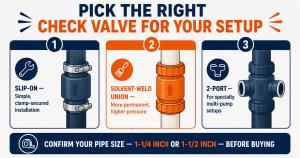
Before anything else, find out whether your pump discharges through 1-1/4″ or 1-1/2″ pipe. These are the two standard sizes, and they are close enough that a mismatched valve will not seal. Check the pump’s discharge outlet or its spec sticker; failing that, measure the pipe’s outside diameter — roughly 1-5/8″ means 1-1/4″ pipe, roughly 1-7/8″ means 1-1/2″ pipe. Slip-on valves like the Hydro Master list both sizes because the clamp fits either, and universal-fit valves like the Superior 99555 cover both thread types, but a solvent-weld or threaded valve has to match exactly. Confirming the number first is a two-minute job that prevents a return.
Slip-on vs solvent-weld union — installation tradeoffs
Slip-on check valves clamp onto the cut pipe ends with rubber couplings and stainless band clamps. They install in minutes with a screwdriver, come apart the same way for service, and forgive small alignment errors — but a clamped coupling is a rubber sleeve under tension, dependable rather than permanent. Solvent-weld union valves, like the Zoeller 30-0040, chemically fuse to the PVC for a joint that is effectively part of the pipe, with a threaded union in the middle so you can still separate it for pump work. That connection is stronger and quieter under pressure, but it means primer, cement, and cure time, and a misaligned joint is harder to undo. For most residential pumps a slip-on valve is entirely adequate; the union design earns its extra effort on harder-working systems.
Pressure rating and when it matters
A standard flapper check valve is built for the pressure a typical sump pump generates lifting water one storey and out through a short pipe run. Push past that — a deep pit with a tall vertical lift, a long horizontal run to daylight, or a high-capacity pump — and the pressure at the valve climbs. A 50 PSI-rated valve like the Zoeller 30-0040 or 30-0041 has margin for those conditions that a basic flapper does not, and the sturdier body also handles repeated water hammer better. If your pump works against noticeable resistance, or the pipes bang each time it stops, the higher rating is the practical choice. For an average basement pump on an average run, a standard valve is plenty.
Why a check valve matters for pump longevity
The real cost of skipping a check valve, or leaving a failed one in place, is measured in pump life. Every time backflow refills the pit and restarts the motor, that is a start the pump did not need — and motor starts, not run hours, wear a sump pump out. A working check valve sharply cuts the number of cycles during a wet spell, extending the interval before the pump needs replacing, and it keeps the discharge line primed so the pump is not lifting a full column of water on every start. If you are weighing whether a primary pump alone is enough protection, our sump pump vs battery backup comparison covers where a second pump fits in.
US Regional Context: Sump pump discharge pipe sizing is fairly standardized across most US residential installations at either 1-1/4 inch or 1-1/2 inch, but confirming your existing pipe size before purchasing a check valve avoids a frustrating mismatch. Most hardware stores stock both sizes, and several universal-fit valves in this category accommodate either size without needing to guess.
Frequently Asked Questions
Q: Do I really need a check valve on my sump pump?
In almost every case, yes. Without one, the water sitting in the discharge pipe drains straight back into the pit the moment the pump shuts off. The pit refills, the float rises, and the pump kicks on again within seconds. That short-cycling wastes energy and piles up motor starts that shorten the pump’s life. Only setups with a very short, nearly flat discharge run — where almost no water flows back — can reasonably skip one, and even then most installers fit a valve anyway.
Q: How do I know what pipe size check valve I need?
Check the pump first. Most sump pumps list the discharge size on the housing sticker or cast into the outlet fitting, and it is almost always 1-1/4″ or 1-1/2″. If it is not marked, measure the pipe’s outside diameter — about 1-5/8″ means 1-1/4″ pipe, about 1-7/8″ means 1-1/2″ pipe. Slip-on and universal-fit valves cover both sizes, but a solvent-weld or threaded valve has to match exactly.
Q: Can a check valve make my sump pump quieter?
It can reduce one specific noise. The loud thud or pipe rattle many people hear after the pump stops is water hammer — the pressure spike when the check valve slams shut against the backflowing water. A full-flow union-style valve like the Zoeller 30-0040 is designed to soften that closure, and mounting the valve slightly higher in the vertical run helps too. It will not quiet the motor or pipe vibration, but the after-shutoff bang is often the most noticeable sound.
Q: How often should a sump pump check valve be replaced?
There is no fixed schedule, but a check valve is a wear part — the internal flapper and its seat degrade over years of slamming shut. Inspect it whenever you service or replace the pump, and suspect it any time the pump starts short-cycling or you hear water draining back after it stops. Many homeowners just fit a fresh valve alongside every new pump, since it costs a small fraction of the pump and a failed one undermines everything the new pump does.
Conclusion — Which Sump Pump Check Valve Should You Buy?
For most sump pumps in most basements, the Hydro Master Slip-On Check Valve is the right call — it seals reliably, fits both standard pipe sizes, installs in minutes with stainless clamps, and costs the least here. If your discharge line works harder than average, the Zoeller 30-0040 brings a 50 PSI rating and a water-hammer-reducing union body, and the Zoeller 30-0041 covers the specialty 2-port setups nothing else in this lineup can.
The Wayne Check Valve Kit is the pick for a first-time install where having every fitting in one box beats shaving cost, and the Superior Pump 99555 is the budget universal option when you want the widest fit for the least money. Whichever you choose, confirm your pipe size first, and replace a worn valve rather than nursing it along. For the pump itself, see our sump pump reviews, and if you are deciding between pump types, our sump pump vs sewage ejector pump comparison covers which one your situation calls for.
Prices and ratings may change. Always check Amazon for current prices.
✍️ About This Review
PTR Editorial Team — Product Reviews. We compare manufacturer specifications, installation requirements, compatibility and available product documentation to help homeowners choose suitable tools and parts. How we review →