Please note: Information in this comparison is based on our research at time of writing and is general in nature. Always check specific product packaging and manufacturer instructions before purchasing or attempting a repair.
Introduction
Every sump pump needs a check valve on its discharge pipe. When the pump shuts off, the check valve stops the column of water standing in the pipe from draining back into the pit — which would otherwise refill the basin and trigger the pump to run again seconds later. That short-cycling wears the motor out early, which makes the check valve one of the most important fittings in the system.
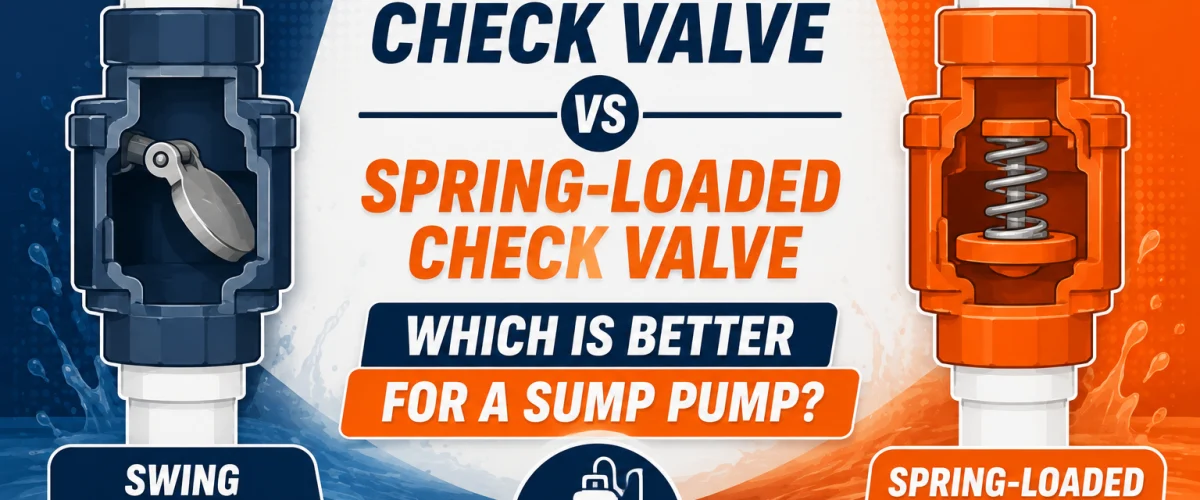
Most residential check valves use one of two designs: a swing (or flapper) valve, and a spring-loaded valve, often sold as a “quiet” or “silent” check valve. Both prevent backflow. What separates them is how they close — and that mechanical detail, not the brand on the box, is what drives how much noise the valve makes, how likely it is to bang the pipes, and how it holds up over years of cycling. This comparison covers the difference and where each design fits. If you are still choosing the pump itself, our sump pump reviews cover that separately.
At a Glance
Swing / Flapper Check Valve
- Closing mechanism: hinged flapper swings shut by gravity and reverse flow after the pump stops
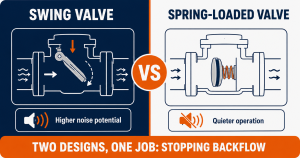
- Noise level: can be louder; the flapper tends to slap its seat as it closes
- Water hammer risk: higher potential in some setups, since the flapper may not seat until reverse flow has momentum
- Flow restriction: low; a full-port body opens close to the full pipe bore
- Install orientation: horizontal, or vertical with upward flow; position must let gravity close the flapper
- Maintenance needs: few parts; flapper and seat wear over years, debris can prop it open
- Typical price range: $
- Typical lifespan: long with clean water; the rubber flapper and seat are the wear point
Spring-Loaded / Quiet Check Valve
- Closing mechanism: a spring pushes the disc toward its seat, so it begins closing as forward flow slows
- Noise level: usually quieter; the spring seats the disc before a hard reverse surge builds
- Water hammer risk: often lower where hammer is a problem, though pipe run and cycling still matter
- Flow restriction: slightly higher; the spring and in-line body add some resistance
- Install orientation: more position-tolerant; the spring, not gravity, closes the disc (still follow the arrow)
- Maintenance needs: more parts; the spring can fatigue or corrode over many years
- Typical price range: $$ to $$$
- Typical lifespan: comparable when clean; spring fatigue is the added long-term variable
How Each Valve Closes
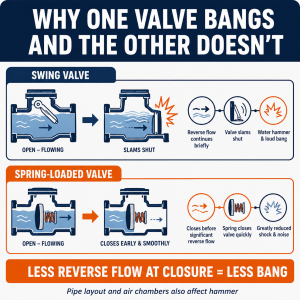
A swing check valve, also called a flapper check valve, is built around a single hinged disc inside the body. While the pump runs, forward flow pushes that flapper up and holds it open. When the pump stops and forward flow ends, the flapper falls back toward its seat under its own weight, and any water that starts to move backward pushes it the rest of the way shut. It is a simple, proven mechanism with very few moving parts.
A spring-loaded check valve replaces gravity with a light spring. The spring constantly pushes the sealing disc toward its seat, so the valve is biased closed at all times. Forward flow from the pump only has to overcome that spring pressure to open the valve and pass through. The moment the pump stops and flow pressure drops, the spring pushes the disc back onto its seat — it does not wait for reverse flow to arrive. That early, flow-driven closure is the whole point of the design.
Neither approach is more “correct”: the swing design trades a slightly later close for near-zero flow resistance and simplicity, while the spring design trades a little added resistance and a few more parts for an earlier, gentler closure.
Noise and Water Hammer
This is the difference most people actually notice. When a swing valve’s flapper closes, it often does so with an audible click or thud as it meets its seat. If a reverse-flowing column of water has already picked up speed before the flapper seats, that column stops abruptly against the closed valve. That sudden stop is water hammer: a pressure spike that travels back through the pipe as a bang or a rattle against the joists.
A spring-loaded valve can reduce this. Because the spring starts seating the disc as forward flow decays, the valve is often nearly or fully closed before significant reverse flow develops, so there is less momentum to arrest and a smaller pressure spike. Valves marketed as “quiet” or “silent” check valves generally work on exactly this principle.
It is worth being careful about how strong that claim is. Water hammer in a sump system is also shaped by how long and rigid the discharge run is, how far the water is lifted, how often the pump cycles, and whether the pipe is strapped tightly to framing or fitted with an arrestor. A spring valve reduces one contributor to hammer; it does not guarantee a silent system, and a well-supported pipe with a swing valve can be quieter than a loosely strapped pipe with a spring valve. If noise is the specific problem you are solving, a spring-loaded valve is a reasonable first move — but pipe support and routing matter just as much.
Flow Restriction and Head Loss
Every check valve costs the pump a little pressure to push through. A full-port swing valve costs very little — with the flapper held fully open, the passage through the valve is close to the full inside diameter of the pipe, so the pump works barely harder than it would with a plain fitting in that spot.
A spring-loaded valve adds slightly more resistance. The pump has to hold the spring compressed the whole time it runs, and many spring valves use an in-line body with a more constrained flow path than a swing valve’s open bore. In most residential sump setups this difference is small and not worth worrying about. It matters more when the pump is already near its capacity — a deep pit with a tall lift, a long run, or a high total head — where trimming extra head loss is worth keeping in mind.
Installation Orientation and Compatibility
A swing valve depends on gravity to help close the flapper, so it has real orientation limits. It is designed for horizontal runs or vertical pipe with upward flow, installed so the flapper can fall toward its seat. Mounting one in a disallowed position can leave the flapper unable to seat properly. Every swing valve carries a flow arrow, and most also specify the positions they can be installed in.
A spring-loaded valve is generally more forgiving. Because the spring closes the disc regardless of which way is down, many spring designs are rated for horizontal or vertical installation with no preferred orientation. That flexibility helps in a tight pit where the discharge pipe geometry does not leave much choice. It does not remove the need to follow the flow arrow — installing any check valve backward defeats it entirely — but it removes one constraint.
On a typical sump pump, the check valve goes on the vertical discharge pipe a short distance above the pump outlet, and both designs are sold in the slip-on (rubber coupling) and union styles common in that spot. Our guide on how to install a sump pump check valve covers that placement and the cut-and-clamp process in detail.
Reliability and Long-Term Maintenance
The swing design’s strength is its simplicity: one moving part, no spring to weaken, nothing to bind. Its failure modes are straightforward. The rubber flapper or its seat wears, hardens, or tears over years of slamming shut, or a piece of debris — a wood chip, a clot of sediment, a small stone — lodges under the flapper and holds it open so backflow gets through. Sump water is rarely clean, so debris fouling is a genuine consideration.
A spring-loaded valve has the same debris exposure plus one more variable: the spring. Over many years of constant compression and cycling, a spring can lose tension or corrode in the damp air of a sump pit. A weakened spring closes more slowly and less completely, which erodes the very advantage the design was chosen for. Quality varies widely — a corrosion-resistant spring in a good valve may outlast the pipe around it, while a cheap one can fade in a few seasons.
For either type, the inspection habit is the same: when you service or replace the pump, open the check valve and check for a flapper or disc that no longer seats cleanly, and between services stay alert for backflow sounds or short-cycling.
Cost and Longevity
A basic swing check valve is usually the least expensive option in this category, in the $ tier — a simple part made in large volume. Spring-loaded and purpose-built quiet valves sit higher, commonly $$ to $$$, reflecting the extra parts and the more involved body.
Longevity is close to a wash when both are used in clean conditions and installed correctly; either can last many years. The gap opens under stress: a swing valve in gritty water is limited by flapper and seat wear, while a spring valve’s life is also tied to how well its spring resists fatigue and corrosion. Paying up for a well-made spring valve makes sense when noise reduction is the goal; paying up for one you do not need just adds parts that can fail.
Which Should You Choose?
For most standard sump pump installations — a normal pit, a reasonable discharge run, an unfinished basement where a little valve noise is fine — a quality swing check valve is a perfectly sound choice and the better value. The case for a spring-loaded valve strengthens as noise sensitivity, pipe run length, or awkward mounting geometry increase.
| Your Situation |
Better Choice |
| Unfinished basement, standard pit, keeping cost down |
Swing / flapper valve |
| Finished basement, or a bedroom near the sump pit |
Spring-loaded (quiet) valve |
| Long or tall discharge run that already bangs on shutoff |
Spring-loaded valve, plus better pipe support |
| Pump running near its capacity, every foot of head counts |
Full-port swing valve (lower flow restriction) |
| Tight pit where pipe geometry forces an unusual valve position |
Spring-loaded valve (orientation-tolerant) |
| Gritty, silty sump water where debris is the main worry |
Either; inspect on a schedule, a simple swing valve is easier to clear |
None of these are absolute. If you fit a swing valve and the pipes bang, pipe straps and an arrestor may solve it without swapping the valve; if a spring valve’s spring fatigues, the noise it was bought to prevent returns. Match the valve to the setup, then support the discharge pipe well whichever you pick. To compare specific valves of either type, our roundup of the best sump pump check valves covers current options across both designs.
✏️ Our Take
Swing and spring-loaded check valves are not a better-and-worse pair — they are two solutions tuned for different priorities. A swing valve is simple, inexpensive, and barely restricts flow, which makes it the sensible default for a standard sump setup where a little noise does not matter. A spring-loaded “quiet” valve trades a little flow resistance and a few more parts for an earlier, gentler closure, which can meaningfully cut valve noise and water hammer in a finished basement or on a long discharge run. Neither choice removes the need to install the valve the right way round and to support the discharge pipe well — those matter as much as the valve design itself.
Prices and ratings may change. Always check Amazon for current prices.
✍️ About This Comparison
PTR Editorial Team — Product Comparisons. We compare manufacturer specifications, installation requirements, compatibility and available product documentation to help homeowners choose suitable tools and parts. How we review →