Please note: Information in this comparison is based on our research at time of writing and is general in nature. Always check specific product packaging and manufacturer instructions before purchasing or attempting a repair.
Introduction
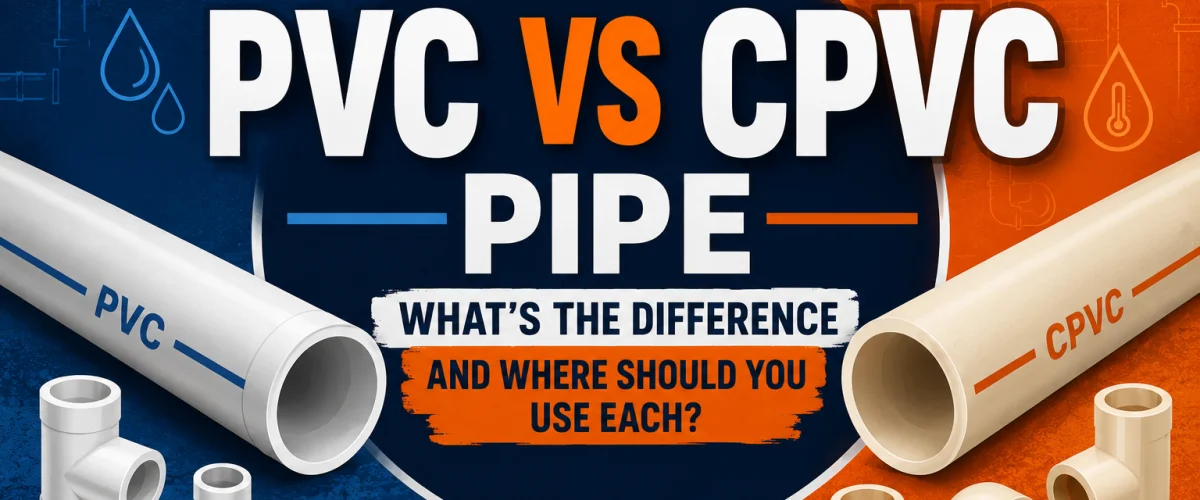
PVC and CPVC are two of the most confused materials in residential plumbing, and it’s easy to see why — they’re rigid white or cream-colored plastic pipes that look nearly identical on a hardware store shelf, and the second name is quite literally the first name with a prefix added. That surface-level similarity leads a lot of homeowners to assume the two are interchangeable, or at worst a minor upgrade from one to the other.
They’re not interchangeable, and the differences matter in ways that go well beyond labeling. PVC and CPVC differ in temperature tolerance, in the specific applications each one is actually approved and suited for, and — critically — in the dimensional standards and cement systems used to join them. This comparison walks through what actually separates the two materials, where each one belongs in a home’s plumbing, and why treating them as swappable is a mistake that can lead to a failed joint or a code violation. Once you’ve settled on PVC, our PVC pipe cutter reviews and our how to cut PVC pipe straight and clean guide cover getting a clean joint, and our PVC Schedule 40 vs Schedule 80 comparison covers the next decision — wall thickness and pressure rating — once material is settled. If you’re trying to decide between a flexible option and a rigid one instead, our PEX vs CPVC pipe comparison covers that different decision — this article is specifically about two rigid materials.
At a Glance
PVC
- Rigid plastic, NOT rated for hot water supply lines
- Common in drain-waste-vent systems and cold water applications
- Uses PVC-specific solvent cement
- Generally less expensive
- Widely available
CPVC
- Rigid plastic, chlorinated formulation
- Rated for both hot and cold potable water supply
- Uses CPVC-specific solvent cement and primer, NOT compatible with PVC cement
- Different dimensional sizing in many common residential products
- Generally costs somewhat more than PVC
✏️ Our Take
PVC and CPVC are not two versions of the same pipe — they’re chemically different materials built for different jobs, and treating them as interchangeable is the single most common and costly mistake homeowners make with this comparison. PVC is the standard choice for drain, waste, and vent lines and cold-water-only applications, where its lower cost and wide availability make sense. CPVC exists specifically because standard PVC isn’t rated for hot water supply lines — its chlorinated formulation handles the heat that would degrade standard PVC over time. The two materials also use different pipe dimensions and completely different, non-interchangeable cement systems, so this isn’t just an application question — the pipes and fittings themselves genuinely aren’t compatible with each other in most residential plumbing systems.
Quick Comparison Table
Here’s how PVC and CPVC stack up across the factors that actually determine which one belongs in a given application.
| Factor |
PVC |
CPVC |
| Hot water supply |
Not rated — do not use |
Rated for hot and cold potable supply |
| Typical application |
Drain-waste-vent, cold-water-only lines |
Hot and cold potable water supply |
| Common dimensional standard |
Schedule 40 / Schedule 80 |
Often CTS (Copper Tube Size) in residential supply |
| Cement system |
PVC-specific cement |
CPVC-specific cement and primer |
| Cement interchangeable? |
No |
No |
| Typical cost tier |
Generally $ |
Generally $$ |
| Best suited for |
Drainage systems, irrigation, cold-only lines |
Any hot or cold potable supply line |
What’s the Actual Material Difference?
PVC, or polyvinyl chloride, is a rigid plastic that’s been a staple of residential plumbing for decades, most widely used for drain-waste-vent (DWV) systems and for cold-water-only supply applications. It’s produced in large volumes, well understood by code officials and contractors alike, and available at essentially every hardware store in the country, which is part of why it remains the default choice anywhere its temperature limitations aren’t a factor.
CPVC, or chlorinated polyvinyl chloride, starts from that same base PVC polymer but goes through an additional chlorination process during manufacturing. That extra step isn’t cosmetic — it fundamentally changes the material’s molecular structure in a way that significantly increases its heat tolerance. The result is a plastic pipe that can handle sustained exposure to hot water temperatures that would soften, warp, or eventually fail standard PVC.
This is the core reason CPVC exists as its own distinct product line rather than simply being an upgraded version of PVC that replaced it everywhere. PVC remains the more cost-effective, widely available choice for applications that never involve hot water, while CPVC fills the specific role of a rigid plastic pipe that can be trusted with a home’s actual hot water supply — a job standard PVC was never designed or approved to do.
💡 Tip: If you’re identifying pipe you didn’t install yourself, our
how to identify your pipe material guide covers how to visually and physically tell PVC, CPVC, and other common pipe materials apart — useful before you assume which one you’re actually working with.
Hot Water and Temperature Ratings
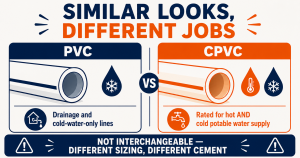
Standard PVC is generally not rated for sustained hot water use. At the temperatures a typical residential hot water supply line reaches, PVC can gradually soften, lose structural rigidity, and eventually fail — not necessarily immediately, but as a slow degradation that can take months or years to show up as a leak or a joint failure. This isn’t a minor technicality or an overly cautious guideline; it’s a genuine limitation of the material itself.
CPVC, by contrast, is specifically engineered to handle both hot and cold potable water supply temperatures reliably over the long term. The chlorination process that distinguishes it from standard PVC is what gives it this expanded temperature range, and it’s rated for the sustained hot water exposure a home’s water heater and hot water lines actually produce.
This temperature difference is the fundamental reason CPVC exists as a distinct product rather than being an unnecessary variant of PVC. If PVC could simply handle hot water reliably, there would be little reason for CPVC to exist at all as a separate, more expensive material — the fact that it does exist, and remains in wide use specifically for hot water supply lines, reflects a genuine engineering limitation in standard PVC that the chlorination process solves.
⚠️ Warning: Never use standard PVC pipe for a hot water supply line. It is not rated for sustained hot water temperatures and can degrade, soften, or fail over time, potentially leading to leaks or pipe failure inside a wall.
Sizing and Dimensional Differences — Why They’re Not Interchangeable
Beyond temperature rating, PVC and CPVC frequently use genuinely different dimensional standards, and this is where the two materials become physically, not just functionally, incompatible in many situations. PVC piping commonly follows Schedule 40 or Schedule 80 dimensional standards, which specify wall thickness and outside diameter based on a nominal pipe size.
CPVC used in many residential water supply applications, however, often follows a different standard entirely: CTS, or Copper Tube Size. This sizing convention exists specifically so CPVC supply piping can integrate more easily with existing copper plumbing systems, matching copper’s outside diameters rather than the Schedule 40/80 dimensions PVC typically uses. The practical result is that a given nominal pipe size — say, 1/2 inch — can have a genuinely different actual outside diameter depending on whether it’s Schedule 40 PVC or CTS-sized CPVC.
That difference means fittings sized for one system generally will not properly fit pipe from the other, even when the nominal size listed on the packaging matches. This isn’t a universal rule across every PVC and CPVC product on the market — dimensional standards can vary by specific product and application — but it’s common enough in residential settings that confirming the actual dimensional standard for both the pipe and any fittings before assuming compatibility is a genuinely necessary step, not an optional precaution.
💡 Tip: Never assume a PVC fitting will properly fit CPVC pipe (or vice versa) just because the nominal size listed matches. Always confirm the actual dimensional standard (Schedule 40/80 versus CTS) for both the pipe and fitting before purchasing or installing.
Joining Methods and Cement Compatibility
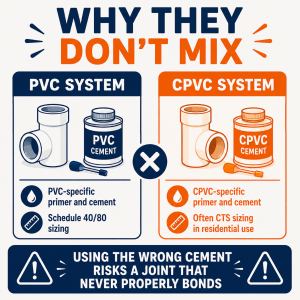
PVC pipe is joined using PVC-specific primer and solvent cement, a chemical process that actually fuses the pipe and fitting together at a molecular level rather than simply gluing two surfaces. CPVC requires its own separate system: CPVC-specific primer and CPVC-specific solvent cement, formulated differently to properly bond with CPVC’s chlorinated plastic.
These two cement systems are formulated specifically for their respective plastics, and in most cases they are not considered interchangeable or reliably compatible with each other. Using PVC cement on a CPVC joint, or CPVC cement on a PVC joint, risks a connection that doesn’t properly fuse — the cement may not chemically bond correctly with plastic it wasn’t formulated for, leaving a joint that looks complete but isn’t actually sound.
This matters well beyond the moment of installation. A poorly bonded solvent-welded joint can hold under initial testing and then fail later under sustained pressure or temperature cycling, which makes using the correct cement system — checked directly against the can’s labeling for both pipe types involved — a genuinely important step rather than a detail to skip if you’re in a hurry or working with whatever cement happens to be on the shelf.
⚠️ Warning: Do not use PVC cement on CPVC pipe or CPVC cement on PVC pipe. While some multi-purpose cements exist that are rated for both materials separately, standard single-purpose PVC and CPVC cements are not interchangeable, and using the wrong one risks a joint that fails to bond properly.
Application: Drainage vs Potable Water Supply
PVC is the standard, widely accepted choice for drain-waste-vent (DWV) piping throughout a home — the pipes that carry wastewater and sewer gas away rather than pressurized potable water. It’s also commonly used for cold-water-only supply applications outside the core hot water system, such as irrigation lines or certain outdoor cold water runs, where its lower cost and easy availability make it the practical default.
CPVC, on the other hand, is used specifically for potable water supply lines that carry both hot and cold water throughout a home — the pressurized lines running from the water heater and main supply out to fixtures. This is squarely the application PVC isn’t rated for, and it’s the reason CPVC continues to be manufactured and sold as a distinct product rather than being phased out in favor of PVC everywhere.
Choosing the correct material for the specific application isn’t a matter of preference — it’s a matter of both basic function and, in many jurisdictions, code compliance. Using PVC on a hot water supply line risks the material failure covered earlier in this comparison, and it can also fail a plumbing inspection outright regardless of whether the installation otherwise looks competent. Our cast iron vs PVC drain pipe comparison covers PVC’s DWV role in more depth if drainage, specifically, is the application you’re planning around.
Cost and Lifespan
PVC is generally less expensive than CPVC and is stocked at essentially every hardware store in the country, reflecting both its simpler manufacturing process and its much broader market of applications, from plumbing to irrigation to a wide range of non-plumbing uses. CPVC costs somewhat more, a difference that largely traces back to the additional chlorination step required during manufacturing, along with a comparatively narrower, more specialized market.
Both materials offer a genuinely long service life when they’re used within their intended application and temperature range — decades of reliable service is a realistic expectation for either one installed correctly. The lifespan conversation changes considerably, though, the moment either material is pushed outside that intended range. PVC exposed to sustained hot water, or CPVC installed with an incompatible cement or dimensional mismatch, can fail well before either material’s realistic long-term potential, which is ultimately the more expensive outcome regardless of the modest cost difference between the two materials upfront.
Building Code Considerations
Local plumbing codes typically specify which material is required or permitted for a given application — drainage versus potable hot and cold water supply being the central distinction relevant to this comparison — and these requirements can and do vary by jurisdiction rather than following one uniform national standard.
Confirming your local code requirements before starting a plumbing project involving either material is a genuinely essential step, not a formality to skip. Using the wrong material for a given application can fail an inspection outright regardless of whether the installation would technically hold water and function, since code compliance is a separate question from basic functionality. This is particularly relevant for any work that will require a permit and inspection, where a failed inspection means redoing the work rather than simply noting a preference for next time.
US Regional Context: Plumbing codes vary by US state and municipality, and while PVC for drainage and CPVC for potable hot/cold supply is a common general pattern, some jurisdictions have specific additional requirements or restrictions. Checking with your local building department before a project involving either material is worth the time, particularly for any work that will require inspection.
Which Should You Use Where?
The decision framework here is more straightforward than the material science behind it. Use PVC for drain-waste-vent systems and for cold-water-only applications, such as irrigation or certain outdoor lines, where its lower cost and wide availability make it the sensible default and its temperature limitations are never a factor.
Use CPVC for any potable water supply line that carries hot water, or anywhere your local code specifically requires it for supply applications regardless of temperature. If a line is ever going to see hot water — even intermittently, rather than constantly — CPVC is the material rated to handle that, and PVC simply is not.
What you should never do is substitute one material for the other based purely on convenience, cost savings, or what happens to be on hand for a repair. Given the temperature rating gap, the dimensional differences covered earlier, and the non-interchangeable cement systems, a substitution made for convenience risks a joint or a pipe run that fails — sometimes quickly, sometimes only after months of quiet degradation behind a wall.
Frequently Asked Questions
Q: Can I use PVC cement on CPVC pipe in an emergency?
This isn’t recommended, even as a temporary fix. PVC cement is formulated to chemically bond with PVC’s specific plastic composition, and using it on CPVC risks a joint that doesn’t properly fuse, potentially leaving a weak connection that fails under pressure later — sometimes well after the “temporary” fix has been forgotten about. If you’re in a genuine emergency and don’t have CPVC cement on hand, a mechanical fitting designed as a temporary repair is a safer stopgap than using the wrong solvent cement, with a proper CPVC-cemented joint following as soon as you have the correct materials.
Q: Is CPVC safe for drinking water?
Yes. CPVC intended for potable water applications is manufactured and certified specifically for that use, and it’s a widely used, code-accepted material for residential hot and cold water supply throughout the US. As with any plumbing material, confirming that the specific product you’re buying is labeled and certified for potable water use — rather than an industrial or non-potable CPVC product — is a reasonable step, since not every CPVC product on the market is intended for drinking water applications.
Q: Why does CPVC cost more than PVC?
The price difference largely comes down to manufacturing complexity. CPVC starts from the same base polymer as PVC but requires an additional chlorination process to achieve its increased heat tolerance, and that extra manufacturing step adds cost. CPVC also serves a narrower, more specialized market — primarily potable hot and cold water supply — compared to PVC’s much broader range of applications, which affects production scale and, in turn, price.
Q: Can I connect PVC pipe directly to CPVC pipe?
Not with a standard solvent-welded joint, given the cement incompatibility and frequent dimensional mismatch covered in this comparison. If you genuinely need to transition between the two materials — for example, connecting a CPVC hot water supply line to an existing PVC section in an application where that’s actually appropriate — a mechanical transition fitting specifically rated for joining PVC to CPVC is the correct approach, rather than attempting a direct solvent-cemented connection between the two.
Conclusion
PVC and CPVC share a name and a similar appearance, but they’re built for genuinely different jobs, and the differences are more than cosmetic. PVC remains the practical, cost-effective choice for drain-waste-vent systems and cold-water-only applications. CPVC exists specifically to handle the hot water supply role that standard PVC isn’t rated for, and it comes with its own dimensional standards and cement system that don’t reliably cross over with PVC’s.
The bottom line is straightforward even if the material science behind it isn’t: match the material to the application, confirm dimensional compatibility before assuming any parts will fit, and always use the correct cement system for the pipe you’re actually working with. If you’re still identifying what’s already installed in your home, our how to identify your pipe material guide can help confirm what you’re working with before you buy replacement parts.
Prices and ratings may change. Always check Amazon for current prices.
✍️ About This Comparison
PTR Editorial Team — Product Comparisons. We compare manufacturer specifications, installation requirements, compatibility and available product documentation to help homeowners choose suitable tools and parts. How we review →