Please note: Information in this comparison is based on our research at time of writing and is general in nature. Always check specific product packaging and manufacturer instructions before purchasing or attempting a repair.
Introduction
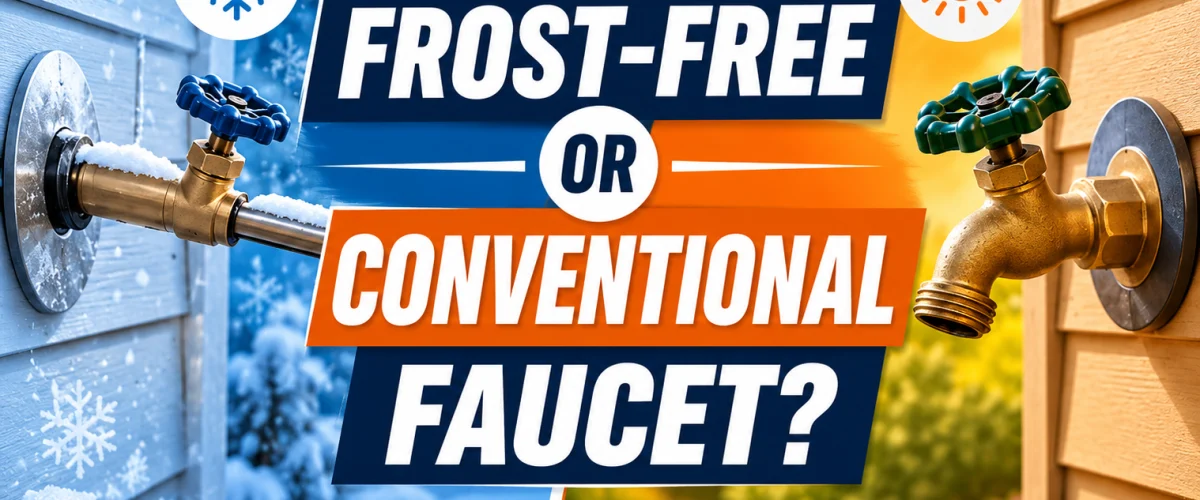
Whether your home needs a frost-free sillcock instead of a conventional outdoor faucet doesn’t have one universal answer. It depends on the installation, the model’s instructions, backflow requirements and local rules, as well as on whether the faucet’s exposed parts can reach freezing temperatures. It’s tempting to assume “frost-free is always better”, but neither design guarantees against freezing, and the better choice depends on those checks.
This comparison isn’t a shopping guide — if you’ve already decided which type you need, our outdoor faucet reviews cover current models across both categories. What follows explains how each design works, where water can sit after the valve is shut, and the checks that should determine which one fits your house.
At a Glance
Standard Outdoor Faucet
- Shuts off at or near the exterior wall face
- The exposed faucet and supply can hold water after closing, depending on the installation
- Winterize before freezing weather: identified interior shutoff, drain, leave open
- Shorter body; check the supply connection and your wall
- Cost varies by model, installation and access
Frost-Free Sillcock
- Shuts off inside the wall, intended to be in heated space
- Designed to drain the exposed section when installed and used as the maker specifies
- Follow the current instructions for your model on hoses before winter
- Check the whole installation: model length, wall thickness, pitch, heated inlet, connection and service access
- Cost varies by model, installation and access
✏️ Our Take
A frost-free sillcock is designed to put the shutoff inside the wall, in heated space, and to drain the exposed part when it is installed and used as the maker specifies; a conventional faucet relies on seasonal winterization. Which suits a home depends on the checks in this guide — exposure to freezing, installation requirements, backflow protection and local rules — not on climate alone, and neither design guarantees that a faucet will not freeze.
Quick Comparison Table
Typical differences between the two designs; the instructions for your exact model govern:
| Factor |
Conventional outdoor faucet |
Frost-free sillcock |
| Shutoff location |
At or near the exterior wall face |
Inside the wall at the end of a long tube, intended to be in heated space |
| Water after shutoff |
Depends on the installation; the exposed faucet and supply can hold water |
Designed to drain the exposed part when installed and operated as the maker specifies; drainage depends on the model and installation |
| Freeze protection |
None built in; depends on winterization steps |
Designed for freeze protection when installed correctly and used as the model’s instructions say |
| Winterization |
For a conventional faucet: identified interior shutoff, drain, leave the outside faucet open |
Follow your exact model’s current instructions, including for hoses |
| Installation |
Shorter body; check the supply connection and your wall |
Check the whole installation: model length, wall thickness, required pitch, heated inlet location, connection and service access |
| Backflow protection |
Depends on the model and application |
Depends on the model and application; separate from freeze protection |
| Cost |
Varies by model, installation and access |
Varies by model, installation and access |
How Each Design Actually Works
A conventional outdoor faucet has its shutoff at or near the exterior wall, so the faucet body and the supply pipe leading to it are exposed to outdoor temperatures. Closing the handle stops the flow, but how much water remains in the faucet and the supply depends on the installation, such as where the pipe runs and whether an interior shutoff and drain are available. That is why conventional faucets are winterized with seasonal steps (see Winterization Requirements).
A frost-free (freezeless) design moves the shutoff to the inner end of a long tube and stem, with the valve seat intended to sit in heated space. The visible faucet body outside is the far end of that tube. The Woodford installation sheets we read describe a tube installed with a slight downward pitch for drainage, and one hydrant model calls for a warm interior inlet.
When the valve is closed, a frost-free design is intended to let water in the tube drain out through the drainage path designed into the model. Woodford’s instructions for its Models 25 and 27, for example, describe water draining out of drain holes behind the handle when the valve is fully closed, and say the models drain automatically when fully shut off, even with a hose attached; the sheets we read for its other models do not address hoses. Whether a given faucet drains depends on the model, the pitch, the installation and how it is used. Use the current instructions for your exact model.
Freeze Protection
The main difference between the designs is where water can sit after the valve is closed. On a conventional faucet, the exposed faucet and supply can hold water that is exposed to outdoor temperatures. A frost-free design is intended to shut off inside the wall in heated space and to drain the exposed part, so less water is left there to freeze when it is installed and used as the maker specifies.
Freezing water expands, and the American Red Cross notes that this puts tremendous pressure on whatever contains it, including metal or plastic pipes. Reducing the water left in the exposed parts is the aim of both winterization steps and frost-free designs, but neither guarantees that a faucet will not freeze.
Freezing temperatures are what make freeze protection relevant. If the faucet’s exposed parts and supply rarely or never reach freezing, the freeze-protection difference matters less, but that is one factor among the checks below, not a rule on its own.
⚠️ Warning: Frost-free drainage depends on the model and the installation, and hose guidance is model-specific. Follow your exact model’s current instructions; if you can’t find them, taking the hose off is the cautious choice. No design guarantees that water will not freeze.
Winterization Requirements
For a conventional outdoor faucet whose interior shutoff valve you have identified, the American Red Cross advises removing, draining and storing hoses, closing the inside valve that supplies the faucet, opening the outside faucet to drain it, and keeping it open so that any water remaining in the pipe can expand without breaking it. Opening the faucet doesn’t guarantee that the line is empty: if water keeps flowing or you can’t tell whether it has drained, ask a plumber or installer. A foam cover is an optional extra layer, not a substitute for those steps.
If your faucet is frost-free, or you can’t identify the valve that supplies it, follow the current instructions for your exact model or ask a plumber before operating any valve. Which seasonal steps a frost-free model needs, including hose handling, depends on the model and the installation. Our outdoor faucet cover reviews are worth a look if you want an added layer on a conventional faucet; for a frost-free faucet, follow the maker’s instructions.
Our full how to winterize outdoor faucets guide walks through the conventional-faucet steps and the hose precaution for frost-free faucets.
💡 Tip: If you are unsure which type you have or how it was installed, check the markings on the faucet or ask a plumber before relying on any seasonal routine.
Installation Checks
A conventional faucet has a shorter body, so installation is mainly about the supply connection and mounting. Check the connection type and how the supply runs.
A frost-free faucet depends on its whole installation, not on wall depth alone. Check the model’s length against the wall thickness; the required downward pitch; where the heated inlet or valve seat will sit (Woodford’s Model 68 sheet calls for a warm interior inlet); the supply connection, whether threaded, push-fit, soldered or another type; and access for service. The maker’s instructions say how each model must be installed. A thin wall doesn’t automatically rule out a frost-free model; have an installer assess whether the model’s requirements can be met.
Our how to replace an outdoor faucet guide covers replacing a faucet; check the maker’s instructions for your model before buying.
Anti-Siphon and Backflow Considerations
Backflow protection is a separate question from freeze protection. A vacuum breaker or anti-siphon device is meant to keep water in a hose or outdoor connection from being drawn back into the home’s drinking water supply under negative pressure, such as when supply pressure drops. A frost-free design does not provide it by itself, and a conventional faucet may or may not have it.
Which device is required, and which arrangements are permitted, depend on the application, the model’s instructions and local requirements, so check all three. Woodford’s sheets show how much models differ: its Models 14 and 16 have no anti-siphon protection, its Models 17, 19, 22 and 25 do, and Model 27 has a dual-check backflow preventer. An add-on vacuum breaker doesn’t automatically suffice: whether one is acceptable depends on the faucet’s instructions, the application and local rules, so confirm before adding one, and ask a plumber or your local authority if you are unsure.
Cost and Maintenance
Cost depends on the model, the materials, the installation and who does the work. A frost-free faucet is a longer assembly than a conventional faucet, but we have not priced either, and the difference for your home depends on the quotes you get and on access.
What affects a quote: the supply connection type and whether it needs soldering or other work, access to the wall from inside, wall thickness and construction, the model’s length and pitch requirements, and whether an interior shutoff exists or has to be added. Maintenance differs too: a conventional faucet needs its seasonal steps, while a frost-free model follows the maker’s instructions.
Failure Modes and Repair Access
Freezing is one way an outdoor faucet can fail: water left in a faucet body or pipe expands and can crack it, and the crack may not show until the water is turned back on. On a conventional faucet the damage is in the exposed faucet or supply; repair access depends on where the damage is and how the pipe runs, so the work can range from the exterior to opening a wall.
A frost-free faucet can also freeze if water stays in the tube, for example from incorrect pitch, an installation problem or hose handling that doesn’t follow the model’s instructions. Wear is another source of trouble: a worn washer or stem can cause a drip at the spout, and what repair is possible depends on the model’s parts. A problem at the shutoff end of a frost-free faucet may need access from inside the home. Ask the maker or a plumber how your model is serviced.
Choosing a Type: Checks to Make
No single factor decides this. Work through these checks, then follow the maker’s instructions for the model you choose:
| Check |
What it affects |
| Can the faucet’s exposed parts or supply reach freezing temperatures? |
If so, freeze protection and winterization matter. A frost-free design is one option; we can’t establish that it is required for your home. |
| Is the faucet conventional, with an identified interior shutoff? |
A conventional faucet can be winterized with the steps above if they will be done every year. If you can’t identify the valve, ask a plumber. |
| Can the model’s installation requirements be met? |
Model length, wall thickness, required pitch, heated inlet location, supply connection and service access (see Installation Checks). |
| Which backflow device does the application call for? |
Separate from freeze protection; depends on the application, the model’s instructions and local requirements. |
| Do local rules require or restrict a type? |
If an applicable rule requires a type, follow it; otherwise it does not decide the choice. |
These checks don’t produce one answer: a frost-free faucet, a conventional faucet with seasonal winterization, or another arrangement may each suit a different home. If you’re unsure which applies, a licensed plumber can look at the installation.
Local requirements: Requirements for outdoor faucets vary by location, so ask your local building department; if an applicable rule requires a type, follow it.
Need a Professional Plumber?
Confirming wall depth, evaluating an interior shutoff, or handling a soldered supply line connection can get more involved than a straightforward swap. If you’d rather leave it to a professional, search PlumberArchive.com — the US plumber directory with 12,000+ verified local plumbers across all 50 states.
Find a trusted plumber near you → PlumberArchive.com
Frequently Asked Questions
Q: Do frost-free sillcocks ever freeze?
Yes. Frost-free designs reduce the water left in the exposed part but don’t guarantee that a faucet will not freeze. Causes can include incorrect pitch, an installation that doesn’t match the maker’s requirements, or hose handling that doesn’t follow the model’s instructions; see How Each Design Works for the hose guidance.
Q: Can I replace a standard outdoor faucet with a frost-free sillcock myself?
That depends on the installation and the maker’s instructions, not only on the connection type. Check the model’s length against your wall, the required pitch, where the heated inlet will sit, the supply connection and service access. If you aren’t sure about any of these, or the work involves soldering or opening a wall, a licensed plumber can assess it. Our how to replace an outdoor faucet guide covers replacing a faucet.
Q: Is a frost-free sillcock worth it in a climate that rarely freezes?
That depends on your own situation, not on climate alone: whether the faucet’s exposed parts and supply could reach freezing, the installation checks, backflow requirements, local rules and cost. Where freezing rarely or never happens, the freeze-protection benefit matters less, but we can’t say whether a frost-free model is worth it for your home.
Q: Do frost-free sillcocks still need to be winterized at all?
Follow your exact model’s current instructions. A frost-free design is meant to drain when properly installed and shut off, which can reduce the seasonal steps, but which steps are needed, including hose handling, depends on the model and the installation. The Red Cross’s general advice is to remove, drain and store hoses used outdoors; see How Each Design Works for model-specific hose guidance.
Conclusion
Frost-free and standard outdoor faucets are built around different assumptions, and the right choice depends on matching the design to your installation, backflow requirements, local rules and how the faucet will be maintained, not on climate or habit alone. A frost-free design is intended to place the shutoff in heated space and drain the exposed part, but neither design guarantees that water will not freeze, and the details depend on the model and installation.
If you’re still deciding, work through the checks above, and see our how to winterize outdoor faucets guide either way. Whichever faucet you have, follow your exact model’s current instructions; for a conventional faucet, follow the steps in that guide.
Check the packaging and the maker’s instructions for your exact model before buying or installing.
✍️ About This Comparison
PTR Editorial Team — Product Comparisons. We compare manufacturer specifications, installation requirements, compatibility and available product documentation to help homeowners choose suitable tools and parts. How we review →