Comparisons
20 Sep 2026

Utility Pump vs. Sump Pump (2026) — Which Do You Need?
Utility pump vs sump pump: one is portable for occasional jobs, the other a permanent install for ongoing water. See which your basement needs.
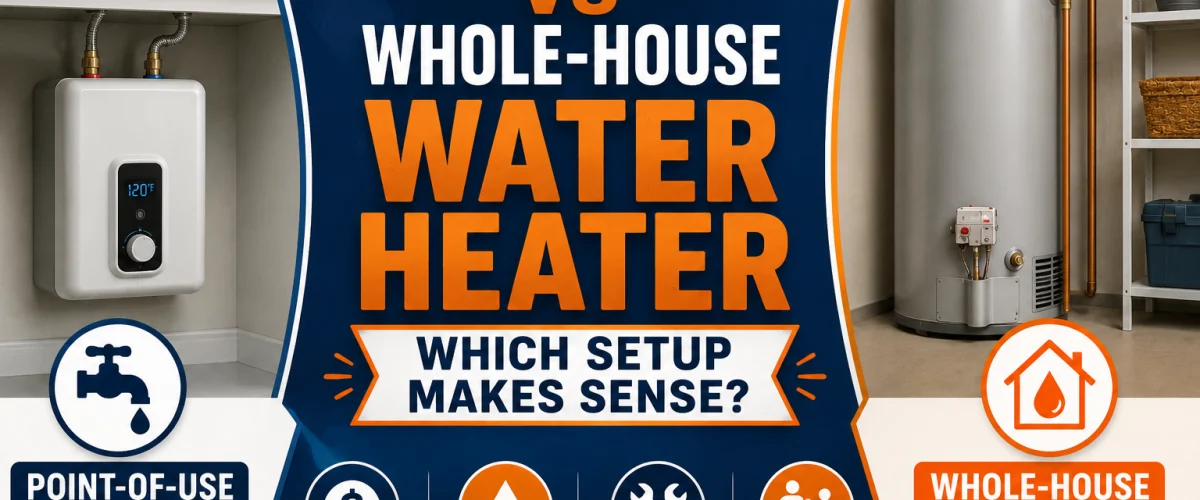
A whole-house water heater serves every fixture from one unit — a point-of-use heater serves just one. We compare when each setup makes sense.
Please note: Information in this comparison is based on our research at time of writing and is subject to change. Always check Amazon for the latest product details before purchasing.
Point-of-use versus whole-house water heating is often framed as an either/or decision, but for most homes it isn’t really that at all. A whole-house water heater is already the standard setup serving nearly every fixture in the home, and it does that job well in most cases. The more common real-world question is narrower: is there one specific fixture — a bathroom at the far end of the house, a detached garage sink — that never seems to get hot water quickly, no matter how well the main system otherwise performs?
That’s the scenario a point-of-use water heater is built to solve, and in the vast majority of homes, it’s installed as a supplement to an existing whole-house system rather than a replacement for it. This comparison walks through how each setup actually works, why distance from the main unit creates a genuine wait-time problem, and the narrower set of situations where point-of-use units alone could realistically cover a home’s needs without a central water heater at all.
At a Glance
Whole-House Water Heater
Point-of-Use Water Heater
✏️ Our Take
For most US homes, this isn’t really a choice between two competing systems — it’s a question of whether a whole-house water heater alone is serving every fixture well enough. If one particular sink or bathroom always takes forever to get hot water because of its distance from the main unit, a small point-of-use heater installed right at that fixture solves the problem directly, without needing to resize or replace the whole-house system. Point-of-use as a complete replacement for whole-house is a much narrower use case — really only practical in very small homes, apartments, or detached spaces like a workshop or guest suite where running a full supply line back to a central unit isn’t practical.
IN THIS GUIDE
The table below maps the most common decision factors to whichever setup actually wins on that point, based on everything covered in this comparison.
| Factor | Winner |
|---|---|
| Serving every fixture in the home | WHOLE-HOUSE |
| Eliminating wait time at a distant fixture | POINT-OF-USE |
| Lower installation cost for one fixture | POINT-OF-USE |
| Covering an entire household’s baseline demand | WHOLE-HOUSE |
| Serving a detached garage, workshop, or guest suite | POINT-OF-USE |
| Standard, proven setup for most US homes | WHOLE-HOUSE |
A whole-house water heater is a single tank or tankless unit sized to meet the hot water demand of the entire home, typically located in a basement, garage, closet, or utility room somewhere central to the home’s plumbing layout. From that one location, it distributes hot water through the home’s supply lines out to every fixture that needs it — kitchen, bathrooms, laundry, and anywhere else hot water is required.
This is the standard setup in the vast majority of US homes, and for good reason: one properly sized unit can efficiently cover an entire household’s demand without needing separate equipment at every fixture. Sizing that single unit correctly — matching its capacity to the home’s peak simultaneous demand — is the main variable that determines whether it keeps up during busy periods like multiple showers running back to back. Our water heater sizing guide covers how to calculate that correctly for your household.
The trade-off inherent to this centralized design is distance. Every fixture is served by the same pipe network running out from one central point, and how far a given fixture sits from that unit directly affects how long hot water takes to arrive there — the core issue explored later in this comparison.
A point-of-use water heater is a small, often compact tank or tankless unit installed directly at or very near a single fixture, rather than at a central location serving the whole home. Because it only has to heat water for that one specific location, it can be dramatically smaller than a whole-house unit — some mini tank models are compact enough to fit inside a vanity cabinet or a small utility closet right next to the fixture they serve.
The most common applications are a distant bathroom that sits far from the main unit, a detached garage or workshop sink that isn’t practical to connect to the home’s central plumbing, or a guest suite or accessory dwelling that functions somewhat independently from the main house. In each case, the point-of-use unit heats water right where it’s needed, completely sidestepping the travel distance that would otherwise apply if that fixture were relying on the whole-house system alone.
Point-of-use units come in both small electric tank and compact tankless configurations, and our under-sink mini tank water heater reviews cover several of the tank-style options commonly used for this purpose. Installation is typically simpler than a whole-house unit too, since it only needs a connection to the cold water supply and a nearby electrical outlet or circuit, rather than tying into the home’s full plumbing and venting infrastructure.
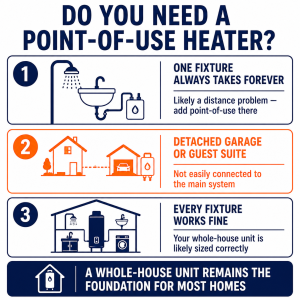
The core issue a point-of-use heater solves is straightforward physics: hot water has to physically travel through the pipe from the whole-house unit to the fixture before it arrives, and the water already sitting in that pipe has to be pushed out first. The farther a fixture sits from the whole-house unit, the more pipe length that water has to travel, and the longer the wait before anything warm actually reaches the faucet or showerhead.
This isn’t just an inconvenience — it’s a genuine waste of both water and time. Every gallon that runs down the drain while waiting for hot water to arrive is water paid for and never actually used for its intended purpose, and that waste compounds every single time that fixture is used. In a home with a single distant bathroom, that might mean a routine daily annoyance; across a household over months and years, it adds up to a meaningful amount of wasted water.
This problem is especially common in larger homes, homes with additions built onto the original structure, or homes with unusual layouts where the water heater’s location wasn’t planned around every fixture’s eventual distance from it. A single-story ranch with the water heater at one end and a primary bathroom at the other, or a two-story addition tacked onto an older home, are both classic setups where one or two fixtures end up meaningfully farther from the unit than the rest of the house.
The most common and most practical use case for a point-of-use heater is as a targeted fix layered on top of an already-working whole-house system, not a replacement for it. Distant bathrooms or kitchens that sit far from the main unit are the classic example — if one specific room consistently takes far longer than every other fixture in the house to deliver hot water, that’s usually a strong signal a point-of-use unit at that location would solve the problem directly.
Detached spaces are another strong fit: a garage workshop, a pool house, a detached guest suite, or any structure not easily or affordably connected back to the main home’s plumbing system. Running a full hot water supply line from the main house out to a detached structure can involve significant trenching, insulation, and cost — installing a small point-of-use unit directly in that space is often far more practical and considerably cheaper.
Point-of-use units also make sense in situations where a full re-pipe to physically shorten the distance between a problem fixture and the main unit simply isn’t practical or affordable — for instance, in a home where the water heater’s location is fixed by the structure’s design and moving it, or rerouting supply lines, would mean a disruptive and expensive renovation. In these cases, treating the symptom directly at the fixture is the more sensible fix than restructuring the whole home’s plumbing to treat the underlying distance issue.
There’s a narrower scenario where point-of-use units alone, without any central whole-house unit at all, could theoretically cover a home’s entire hot water needs. Very small homes, apartments, or tiny houses with minimal overall hot water demand and only a few fixtures are the main candidates — in these compact living situations, the total demand across the whole space may be low enough that individual point-of-use units at each fixture, taken together, cover what’s actually needed without requiring a dedicated central unit.
This is a legitimate approach in the right circumstances, but it’s a meaningfully more specialized one than using point-of-use as a supplement. It requires deliberately planning multiple units across a small number of fixtures rather than installing one unit to solve one specific problem, and it works best when the overall footprint and fixture count are genuinely limited to begin with.
Adding a point-of-use unit as a supplement to an existing whole-house system is a relatively modest added cost compared to the alternative of re-piping the home to shorten the distance to a problem fixture, or upsizing the whole-house unit in an attempt to compensate for travel distance — which, notably, wouldn’t even fully solve a distance-based wait time problem, since a bigger tank doesn’t make water travel through the existing pipe any faster. Point-of-use units, particularly compact tank-style models, generally fall in a lower price tier ($ to $$) than a full whole-house replacement or a re-piping project.
Whole-house units carry the larger upfront cost of the two setups, since they need to be sized to serve the entire home’s baseline demand rather than a single fixture — typically landing in the $$ to $$$ tier depending on tank versus tankless configuration and installation complexity. That cost reflects the unit covering every fixture in the home, not just one, which is the fundamental trade-off compared to a point-of-use unit’s narrower but cheaper scope.
Framed this way, the cost comparison isn’t really point-of-use versus whole-house as competing purchases — it’s the modest added cost of a point-of-use unit at one problem fixture, weighed against the larger cost of re-piping or upsizing to solve the same problem through the whole-house system instead. In most cases, the point-of-use addition is the more cost-effective fix for a distance-specific problem.
Nearly every home benefits from a whole-house water heater as the foundation of its hot water system — it’s the proven, standard setup for a reason, and correctly sized, it serves the entire household’s needs without requiring separate equipment at every fixture. Start there if you don’t already have a whole-house unit in place, and use our water heater sizing guide to make sure whatever unit you choose is sized appropriately for your household’s actual demand.
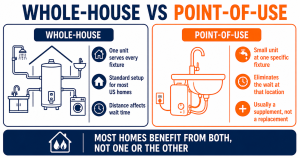
From there, add a point-of-use unit specifically at any fixture with a persistent, specific wait-time problem — a distant bathroom, a detached workshop sink, a guest suite that isn’t easily tied into the main plumbing. This targeted approach solves the actual problem without the cost or disruption of restructuring the whole home’s plumbing layout.
Reserve point-of-use-only setups, with no central unit at all, for very small or unconventional spaces — a tiny house, a small apartment, or a similarly compact living situation where overall demand and fixture count are genuinely limited. For the typical single-family home, this remains the exception rather than the rule.
If you’re weighing a point-of-use install for a distant fixture or a detached space, or want help sizing a whole-house replacement, search PlumberArchive.com — the US plumber directory with 12,000+ verified local plumbers across all 50 states.
Get weekly plumbing tips and DIY guides delivered straight to your Facebook feed.
Yes — this is actually the most common way point-of-use units are used. They install as a targeted addition at a specific fixture, working independently of the whole-house system rather than replacing or interfering with it. The whole-house unit continues serving the rest of the home exactly as before, while the point-of-use unit handles just the one problem fixture.
It depends on the specific unit and configuration, but point-of-use heaters are sized for a single fixture’s demand rather than whole-household use — generally enough for one sink, or in some tankless configurations, enough for a single shower. They aren’t designed or intended to supply multiple fixtures simultaneously the way a whole-house unit is, since that’s outside their intended scope.
Not necessarily — point-of-use describes where and how a unit is installed (at a single fixture), while tankless describes how it heats water (on-demand rather than from a stored tank). Point-of-use units come in both small tank and tankless configurations. Our tankless vs tank water heater comparison covers that separate question of tank style, which applies to both whole-house and point-of-use units and is a different decision from the placement question covered in this article.
It depends on the installation and your comfort level with basic plumbing and electrical work. A point-of-use unit is generally simpler to install than a whole-house system, since it only needs a cold water supply connection and a nearby power source rather than integration with the home’s full plumbing and venting. That said, any project involving both water lines and electrical connections carries real risk if done incorrectly, so many homeowners still prefer a licensed plumber for the installation, particularly for anything involving permanent electrical wiring rather than a simple plug-in unit.
For nearly every US home, a whole-house water heater remains the correct foundation, and the real decision isn’t whether to replace it with point-of-use units — it’s whether one specific fixture’s persistent wait-time problem is worth solving with a targeted point-of-use addition. If a distant bathroom or a detached workshop sink never seems to get hot water quickly, a point-of-use unit installed right there solves it directly, at a fraction of the cost and disruption of re-piping or upsizing the whole-house system. Reserve point-of-use-only setups for genuinely small or unconventional living spaces, and lean on a properly sized whole-house unit for everything else.
Prices and ratings may change. Always check Amazon for current prices.
✍️ About This Comparison
Written by Sarah Mitchell, Home Improvement Editor at PlumbingToolsReview — specializing in helping homeowners make smart buying decisions without overspending. Learn how we test →
Utility pump vs sump pump: one is portable for occasional jobs, the other a permanent install for ongoing water. See which your basement needs.
Pipe repair clamp, tape, or epoxy — which should you use for a leaking pipe? Compare how each works, durability, and when to reach for which.
Not sure if your home has a septic tank or a sewer connection? Learn how to tell which one you have, plus the maintenance and cost differences.

