Please note: Information in this comparison is based on our research at time of writing and is subject to change. This guide is not a substitute for a professional plumbing assessment — if you have specific concerns about your home’s drain pipe condition, confirm them with a licensed plumber.
Introduction
Cast iron vs PVC drain pipe isn’t really a “which should I buy” decision the way most plumbing comparisons are. PVC is the near-universal choice for new drain, waste, and vent (DWV) installation in US homes today, so if you’re weighing these two materials, odds are you’re not shopping for a new install — you’re trying to figure out what’s already running through your home’s walls and floors, and whether it’s something to be concerned about.
That’s the framing this comparison uses. We’ll cover how to tell which material you actually have, why cast iron was once the standard and how it ages over decades, why PVC became the common replacement, a practical noise difference between the two that surprises a lot of homeowners, and the signs that suggest aging cast iron may need a closer look. This is a distinct comparison from supply-line materials — if you’re trying to identify or evaluate the pipes bringing fresh water into your home rather than carrying wastewater away, our copper vs galvanized steel pipe comparison covers that supply-line equivalent decision separately.
At a Glance
Cast Iron Drain Pipe
- Heavy and genuinely durable when well-maintained
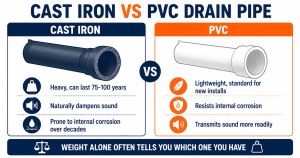
- Long lifespan — some installations last 75–100 years
- Naturally quieter due to mass dampening sound
- Prone to internal corrosion and scale buildup over decades
- Rarely installed new today
PVC Drain Pipe
- Lightweight and easy to handle
- Standard for new DWV installation today
- Resists internal corrosion
- More affordable material and labor cost
- Noisier — sound transmission is a common complaint without added insulation
✏️ Our Take
Cast iron drain pipe has a genuinely impressive track record — some installations have lasted 75 to 100 years — which is exactly why so many older US homes still have it in place today. The concern isn’t that cast iron is a bad material, it’s that it does eventually corrode from the inside, and that process is invisible until it causes a real problem like a slow leak or a full blockage from accumulated scale. PVC became the standard replacement not because cast iron failed as a concept, but because PVC resists that internal corrosion entirely while costing considerably less to install. If your home still has cast iron drain lines, the practical question isn’t really “which is better” — it’s whether your specific pipes are still in good condition.
Quick Comparison Table
The table below summarizes how cast iron and PVC compare across the factors that actually matter to a homeowner deciding whether — or when — to be concerned about existing cast iron drain pipe.
| Factor |
Winner |
| Resistance to internal corrosion |
PVC |
| Lower material and labor cost |
PVC |
| Sound dampening / quieter drainage |
CAST IRON |
| Still commonly used in new installations |
PVC |
| Proven long-term track record when well-maintained |
CAST IRON |
| Ease and speed of installation |
PVC |
How to Identify Which Pipe Material You Have
Before worrying about corrosion, noise, or replacement cost, it helps to simply confirm what material is actually running through your home’s drain, waste, and vent system. The two are usually easy to tell apart once you know what to look for. Cast iron drain pipe is dark gray to black, has a distinctly heavy, dense feel, and typically connects using either a hub-and-spigot joint (a flared end that the next section’s straight end fits into, sealed with lead and oakum on older installations) or a no-hub coupling — a stainless steel band clamped around a rubber sleeve joining two pipe ends.
PVC drain pipe, by contrast, is lightweight white or off-white plastic, with a smooth, uniform surface and solvent-welded joints where sections are glued together rather than clamped or sealed with packing material. Weight and color together are usually enough to tell the two apart at a glance, but a simple tap test is worth doing too: rap the pipe gently with a knuckle or a tool handle. Cast iron responds with a solid, dull thud, while PVC sounds noticeably hollow and lighter — a quick, reliable confirmation even on painted-over pipe where color is harder to judge.
If you want a more complete walkthrough — including how to identify PEX, copper, and galvanized steel supply pipe alongside these two drain materials — our guide to identifying your pipe material covers all of them in more detail, including where in a typical home to look first.
💡 Tip: If you can access exposed drain pipe in a basement or crawlspace, weight alone is often the fastest indicator — cast iron pipe is dramatically heavier than PVC of the same diameter, noticeable even without tools.
Why Cast Iron Was Once the Standard
Cast iron was the standard drain, waste, and vent material for much of the 20th century in US homes, and builders had good reason to rely on it. Its sheer mass made it exceptionally durable against physical damage, resistant to the kind of cracking or impact failure that lighter materials can suffer, and it held up well to the constant presence of wastewater without degrading structurally over a long service life.
That same mass also gave cast iron a practical advantage that had nothing to do with durability: it dampens sound remarkably well. Water and waste moving through a heavy iron pipe simply doesn’t transmit noise into the surrounding structure the way a lighter material does, which mattered in an era when DWV piping was frequently routed close to living spaces without much thought given to acoustic insulation.
Cast iron remained the dominant DWV choice in US residential construction well into the mid-20th century, and it’s common in homes built before PVC became widely adopted for drain, waste, and vent systems starting roughly in the 1970s and 1980s, with the exact transition point varying by region and local plumbing codes at the time.
How Cast Iron Drain Pipe Ages Over Time
Cast iron’s long-term vulnerability is on the inside, in a process that’s invisible from outside the pipe for decades. Wastewater moving through the pipe gradually corrodes the interior surface, and that corrosion doesn’t wash away cleanly — it builds up as scale, a rough, mineral-and-rust deposit that clings to the pipe wall and slowly narrows the interior diameter available for water and waste to pass through.
As scale accumulates over years and decades, the interior surface becomes progressively rougher, which creates more opportunities for debris, grease, and solid waste to catch and accumulate rather than flushing through cleanly. This is a meaningfully different failure mode than a single blockage — it’s a gradual narrowing that makes the entire length of affected pipe more prone to clogs over time, even with normal household use that wouldn’t trouble a smooth-walled pipe.
In more severe cases, the corrosion process can progress beyond scale buildup into actual material loss, where the pipe wall itself thins to the point of developing pinhole leaks, or in worse cases, larger failures. This tends to happen first and most severely at joints, where the original sealing material — lead and oakum in older hub-and-spigot installations — has had the most opportunity to degrade over a multi-decade service life. None of this happens overnight, and a well-maintained cast iron system can genuinely last a century, but the underlying aging process is a real, ongoing consideration for any home that still has it.
Why PVC Became the Common Replacement
PVC became the standard choice for new DWV installation and cast iron replacement starting several decades ago, and the reasoning comes down almost entirely to how it compares to cast iron over a long service life. PVC resists the internal corrosion process that eventually affects cast iron — it doesn’t rust, and it doesn’t develop the scale buildup that comes from decades of mineral and rust deposits clinging to a corroding metal surface.
That corrosion resistance translates directly into a smoother, more consistent interior surface over the pipe’s lifetime. Waste and debris move through PVC without the rough, scale-lined surface that makes an aging cast iron pipe increasingly prone to trapping material and clogging. For homeowners, that means fewer of the slow, recurring drainage problems that gradually worsening cast iron scale tends to produce.
PVC also has a significant practical advantage that has nothing to do with corrosion: it’s dramatically lighter and easier to work with than cast iron. Sections can be cut, fitted, and solvent-welded by a single plumber without the specialized tools and physical effort that hub-and-spigot or no-hub cast iron installation requires, which translates directly into lower labor cost for both new installation and replacement work. That combination of corrosion resistance and lower installed cost is why PVC has been the default DWV material in US new construction for decades now.
Noise Differences — A Real Practical Factor
One tradeoff of switching from cast iron to PVC surprises a lot of homeowners after the fact: noise. Cast iron’s mass naturally dampens the sound of water and waste moving through the pipe, so a cast iron drain line running near a living space or bedroom is typically close to silent during normal use. PVC doesn’t have that same mass to work with, and it transmits the sound of moving water considerably more readily through its thinner, lighter walls.
This isn’t a minor or hypothetical concern — it’s a common and legitimate complaint in homes where cast iron drain lines have been replaced with bare PVC, particularly in multi-story homes where a second-floor bathroom drains down through walls near a bedroom or living room below. The sound of a toilet flushing or a shower draining can become noticeably more audible than it was with the original cast iron in place, especially in the first weeks after a replacement when homeowners aren’t yet used to it.
The good news is that this is a solvable problem, not an inherent flaw in choosing PVC. Sound-insulating pipe wrap or a properly built acoustic enclosure around PVC drain lines in noise-sensitive locations can substantially reduce the sound transmission, bringing the practical noise level much closer to what cast iron originally provided. The key is addressing it during installation or replacement, since retrofitting sound insulation after the fact — once the pipe is already closed up behind a wall or ceiling — is considerably more disruptive than doing it while the wall is already open.
⚠️ Warning: If you’re replacing cast iron with PVC in a section near a bedroom or living space, ask your plumber about acoustic pipe insulation — it’s a relatively small added cost that addresses the most common complaint homeowners have after switching from cast iron to PVC.
Signs Your Cast Iron Pipes May Need Attention
Because cast iron corrodes gradually from the inside, the signs it may need attention tend to build slowly rather than appear all at once. Recurring or difficult-to-clear clogs, especially in the same drain line despite normal household use, are one of the more common indicators — that pattern is consistent with scale buildup narrowing the pipe and roughening its interior surface rather than a single isolated blockage. If you’re dealing with clogs that keep coming back no matter how often you clear them, our drain snake reviews can help you clear the immediate clog, though a recurring pattern is worth flagging to a plumber as a possible sign of aging pipe underneath.
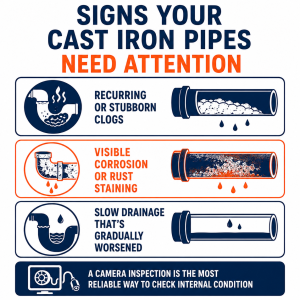
Visible corrosion, rust staining, or flaking at any exposed sections of cast iron pipe — in a basement, crawlspace, or utility area — is a more direct physical sign, particularly around joints where deterioration tends to show up first. Slow drainage that has gradually worsened over months or years, rather than changing suddenly, is another pattern consistent with internal scale buildup narrowing the pipe over time. Any visible moisture, staining, or discoloration on ceilings or walls near where drain lines run is a sign worth taking seriously and having evaluated promptly, since it can indicate a joint or section that has already begun leaking.
Cast iron drain pipe remains common in older housing stock across much of the US, particularly in homes built before the 1970s to 1980s depending on region and local building codes at the time, so the age of a home is a useful general risk indicator even without other symptoms present yet. None of these signs on their own confirm exactly how severe the situation is — a camera inspection by a licensed plumber is the most reliable way to assess the interior condition of cast iron drain lines, since exterior appearance alone often doesn’t reflect how much internal corrosion has actually occurred.
Frequently Asked Questions
Q: How long does cast iron drain pipe typically last?
Well-maintained cast iron drain pipe can genuinely last 75 to 100 years in some cases, which is part of why it’s still common in older US homes. That said, actual lifespan varies considerably based on water chemistry, how the pipe was originally installed, and how much internal corrosion has accumulated over time — it isn’t a fixed number, and the only reliable way to know the condition of a specific home’s pipes is a professional inspection rather than an age-based estimate.
Q: Is it necessary to replace all cast iron pipe at once, or can it be done in sections?
In most cases, replacement can be done in sections rather than all at once. A plumber can prioritize the sections showing the clearest signs of trouble — recurring clogs, visible corrosion, or a confirmed leak — while leaving sections that are still in good condition undisturbed. This phased approach spreads out both the cost and the disruption compared to a full system replacement, and it’s the more common approach for homeowners addressing aging cast iron gradually rather than all at once.
Q: Can PVC be connected directly to existing cast iron pipe?
Yes, cast iron and PVC can be connected using a no-hub coupling — a rubber sleeve with a stainless steel band clamped around it, which is a standard fitting specifically designed to join dissimilar drain pipe materials. This is exactly how most partial or phased cast-iron-to-PVC replacements are done in practice, allowing a plumber to swap out a problem section without having to replace an entire run back to its original cast iron connection point.
Q: Does cast iron drain pipe affect home insurance or resale value?
It can factor into both, though the effect isn’t uniform and depends heavily on the specific insurer, local market, and the actual condition of the pipe. Some insurers may ask about plumbing age or material during underwriting, and some buyers or inspectors may flag older cast iron as a point worth investigating further during a home purchase. A documented professional inspection confirming the pipe’s actual condition is generally more useful in either situation than the pipe’s age or material alone, since it replaces uncertainty with an actual assessment.
Conclusion
Cast iron drain pipe remains common in older housing stock across much of the US, and its long track record — sometimes 75 to 100 years — means plenty of homes still have it in perfectly serviceable condition. The material itself isn’t the concern; the gradual, invisible internal corrosion process is, which is why age alone shouldn’t be treated as a verdict on your specific pipes.
PVC has become the standard replacement because it resists that corrosion entirely and costs meaningfully less to install, though it comes with a real tradeoff in sound transmission that’s worth planning for with acoustic insulation near living spaces. If you decide to replace a section with PVC yourself, our guide to cutting PVC pipe straight and clean covers the technique. If your home shows signs like recurring clogs, visible corrosion, or gradually worsening drainage, the right next step is a professional camera inspection — not an assumption in either direction about what’s actually happening inside your pipes.
Prices and ratings may change. Always check Amazon for current prices.
✍️ About This Comparison
PTR Editorial Team — Product Comparisons. We compare manufacturer specifications, installation requirements, compatibility and available product documentation to help homeowners choose suitable tools and parts. How we review →