Please note: Information in this comparison is based on our research at time of writing and is subject to change. If a clog doesn’t respond to either tool, or you suspect a deeper drain line issue, consult a licensed plumber rather than continuing to force it.
Introduction
Nearly every clogged toilet starts with the same question: reach for the plunger, or go straight to a toilet auger? It seems like a small decision, but picking the wrong tool first can waste ten minutes on a clog that was never going to respond to plunging, or in rarer cases, make the clog genuinely worse.
This comparison breaks down exactly when each tool is the right call, why the order you try them in matters, and how to tell early on which one you actually need. If you want a vetted tool to reach for, our toilet augers review covers our top picks, and if you’re dealing with a clog and don’t have a plunger on hand at all, our guide to unclogging a toilet without a plunger covers other options.
✏️ Our Take
A plunger should almost always be your first attempt at a clogged toilet — it’s faster, requires no special tool beyond one you likely already own, and resolves the majority of everyday clogs caused by waste and toilet paper. A toilet auger becomes necessary when a plunger can’t generate enough force to clear the blockage, or when the clog is caused by something a plunger physically can’t move, like a solid object lodged further down the trap. The real skill isn’t choosing between them in the abstract — it’s knowing when to stop plunging and switch to an auger, since repeatedly plunging an auger-level clog just wastes time and can occasionally worsen the situation by pushing material further into the trap.
How a Plunger Clears a Clog
A plunger clears a clog by creating a seal over the drain opening and using water pressure — generated through repeated pushing and pulling — to physically dislodge whatever’s blocking the trap. The pushing stroke forces water and pressure down into the clog, while the pulling stroke helps break the clog apart by pulling it back toward the bowl.
A flange plunger, which has an extended rubber flap folded out from the base of the cup, creates a significantly better seal in a toilet bowl than a standard cup plunger, which is designed for the flat surface of a sink or tub drain. That better seal is what actually generates clearing pressure, which is why the flange design matters far more than most people realize. Plungers work best on soft, water-permeable clogs — waste and toilet paper buildup — which accounts for the overwhelming majority of everyday toilet clogs.
Technique matters almost as much as the tool itself. Submerge the plunger fully before you start, since plunging with air trapped in the cup wastes the first several strokes on compressing air instead of driving water pressure into the clog. Push down slowly to force the seal into place, then pull up sharply — the upward pull is often what actually breaks a clog loose, since it creates suction that drags material back toward the bowl rather than just pushing it deeper. A steady rhythm of full strokes outperforms fast, shallow jabs almost every time.
💡 Tip: Always use a flange plunger, not a standard cup plunger, for toilet clogs — the extended flap seals into the toilet’s curved drain opening far more effectively, and a proper seal is what actually generates clearing pressure.
How a Toilet Auger Clears a Clog
A toilet auger works completely differently — instead of generating pressure, it’s a flexible cable with a curved end that feeds directly into the toilet trap, physically breaking up the clog or hooking onto it so it can be pulled back out or pushed on through. Turning the crank handle advances the cable further into the trap while helping it work through whatever’s blocking the passage.
A toilet auger is specifically built with a protective coating or curved plastic housing designed to avoid scratching the toilet’s porcelain bowl as the cable passes through it, unlike a standard drain snake, which has no such protection. Because it physically reaches into and through the trap rather than relying on water pressure, an auger can clear clogs located further into the trap and beyond it that a plunger’s pressure simply can’t reach.
Most residential toilet augers use a hand-crank drum design, where the cable retracts into a small drum housing between uses — compact, inexpensive, and sufficient for the overwhelming majority of household clogs. The crank turns a gear that both advances and rotates the cable simultaneously, which is what lets it work through a clog rather than just pushing blindly against it. A small number of tougher, recurring clogs may call for a motorized version, but that’s rarely necessary for a typical residential bathroom.
💡 Tip: Never use a standard drain snake in a toilet in place of a toilet auger — a regular drain snake lacks the protective coating and can scratch or crack porcelain, which a toilet-specific auger is designed to avoid.
When a Plunger Is Enough
A plunger is the right tool when the clog is recent and caused by normal use — waste, or a reasonable amount of toilet paper, rather than anything unusual flushed by accident. Another good sign is a water level that’s rising but not overflowing, with no indication that a foreign object caused the blockage. Together, this covers the substantial majority of everyday toilet clogs, which is exactly why a plunger should almost always be the first thing you reach for.
Pay attention to how the water responds as you plunge, since it tells you whether you’re making progress even before the clog fully clears. Water level dropping steadily with each stroke, or air bubbles gurgling back up through the bowl, are both signs the seal is working and the blockage is starting to move. If the water level hasn’t budged at all after a genuine effort, that’s useful information heading into the next section rather than a reason to simply keep plunging harder.
💡 Tip: Give a plunger 15-20 firm plunges before concluding it isn’t working — many people give up too early after just a few attempts, when persistence with proper technique often succeeds.
When You Need a Toilet Auger Instead
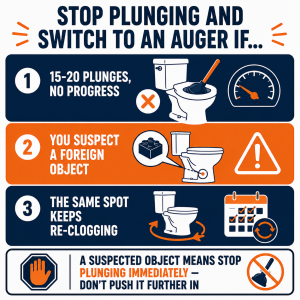
A toilet auger becomes the right call once repeated plunging — 15-20 or more firm attempts with a proper seal — hasn’t made any real progress. It’s also the better choice when you suspect a foreign object caused the clog, such as a toy, an excessive amount of paper product, or anything else that shouldn’t have been flushed in the first place. A clog that recurs repeatedly at the exact same location, even after you’ve successfully cleared it with a plunger each time, is another strong sign that an auger is what you actually need, since it points to something lodged in the trap rather than a fresh, soft clog.
A complete lack of water movement is also worth noting on its own. If plunging produces no change whatsoever in water level — not even a slight drop or a gurgle — rather than slow, partial progress, that’s a stronger signal of a solid obstruction than a soft clog that’s simply resistant. Soft clogs almost always show at least some incremental response to plunging, while a solid object tends to block flow completely regardless of how much pressure you generate. For a closer look at how an auger stacks up against a standard drain snake for tougher jobs, see our toilet auger vs drain snake comparison.
⚠️ Warning: If you suspect a solid foreign object caused the clog, stop plunging immediately — repeated plunging can push a solid object further into the trap or even past it into the branch drain line, turning an auger-level fix into a toilet removal job.
Risk of Damage — What Each Tool Can and Can’t Safely Do
A plunger carries very low risk of damage to the toilet itself when used correctly with a proper seal — there’s essentially nothing rigid or sharp coming into contact with the porcelain. A toilet auger also carries low risk when used gently and correctly, but excessive force can potentially scratch porcelain or damage older, more fragile toilet bowls, particularly on vintage fixtures with thinner glazing. Neither tool poses meaningful risk to your home’s plumbing when used as intended — the real risk mainly comes from using the wrong tool entirely, like a standard drain snake in place of a toilet auger, or simply applying excessive force with either tool.
Older toilets manufactured before the 1994 federal low-flow standard (which mandated 1.6 gallons per flush or less) tend to clog less often thanks to their higher flush volume, but homes that have upgraded to modern low-flow or dual-flush toilets — now standard in most new construction and renovations across the US — see more frequent minor clogs simply due to reduced flush power. This doesn’t mean low-flow toilets are worse, but homeowners who’ve recently upgraded should expect to reach for a plunger somewhat more often than they did with an older high-flow model.
💡 Tip: If your home has an older toilet with a known fragile bowl (particularly common in vintage or antique fixtures), advance a toilet auger slowly and stop at the first sign of resistance rather than pushing through it.
Cost and Convenience
A plunger sits at the lowest cost tier ($) of any toilet-clearing tool, and most households already own one, which makes it the obvious first attempt regardless of the clog. A toilet auger costs modestly more ($) for a dedicated tool, but it’s a worthwhile investment for any household that deals with clogs more than just occasionally, since it handles the entire category of clogs a plunger physically can’t touch.
Convenience follows a similar pattern. A plunger requires zero setup or technique beyond what most people already know intuitively, and cleanup is as simple as rinsing it off and setting it back in its holder. A toilet auger takes a little more effort to use correctly the first time — feeding the cable in, cranking steadily, and retracting it without splashing — but that learning curve is minor and typically only needs to happen once before it becomes second nature.
💡 Tip: A toilet auger pays for itself quickly if you experience even two or three clogs a year that a plunger can’t handle — compared to the cost and wait time of a plumber visit for what’s usually a five-minute DIY fix with the right tool.
Which Should You Choose?
The table below maps the most common decision factors to whichever tool actually wins on that point.
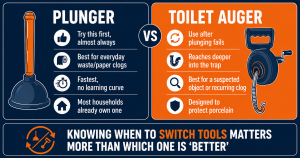
| Factor |
Winner |
| Lowest cost, most households already own it |
PLUNGER |
| Reaches deeper into the trap |
TOILET AUGER |
| Best for everyday waste/paper clogs |
PLUNGER |
| Best for a suspected foreign object |
TOILET AUGER |
| Fastest for a simple, recent clog |
PLUNGER |
| Best for a recurring clog at the same spot |
TOILET AUGER |
| Simplest technique, no learning curve |
PLUNGER |
| Designed specifically to protect porcelain |
TOILET AUGER |
Choose a Plunger If:
- The clog is recent and likely caused by normal use
- You want to try the simplest, fastest option first
If this describes your situation, our guide to unclogging a toilet without a plunger is a useful backup if you don’t have one on hand at all.
Choose a Toilet Auger If:
- Repeated plunging hasn’t cleared the clog
- You suspect a foreign object or a recurring clog at the same location
If this describes your situation, our toilet augers review covers vetted models worth adding to your toolkit.
Need a Professional Plumber?
If neither a plunger nor a toilet auger clears the clog, or the same drain keeps backing up, the problem is likely further down the line than either tool can reach.
Find a licensed plumber in your area at PlumberArchive.com — the US plumber directory with 12,000+ verified local plumbers across all 50 states.
Find a trusted plumber near you → PlumberArchive.com
Frequently Asked Questions
Q: Should I always try a plunger before using a toilet auger?
In almost every case, yes. A plunger is faster, requires no special tool most households don’t already own, and resolves the majority of everyday clogs. The one exception is if you already strongly suspect a foreign object caused the clog — in that case, skip straight to a toilet auger, since repeated plunging can push a solid object further into the trap.
Q: Can a toilet auger damage my toilet?
Used correctly and gently, the risk is low. A toilet auger is specifically designed with a protective coating or curved housing to avoid scratching porcelain, unlike a standard drain snake. The main risk comes from applying excessive force, particularly on older or more fragile toilet bowls, so advance the cable slowly and stop at the first sign of real resistance rather than pushing through it.
Q: How many times should I plunge before switching to an auger?
Give it 15-20 firm plunges with a proper seal before concluding a plunger isn’t going to work. Many people give up too early after just a few attempts, when persistence with correct technique often succeeds. If you’ve genuinely made that many attempts without any progress, that’s your signal to switch to a toilet auger rather than continuing to plunge.
Q: Can I use a regular drain snake instead of a toilet auger?
We don’t recommend it. A standard drain snake lacks the protective coating or curved housing a toilet auger has specifically to avoid scratching or cracking porcelain. It’s built for metal or PVC pipe, not the delicate glazed surface of a toilet bowl, so the modest extra cost of a dedicated toilet auger is worth it to protect the fixture.
Conclusion
A plunger should be your first attempt for nearly every toilet clog, given how fast and simple it is compared to any other option. A toilet auger becomes necessary once a plunger has genuinely failed after a reasonable number of attempts, or when you suspect a foreign object or a recurring clog at the same location.
Knowing when to switch tools matters more than which one is objectively “better” — they’re built for different jobs, and using them in the right order is what actually gets your toilet working again quickly. For a deeper dive into toilet augers specifically versus a standard drain snake, our toilet auger vs drain snake comparison covers that decision. If you need a vetted auger for your toolkit, see our toilet augers review, and if you’re dealing with a clog right now without a plunger on hand, our guide to unclogging a toilet without a plunger covers other options that work in a pinch.
✍️ About This Comparison
PTR Editorial Team — Product Comparisons. We compare manufacturer specifications, installation requirements, compatibility and available product documentation to help homeowners choose suitable tools and parts. How we review →