
Guides
19 Oct 2026

Can’t Reach the Faucet Nut? Choose the Right Tool Before You Buy
Not sure which tool fits your faucet nut? Identify the fixing, see how it lets go and check your clearance first. Then choose a tool, or use one you own.
How to unclog a basement floor drain — step-by-step guide covering shop vacs, drain snakes, and spotting a main sewer line problem.

Please note: Information in this guide is subject to change. If you suspect a main sewer line problem or notice any sewage backup, stop troubleshooting and consult a licensed plumber.
A clogged basement floor drain is a genuinely different problem from a clogged sink, shower, or toilet, even though the symptom — water that won’t drain — looks similar. A floor drain sits at the lowest point in your home’s plumbing system, so it’s often the first fixture to show a problem developing much further down the line, closer to the main sewer connection. It’s also used far less often than a sink or shower, so debris that would normally flush through can sit undisturbed for months.
This guide covers the full troubleshooting process, from the simplest methods up to a proper drain snake, and just as importantly, how to recognize the warning signs of a main sewer line issue rather than a simple local clog. For a slow drain elsewhere in the house, our guide to unclogging a drain without chemicals covers sinks and showers, and our drain snakes review compares models with the longer cable floor drains require.
At a Glance
| Difficulty | Moderate |
| Time | 30–90 Minutes (varies significantly by clog severity) |
| Cost | $ — a drain snake if you don’t already own one; most other steps use tools you likely have |
| Tools Needed | Drain snake (25+ ft for floor drains, longer than sink augers), rubber gloves, flashlight, wet/dry shop vacuum (optional but helpful), bucket, old towels |
| Skill Level | Intermediate |
✏️ Our Take
A basement floor drain clog is genuinely different from a sink or shower clog, and treating it the same way is the most common mistake homeowners make. Because a floor drain sits at the lowest point in your home’s plumbing system and often connects closer to the main sewer line, a slow-draining or backed-up floor drain can be an early warning sign of a much bigger problem further down the line — not just a local clog. Start with the simplest explanation first, but don’t assume it’s a minor issue if basic clearing methods don’t work quickly, since a floor drain that won’t clear at all is one of the clearest signs of a main sewer line problem that needs professional attention.
IN THIS GUIDE
Floor drains sit at the lowest point in a home’s entire plumbing layout, below every sink, shower, and toilet in the house. Wastewater from every fixture flows past that same low point on its way to the main sewer line, so a floor drain is often the very first place a downstream problem becomes visible — before it ever shows up as a slow sink or a gurgling toilet.
Floor drains are also used far less frequently than a kitchen sink or a daily shower, which creates two problems. First, the P-trap beneath the drain — the curved section holding a small water reservoir that blocks sewer gas — can dry out from evaporation if weeks pass without use, letting sewer gas smell into the room with no clog at all. Second, whatever debris makes it in has nothing regularly pushing it through. Unless tied to a sump discharge or washing machine standpipe, gravity and the occasional splash are usually the only things moving debris along — infrequent use, no active flow, and a direct line to your sewer’s lowest point, exactly why these clogs behave differently.
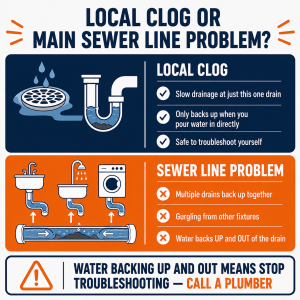
Before clearing anything, take a few minutes to figure out which problem you’re dealing with, since the right response differs completely. A simple, local clog usually shows up as slow drainage limited to that one drain — pour a bucket of water directly in and it pools or drains slowly, but every other fixture works normally. That’s the problem this guide’s process is built to solve.
A main sewer line problem looks different. Watch for multiple drains backing up around the same time — the floor drain acting up alongside a nearby toilet or laundry sink — or gurgling from other fixtures specifically when the floor drain is used, which is air being pushed back through the system by a blockage further down the shared line. The most serious sign is water or sewage rising out of the floor drain when you run water elsewhere, since that water has nowhere else to go and is finding the lowest exit point available. This distinction matters: a local clog is a reasonable DIY project, while a main line issue usually needs professional-grade equipment with a much longer cable than a household snake.
Gather these items before you start, since floor drain work tends to be messier than a sink clog:
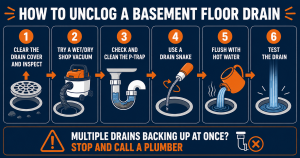
Step 1 — Clear the Drain Cover and Inspect
Remove the drain’s grate or cover — it either lifts straight out or requires unscrewing a couple of fasteners around the rim. Use your flashlight to look into the opening for anything visible near the surface: hair, lint, or sediment buildup. Clear anything you can reach by hand, wearing gloves, before moving on. A floor drain clog is often just surface-level buildup, cleared in under a minute once you can see what’s there.
If inspection didn’t turn up an obvious clog, a wet/dry shop vacuum is worth trying before reaching for a drain snake. Set it to wet mode — confirm it’s rated for liquids first — and press the nozzle tightly against the opening to create close to a full seal. Run it for 30 to 60 seconds. This step is optional, but it’s genuinely effective at pulling out lighter debris and hair clogs near the opening, and faster than snaking when it works.
Many basement floor drains have an accessible trap or threaded cleanout cap near the drain body — look for a round plug, often a different color or material than the surrounding pipe. If you find one, remove it carefully with your bucket underneath first, since standing water will drain out the moment you break the seal. Inspect inside with your flashlight, since this is often where debris settles, and clean out anything you find before threading the cap back on securely.
If earlier steps haven’t cleared the drain, feed the snake’s cable into the opening (or the cleanout, if you have one), turning the crank clockwise as you advance it. When you feel resistance — typically the clog — continue turning while applying gentle, steady forward pressure to break through or hook onto it. Slowly retract the snake once resistance breaks; the clogged material often comes out attached to the cable, the clearest sign you’ve cleared it rather than pushed it further along.
Homes across the Midwest and Northeast with older clay or cast iron sewer lines are significantly more prone to floor drain backups than homes with modern PVC sewer lines, since aging clay pipe is vulnerable to root intrusion from nearby trees and cast iron gradually corrodes and narrows internally over decades, both of which restrict flow at exactly the lowest point in the system — the floor drain. If your home was built before 1970 and you’re experiencing repeat floor drain backups, a sewer line camera inspection is worth the cost to rule out a structural pipe issue before continuing to treat it as a simple clog.
Once you’ve retracted the snake and removed any visible clog material, flush the drain with several gallons of hot tap water, poured steadily. This clears away smaller loosened debris and doubles as an immediate test of whether the drain is flowing freely again — it should move down steadily without pooling or slowing to a trickle.
Pour a full bucket of water into the drain and time how quickly it clears — a more demanding test than the hot water flush, since the larger volume exposes a partial clog a smaller amount might miss. A properly cleared drain takes the water down steadily, without pooling or slow gurgling. If drainage is still slow after this full process, the clog may be further down the line than a standard 25-foot snake can reach, pointing toward a longer professional cable or the sewer line issues covered next.
A few situations mean it’s time for a licensed plumber: multiple fixtures backing up at once, a snake that makes no progress or consistently meets hard resistance at the same distance (often structural rather than a clearable clog), recurring clogs despite thorough clearing (usually root intrusion, a partial collapse, or persistent buildup further down the line), and any sewage smell or visible backup, both a plumbing and health concern. Our smelly drain fix guide can help narrow down whether odor is trap-related or something more serious.
Once cleared, a little ongoing attention goes a long way. If the drain is infrequently used, pour a gallon or two of water down it every few months to keep the P-trap filled and prevent both odor and long, undisturbed debris buildup. Keep the area around the drain clear of loose debris, which matters most in storage basements. If your drain handles laundry runoff, a simple strainer cover over the opening dramatically reduces lint buildup — one of the most common causes of a slow floor drain in homes with a basement laundry setup. Our drain snakes review can help you pick a model with the right cable length if you need to snake it again.
If you’re seeing signs of a sewer line problem or the same clog keeps coming back, search PlumberArchive.com — the US plumber directory with 12,000+ verified local plumbers across all 50 states.
Get weekly plumbing tips and DIY guides delivered straight to your Facebook feed.
The most common cause is a dry P-trap rather than an actual clog. Floor drains are used so infrequently that the water reservoir in the trap, which normally blocks sewer gas, can simply evaporate over weeks without use. Pouring a gallon or two of water down the drain refills the trap and typically resolves the smell within minutes. If the odor persists, our smelly drain fix guide covers other possible causes.
For a drain that sees regular use, a quick check every few months and a full cleaning once or twice a year is generally sufficient. For a rarely-used drain, the priority shifts toward keeping the trap filled — pour water down it every few months even without visible debris, since a dry trap is the more common issue.
We don’t recommend it. Chemical drain cleaners are formulated for smaller sink and shower drains, and they’re considerably less effective against the larger clogs and longer pipe runs typical of floor drains, often just sitting on top of the blockage. They also pose a safety risk if you follow up with a shop vac or drain snake afterward. The mechanical methods in this guide are safer and more effective here.
Water or sewage rising out of a floor drain, particularly as you run water elsewhere, is one of the clearest signs of a main sewer line blockage rather than a local clog. Because the floor drain sits at the lowest point in your plumbing system, it’s the path of least resistance when water further down the line has nowhere else to go. This calls for a licensed plumber rather than continued DIY troubleshooting, since the blockage is typically beyond where a household snake can reach.
A clogged basement floor drain often signals something different than a clogged sink or shower, simply because of where it sits in your home’s plumbing system. Its position at the lowest point means it’s frequently the first place a bigger, further-downstream problem becomes visible — which is why this troubleshooting process starts with the simplest local explanations but keeps a close eye on warning signs the whole way through.
Start with a visual inspection, try a shop vacuum, check any accessible trap, and move to a drain snake if needed — but don’t fall into the trap of repeatedly re-clearing the same symptom if it keeps coming back or multiple drains start acting up at once. Those are moments to call a plumber rather than reach for the snake again. Prevention is far easier than a full backup: keeping an infrequently-used drain’s trap filled and the surrounding area clear prevents most future clogs before they start.
If your slow drain is actually a sink or shower, our guide to unclogging a drain without chemicals covers those fixtures. For the right tool, our drain snakes review compares models suited to the longer cable this job requires, and if persistent odor is your main concern, our smelly drain fix guide covers that in more depth.
✍️ About This Guide
PTR Editorial Team — Plumbing Guides. We compare manufacturer specifications, installation requirements, compatibility and available product documentation to help homeowners choose suitable tools and parts. How we review →
Not sure which tool fits your faucet nut? Identify the fixing, see how it lets go and check your clearance first. Then choose a tool, or use one you own.
Check your manual and the drain route first: gravity hose, built-in pump or external pump. Then see whether you need a dehumidifier hose at all.
Explore portable bidets that need no water-line connection, from bottle caps and squeeze bottles to battery-powered handhelds.

