Please note: Information in this guide is based on our research at time of writing and is subject to change. Always consult a licensed plumber for diagnosis of serious plumbing issues before attempting repairs.
Introduction
Bathroom sink clogs are one of the most common plumbing complaints in any US home, and they’re caused by a much narrower set of culprits than a kitchen sink or shower drain clog. There’s no grease or food debris to deal with, and it isn’t shower-specific hair catchers or drain covers at play either — a slow or blocked bathroom sink almost always comes down to hair, soap scum and toothpaste residue building up on the popup stopper mechanism, or in the trap just below it.
This guide walks through the fix in order from simplest to most involved, starting with a single step that clears the majority of slow bathroom sinks in under a minute. If chemical drain cleaners are more your style for tougher buildup, our guide to the best drain unblockers covers safe options for this specific fixture, and if the clog turns out to be further down the line than the trap, our guide to the best drain snakes covers the tool built for that job.
At a Glance
| Difficulty |
Easy |
| Time |
10–20 Minutes |
| Cost |
Free — household items only |
| Tools Needed |
Old toothbrush, plunger, baking soda and vinegar (optional), drain snake or hair removal tool (optional) |
| Skill Level |
Beginner |
✏️ Our Take
Almost every bathroom sink clog is the same thing: a mat of hair, soap scum and toothpaste residue caught on the popup drain stopper or in the trap just below it. The fix takes under 10 minutes in most cases and requires nothing beyond what’s already in the bathroom — no chemicals, no special tools. Start by removing and cleaning the popup stopper before trying anything else, because that single step clears the majority of slow bathroom sinks without any further effort.
Why Bathroom Sinks Clog (It’s Almost Always the Same Thing)
A bathroom sink clog has a much shorter list of usual suspects than other drains in the house. Our guide to unclogging a kitchen sink deals with grease and food debris, and it often involves the garbage disposal — neither of which applies here. Our guide to unclogging a shower drain focuses on hair catchers and drain covers built for the shower specifically. A bathroom sink clog is its own, narrower problem: hair, soap scum and toothpaste residue, and almost nothing else.
The popup drain stopper mechanism is usually the first point of accumulation. It’s designed to sit just above the drain opening so it can be pushed down to close off the sink, and that same position means hair and soap scum catch on it before either ever reaches the pipe below. Left uncleaned long enough, that buildup becomes thick enough to slow — and eventually stop — the water passing around it.
The P-trap, the curved section of pipe directly beneath the sink, is the second most common blockage point. Anything fine enough to get past the stopper mechanism tends to settle in the trap instead, where the pipe’s curve naturally collects debris rather than letting it flow straight through.
💡 Tip: A slow bathroom sink that gets progressively worse over weeks is almost always a stopper or trap issue — a sink that suddenly blocks completely is more likely a solid object dropped down the drain.
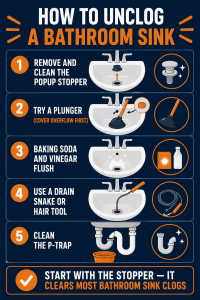
Step 1 — Remove and Clean the Popup Stopper
Most popup stoppers lift straight out of the drain opening with a firm upward pull, though some designs require a quarter turn first to release a locking tab before they’ll lift free. Try this first, since it’s the fastest way to get the stopper out for cleaning.
If the stopper won’t lift out no matter how you turn it, it’s likely connected to a pivot rod underneath the sink, which holds it in place from below. Look under the sink for a small nut where a horizontal rod meets the drain pipe, unscrew that retaining nut, and slide the pivot rod out — the stopper should then lift free from above. Once it’s out, clean the hair and soap buildup off the stopper itself and off the pivot rod mechanism with an old toothbrush, working into the grooves and the ball joint where debris tends to wrap tightest.
💡 Tip: The underside of the popup stopper and the pivot rod it sits on are where most of the hair accumulates — these are out of sight and rarely cleaned, which is exactly why they clog.
Step 2 — Try a Plunger
If cleaning the stopper didn’t fully clear the slowdown, a plunger is the next step. Cover the overflow opening on the sink basin — the small slotted hole near the top rim — with a wet cloth before plunging. Without that seal, air pressure escapes through the overflow instead of pushing down against the clog, and the plunger will seem to do nothing no matter how hard you work it.
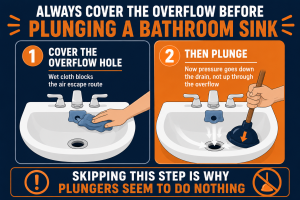
Use a standard cup plunger for this, not a flange plunger, which is shaped for toilets and won’t form a proper seal against a flat sink basin. Fill the sink with a couple of inches of water first so the plunger has something to push against, then plunge with 10–15 firm strokes, keeping the cup fully sealed against the drain opening throughout.
⚠️ Warning: Always cover the overflow opening before plunging a bathroom sink — failing to do this is the most common reason a plunger seems to have no effect at all.
Step 3 — Baking Soda and Vinegar Flush
Pour half a cup of baking soda directly into the drain, followed by half a cup of white vinegar. The mixture will foam actively as it reacts — that’s expected, and it’s the foaming action working against the soap scum and residue coating the inside of the pipe. Let it sit and work for about 10 minutes, then flush the drain with hot tap water to carry the loosened buildup through.
In hard water states like Arizona, Texas, Nevada and parts of California, soap scum combines with mineral deposits to form a harder, stickier buildup on stopper mechanisms and inside drain pipes than in soft water regions — what clears with a simple hot water flush in a soft water home may need a baking soda and vinegar soak to dissolve in a hard water area. Homeowners in these states should clean their bathroom sink stoppers monthly rather than waiting for a visible slowdown.
💡 Tip: Don’t use boiling water on bathroom sink drains — many bathroom sinks have PVC trap arms that can soften or warp with boiling water. Hot tap water is sufficient and safe.
Step 4 — Use a Drain Snake or Hair Removal Tool
A plastic hair removal tool — a thin, barbed plastic strip sold at any hardware store — is inexpensive and often pulls out a full hair clog in a single pass. Feed it down past the stopper opening, twist gently, and pull it back out slowly so the barbs catch and drag the clog with it rather than pushing it further down.
If the blockage sits further down the drain line, beyond the reach of a hair removal tool and past the P-trap, a proper drain snake is the right tool for the job. Our guide to the best drain snakes covers options sized for bathroom sink lines rather than larger main-line clogs.
💡 Tip: The plastic barbed hair removal tools cost very little and are worth keeping under every bathroom sink — they reach past the stopper mechanism and grab hair clogs that baking soda and vinegar can’t dissolve.
Step 5 — Clean the P-Trap
If the sink is still slow after the steps above, the P-trap itself — the curved pipe section directly below the sink — is the next place to check. Place a bucket underneath to catch any standing water before you start, since the trap holds whatever hasn’t drained through yet.
Unscrew the slip nuts on either end of the trap by hand — most are designed to be hand-tightened and shouldn’t need a wrench. Remove the trap, clear out any hair, debris or buildup you find inside, and rinse it thoroughly before reinstalling. Hand tight plus a quarter turn is sufficient when putting it back — overtightening can crack the plastic nuts on many trap assemblies. Our guide to how to clean a P-trap covers the full process step by step if you want more detail on this specific part.
💡 Tip: A P-trap clog usually reveals itself as a sink that drains fine for a few seconds then backs up — the trap fills faster than it empties when partially blocked.
When to Call a Plumber
Most bathroom sink clogs resolve somewhere in the five steps above, but a few signs mean it’s time to stop and call a professional instead of continuing to work on it yourself. The clearest one is the clog persisting after all five steps — at that point the blockage is likely somewhere in the drain line beyond what a home hair tool or snake can reach.
Multiple fixtures in the home being slow or backing up at the same time is another clear signal, and it points to the main drain line rather than this one sink specifically. The same is true if you hear gurgling from other drains — a toilet, a tub, a different sink — when you run water in the bathroom sink. That gurgling is air being displaced somewhere in the shared line, not a symptom this sink’s own trap or stopper can explain.
⚠️ Warning: Multiple slow or gurgling drains throughout the house at the same time is not a bathroom sink problem — it is a main drain line problem that needs a plumber, not a household fix.
How to Prevent Bathroom Sink Clogs
Clean the popup stopper monthly — it takes under a minute once you know how to lift it out, and it’s the single habit that prevents the majority of clogs before they ever form. Run hot water for about 30 seconds after brushing your teeth or washing your hair at the sink, which helps carry toothpaste residue and loose hair further down the line instead of letting it settle right at the stopper.
Doing the baking soda and vinegar flush from Step 3 once a month as routine maintenance, even when the sink is draining normally, keeps soap scum from building up to the point where it needs more aggressive treatment. If you’d rather keep a chemical option on hand for occasional tougher buildup, our guide to the best drain unblockers covers products safe for regular bathroom sink use.
💡 Tip: The single most effective prevention habit is cleaning the popup stopper once a month — it takes less than a minute and eliminates the majority of bathroom sink clogs before they form.
Need a Professional Plumber?
If the clog persists after working through all five steps, or you’re noticing multiple slow drains throughout the house at once, that’s beyond a bathroom sink fix and worth handing to a professional.
Find a licensed plumber in your area at PlumberArchive.com — the US plumber directory with 12,000+ verified local plumbers across all 50 states.
Find a trusted plumber near you → PlumberArchive.com
Follow Us on Facebook
Get weekly plumbing tips, honest tool reviews and DIY repair guides delivered straight to your Facebook feed. We cover emergency repairs, pipe maintenance, drain tools and everything in between — written for US homeowners who want to handle more themselves.
Follow PlumbingToolsReview on Facebook →
Frequently Asked Questions
Q: What causes a bathroom sink to drain slowly?
A slow bathroom sink is almost always hair, soap scum and toothpaste residue building up on the popup stopper mechanism or in the P-trap just below it. Unlike a kitchen sink, grease and food debris aren’t a factor, and unlike a shower drain, it isn’t about hair volume alone — it’s the combination of hair and soap scum caught on the stopper’s moving parts that causes the gradual slowdown most homeowners notice first.
Q: Is it safe to use chemical drain cleaners in a bathroom sink?
Used occasionally and as directed, most chemical drain cleaners are safe for a bathroom sink, but they should be a later option rather than a first response — the baking soda and vinegar flush in Step 3 clears the same soap scum buildup without any chemical exposure. If you do want a chemical option on hand for tougher or recurring buildup, our guide to the best drain unblockers covers which formulas are appropriate for this fixture. Avoid using a chemical cleaner right before attempting to plunge or remove the trap, since splashback becomes a real risk.
Q: How do I remove a bathroom sink popup stopper that won’t lift out?
If a firm upward pull — or a pull combined with a quarter turn — doesn’t free the stopper, it’s connected to a pivot rod underneath the sink. Look under the sink for a small retaining nut where a horizontal rod meets the drain pipe, unscrew it, and slide the pivot rod out; the stopper should then lift free from above. Keep a small container nearby for the nut and any washers so nothing gets lost while the sink is apart.
Q: How often should I clean my bathroom sink drain?
Cleaning the popup stopper once a month is enough for most households and takes under a minute once you know how to remove it. In hard water states like Arizona, Texas, Nevada and parts of California, where mineral deposits combine with soap scum to form tougher buildup, monthly cleaning is worth doing proactively rather than waiting for a visible slowdown. Pairing that with the baking soda and vinegar flush from Step 3 as routine monthly maintenance prevents the majority of clogs from forming in the first place.
Conclusion
Remove and clean the popup stopper first — this single step alone clears most bathroom sink clogs, and it costs nothing beyond a couple of minutes with an old toothbrush. Work through the remaining steps in order — plunger, baking soda and vinegar, a hair tool or drain snake, then the P-trap — before reaching for chemical drain cleaners or calling a plumber.
If you notice multiple slow drains throughout the house at once, or gurgling from other fixtures when you run the bathroom sink, that’s a main drain line problem rather than something this guide’s steps can fix — bring in a professional at that point rather than continuing to work on the sink itself.
For more detail on the trap specifically, our guide to how to clean the P-trap covers the full process. If the clog turns out to be further down the line, our guide to the best drain snakes covers the right tool for that job, and for routine chemical-free or chemical maintenance between deep cleans, our guide to the best drain unblockers rounds out the toolkit.
✍️ About This Guide
PTR Editorial Team — Plumbing Guides. We compare manufacturer specifications, installation requirements, compatibility and available product documentation to help homeowners choose suitable tools and parts. How we review →