Please note: Information in this guide is based on our research at time of writing and is subject to change. Always consult a licensed plumber for diagnosis of serious plumbing issues before attempting repairs.
Introduction
Both a ball valve and a gate valve shut off water flow completely, but they work in entirely different ways, and that difference matters a lot more than it might seem. One closes with a quarter turn and keeps working reliably for decades with zero maintenance. The other requires several full turns to operate and is notorious for seizing solid after years of sitting untouched — often right when you need it most, during an actual leak or emergency.
Knowing which type of valve controls your home’s water — and whether it’s due for a replacement — is practical knowledge every homeowner benefits from having before an emergency forces the question. This guide covers how each valve works, how they compare on reliability and flow rate, and where each type is actually used today. Our roundup of the best water shut off valves covers current ball valve options if you’re ready to replace one, and our guide to how to fix a leaking pipe covers what to do once you’ve got the water isolated.
✏️ Our Take
Ball valves and gate valves both shut off water flow, but they work in completely different ways and suit different situations. A ball valve uses a rotating ball with a hole through the centre — a quarter turn opens or closes it fully, it operates reliably even after years of no use, and you can tell at a glance whether it’s open or closed by the handle position. A gate valve uses a rising threaded stem with a wedge-shaped gate that takes multiple turns to raise or lower — it provides better flow rate when fully open but is prone to seizing after years without use. For any shutoff valve in a residential home, a ball valve is almost always the better choice. Gate valves are still found in older homes and have legitimate uses in irrigation and industrial settings where precise flow throttling matters.
How a Ball Valve Works
A ball valve contains a rotating ball with a hole bored straight through its centre, sitting inside the valve body between the pipe connections on either side. When the hole lines up with the pipe, water flows through unrestricted; when the ball rotates 90 degrees, the solid part of the ball blocks the bore entirely and flow stops.
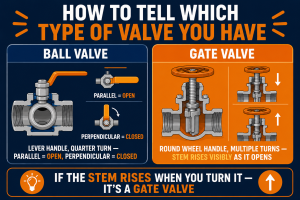
The handle position tells you exactly which state the valve is in without any guesswork. When the handle sits parallel to the pipe, the valve is open. When it’s turned perpendicular to the pipe, the valve is closed. Getting from fully open to fully closed — or back again — takes exactly one quarter turn, regardless of the valve’s size. Our roundup of the best water shut off valves covers current ball valve models for main and branch line shutoffs.
💡 Tip: The handle position on a ball valve tells you its state at a glance — parallel to the pipe means open, perpendicular means closed. There’s no ambiguity or counting turns required.
How a Gate Valve Works
A gate valve contains a wedge-shaped metal gate that rises and lowers inside the valve body on a threaded stem, physically dropping down into the pipe bore to block flow or lifting clear of it to allow flow through. Unlike a ball valve’s quarter turn, this mechanism requires multiple full turns of the handle to travel from fully open to fully closed.
One visible tell of a gate valve in good working order is the rising stem itself — as you turn the handle to open the valve, the threaded stem visibly rises up out of the handle housing, and it lowers back down as you close it. That visible motion is a useful diagnostic in itself, separate from whether the valve actually seals properly once closed.
💡 Tip: A gate valve’s stem visibly rises as you open it — if the stem isn’t rising or the valve feels stiff, the gate mechanism may already be corroded or seized internally.
Reliability and Ease of Use
Ball valves operate reliably even after sitting untouched for years — the quarter turn mechanism has no fine threads to seize and no small parts that corrode into place, so a ball valve you haven’t touched since it was installed will typically still turn smoothly the first time you need it.
Gate valves have the opposite reputation, and it’s well earned. A gate valve left untouched for years commonly seizes in the open position, or the wedge and seat corrode and pit enough that the valve no longer forms a complete seal even when you manage to force it fully closed. In a genuine emergency — a burst pipe actively spraying water — this difference is the whole story: a ball valve closes in one confident motion, while a gate valve requires several full turns while water is actively flowing and pressure is working against you the entire time.
⚠️ Warning: A gate valve on a main water shutoff that hasn’t been operated in years may fail or not fully seal when you urgently need it closed — this is the single most important reason to know which type of valve you have before an emergency happens.
Flow Rate Differences
A fully open ball valve restricts flow very slightly, since the ball’s bore — even when perfectly aligned with the pipe — still introduces a small amount of turbulence at the transition points where it meets the surrounding pipe. A fully open gate valve, by contrast, provides nearly unrestricted flow, because the gate retracts completely up and out of the pipe bore, leaving a straight, unobstructed path for water to pass through.
In residential plumbing, this theoretical advantage rarely shows up in any way you’d actually notice. Household water demand — a shower, a washing machine, a couple of fixtures running at once — sits well within what a fully open ball valve can deliver without any perceptible restriction.
💡 Tip: The flow rate advantage of a gate valve matters in high-volume industrial or irrigation settings — in a typical residential home, the difference between the two is not perceptible at the tap.
Longevity and Maintenance
Ball valves last decades with essentially no maintenance when used with clean residential water — the simple ball-and-seal design has very few points where wear can accumulate, and the seals themselves are protected from the water flow except during the brief moment of turning.
Gate valves age far less gracefully. The valve seat and the wedge itself can corrode or pit over years of use, and mineral scale can build up on both surfaces to the point where the gate no longer forms a complete seal even when fully closed — the valve looks shut but still allows a slow trickle past it. In older homes across the Northeast and Midwest — particularly those built before 1970 — gate valves on main water shutoffs and branch lines are extremely common, and many haven’t been operated in decades. A gate valve that hasn’t been turned in years is likely to either not fully close or to fail entirely when forced — homeowners in these areas who discover a gate valve on their main shutoff should consider having a plumber replace it with a ball valve proactively, before an emergency makes it critical to close quickly. Once you’ve isolated the water, our guide to how to fix a leaking pipe covers the repair itself.
💡 Tip: A gate valve that leaks past its seat when closed is not reliably repairable by a homeowner — at that point replacement with a ball valve is the practical solution.
Where Each Is Used Today
Ball valves are the standard in all modern residential plumbing — main water shutoffs, individual branch lines, appliance shutoffs under sinks and toilets, and washing machine supply valves all use ball valves almost universally in new construction and renovation work today.
Gate valves are still found throughout older homes that haven’t had their shutoffs upgraded, and they retain legitimate roles in irrigation systems, fire suppression systems, and industrial or municipal water infrastructure, where their superior fully-open flow rate and ability to throttle flow gradually still matter. New residential installations, however, almost exclusively use ball valves now — gate valves in a home today are typically leftover from an earlier era of construction rather than a deliberate current choice.
💡 Tip: If you’re replacing any valve in a residential home today, install a ball valve regardless of what was there before — there is no residential situation where a gate valve is the better modern choice.
Which Should You Choose?
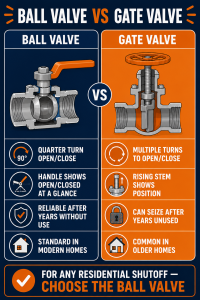
The table below compares the two head-to-head across the factors that actually matter for a residential decision:
| Factor |
Winner |
| Quick open/close in an emergency |
Ball Valve |
| Visible open/closed status at a glance |
Ball Valve |
| Reliability after years without use |
Ball Valve |
| Maximum flow rate when fully open |
Gate Valve (marginally) |
| Modern residential installation |
Ball Valve |
| Older home — existing valve |
Identify Type and Consider Replacing |
| Irrigation or industrial flow control |
Gate Valve May Be Specified |
Choose a Ball Valve for:
- Any new residential shutoff installation
- Replacing an ageing gate valve on a main shutoff — see our roundup of the best water shut off valves for current options
Choose a Gate Valve only if:
- An existing specification or system requires it
- You’re replacing an existing gate valve in an irrigation or industrial context where flow control is genuinely needed — and if the surrounding pipework needs attention at the same time, our roundup of the best pipe repair kits covers options for fixing what’s around it
Need a Professional Plumber?
If you’ve discovered an ageing gate valve on your main shutoff, or you’re not confident identifying or operating the valve you have, a licensed plumber can replace it with a ball valve safely and confirm the rest of your shutoff system is in good working order.
Find a licensed plumber in your area at PlumberArchive.com — the US plumber directory with 12,000+ verified local plumbers across all 50 states.
Find a trusted plumber near you → PlumberArchive.com
Follow Us on Facebook
Get weekly plumbing tips, honest tool reviews and DIY maintenance guides delivered straight to your Facebook feed. We cover shutoff valves, pipe repairs, drain maintenance and everything in between — written for US homeowners who want to handle more themselves.
Follow PlumbingToolsReview on Facebook →
Frequently Asked Questions
Q: How do I know if I have a ball valve or gate valve?
Look at the handle. A ball valve has a lever-style handle that you turn a quarter turn — parallel to the pipe means open, perpendicular means closed. A gate valve has a round wheel-style handle, or sometimes a lever on a longer stem, that you turn multiple full rotations to open or close, and you’ll typically see the threaded stem itself rise up as the valve opens. If you’re still not sure, a plumber can identify it in seconds during any other visit.
Q: Can I replace a gate valve with a ball valve myself?
It depends on the pipe material and your comfort level working with it — the job typically involves cutting out the old valve and soldering, threading, or press-fitting in the new one, depending on whether the line is copper, galvanized steel, or PEX. Given that this valve controls your main water shutoff, and a mistake here can mean water damage or having to shut off water at the street, most homeowners are better served having a licensed plumber handle this specific replacement rather than attempting it themselves.
Q: Why do older homes have gate valves instead of ball valves?
Gate valves were the standard residential shutoff valve for most of the 20th century, before ball valves became widely available and affordable for home plumbing. Homes built before the 1970s and 1980s, particularly across the Northeast and Midwest, were built and plumbed during the era when gate valves were simply what plumbers installed — it wasn’t a lesser choice at the time, but ball valves have since proven more reliable over the long term, especially for a valve that may go years between uses.
Q: Is a ball valve better than a gate valve for a main water shutoff?
Yes, for virtually every residential situation. A main shutoff valve is exactly the kind of valve that might sit untouched for years and then suddenly need to work perfectly during an actual emergency — a burst pipe, a major leak, a fixture failure. A ball valve is built for precisely that scenario: reliable after years of no use, and closable in one quarter turn rather than several full rotations while water is actively flowing. The only advantage a gate valve holds — slightly higher flow rate when fully open — isn’t something you’d notice in a residential setting.
Conclusion
Ball valves are the right choice for virtually every residential application — new installations, appliance shutoffs, and any replacement of an ageing valve elsewhere in the house. Their quarter-turn operation, at-a-glance open/closed status, and reliability after years of no use make them the clear winner for anything you might need to close quickly and without warning.
A gate valve left unoperated for years is a genuine reliability risk worth addressing proactively rather than discovering during an emergency, particularly on a main shutoff in an older home. Replacing an ageing gate valve with a ball valve is one of the most practical, relatively low-cost plumbing upgrades a homeowner can make — it turns an unreliable unknown into a valve you can trust to work the one time it truly matters.
See our roundup of the best water shut off valves for current ball valve options, our guide to how to fix a leaking pipe for once you’ve isolated the water, and our roundup of the best pipe repair kits for the pipework around an older valve that may need attention at the same time.
✍️ About This Comparison
PTR Editorial Team — Product Comparisons. We compare manufacturer specifications, installation requirements, compatibility and available product documentation to help homeowners choose suitable tools and parts. How we review →