Comparisons
20 Sep 2026

Utility Pump vs. Sump Pump (2026) — Which Do You Need?
Utility pump vs sump pump: one is portable for occasional jobs, the other a permanent install for ongoing water. See which your basement needs.
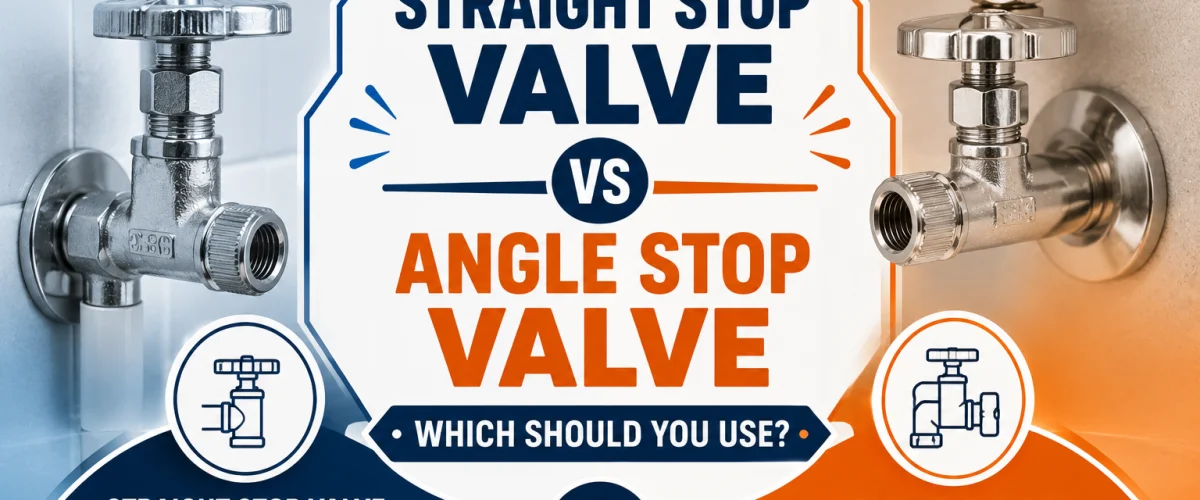
Straight and angle stop valves do the same job, but the water supply line's direction of approach determines which one actually fits — here's how to tell.
Please note: Product information referenced here is based on our research at time of writing and is general in nature. Always check a specific product’s label before use.
If you’ve ever stood in the plumbing aisle staring at two nearly identical shut-off valves, you’ve run into a question that has almost nothing to do with brand, price, or personal preference. Straight stop valves and angle stop valves do the exact same job — they let you shut off water to a single fixture — but they’re built for two different physical layouts. A straight stop valve passes water through in one continuous line. An angle stop valve takes water in from one direction and redirects it out at a 90-degree turn. Which one you need is determined almost entirely by how your water supply line physically approaches the fixture.
That’s the part that trips people up: this isn’t a “which is better” decision the way choosing between two drills might be. It’s a geometry question. If the supply line comes straight out of the wall in line with the fixture connection, you need a straight valve. If it comes up from the floor or out from the wall at an offset — which is the far more common setup in US homes — you need an angle valve. Buy the wrong one and it simply won’t fit the way your plumbing is laid out, no matter how well-reviewed the product is. This guide walks through how each type works, why one shows up far more often than the other, and exactly how to tell which your fixture needs before you buy.
At a Glance
Straight Stop Valve
Angle Stop Valve
✏️ Our Take
This isn’t really a preference question — it’s a geometry question. An angle stop valve is the far more common choice in most US homes because most supply lines enter from the wall or floor below the fixture, and the 90-degree turn lets the flexible connector run cleanly up to the toilet or faucet without kinking. A straight stop valve is the right call specifically when the supply line and the fixture connection are already in line with each other, which is a less common but still real configuration. Before buying either one, the fastest way to know which you need is to look at how your existing valve (or the exposed supply line, if there’s no valve yet) is oriented.
IN THIS GUIDE
Here’s how straight and angle stop valves stack up on the factors that actually decide which one you need.
| Factor | Straight Stop Valve | Angle Stop Valve |
|---|---|---|
| Typical cost | $ | $ |
| Water flow path | Straight through, no directional change | 90-degree turn from inlet to outlet |
| Best fit for | Supply line already inline with fixture connection | Supply line offset from fixture connection |
| How common in US homes | Less common, situational | Standard for most toilets and sinks |
| Installation mechanism options | Compression, push-to-connect, other | Compression, push-to-connect, other |
| Risk if wrong type installed | Won’t align with fixture connection | Excess slack or forced bend in connector |
| Best for | Inline supply/fixture layouts, some wall-mounted setups | Toilets, sinks, standard floor/wall supply lines |
A straight stop valve is about as simple as shut-off hardware gets. Water enters the valve body on one side and exits directly opposite it, continuing along the same straight line it was already traveling. There’s no redirection built into the valve itself — the inlet and outlet sit in a single axis, so the valve’s job is purely to open or close that line, not to change the direction water is moving through it.
That straight-through design only makes sense in one specific situation: when the supply line’s approach and the fixture’s connection point are already aligned with each other. If water is coming out of the wall or floor on the same line the fixture connection sits on, a straight valve lets the supply line continue in that direction with a shut-off point in the middle, and the flexible connector running from the valve to the fixture stays short and direct.
Where this shows up most often is in certain wall-mounted fixture installations, and occasionally in unusual plumbing layouts where a previous installer ran the line to land inline with the connection point. It’s a less common configuration than the angled alternative, but when the layout calls for it, a straight valve is the correct fit. Our water shut off valve reviews include a straight stop valve model alongside angle stop options, since both configurations show up in real installations.
An angle stop valve handles the far more common real-world scenario: the supply line and the fixture connection point don’t sit on the same line at all. Water enters the valve from one direction — typically straight out of the wall or straight up from the floor — and exits at a 90-degree angle, redirected toward wherever the fixture’s connection actually is.
That built-in bend does real work. Instead of forcing the flexible supply connector to twist on its own to bridge an offset supply line, the valve itself absorbs the direction change. The connector coming off an angle valve can then run in a short, clean, mostly straight path up to the toilet or faucet, which is both a cleaner installation and a more reliable one — connectors that have to compensate for misalignment on their own are more prone to kinking or unnecessary strain.
This is why angle stop valves are the default assumption in plumbing supply aisles and in most fixture installation instructions — the 90-degree redirect matches how the majority of US homes actually route their supply lines. Our dedicated angle stop valve reviews cover several models built specifically for this configuration.
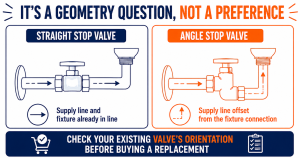
The reason angle stop valves dominate the market comes down to how residential plumbing actually gets routed. For most toilets and sinks, the supply line comes up from the floor behind or beside the fixture, or out from the wall at a point that isn’t directly in line with where the fixture’s own connection sits. That offset is the norm, not the exception — it’s simply how supply lines get run during original construction or remodeling.
Given that offset, a 90-degree angle at the valve is the cleanest way to bridge the gap. Instead of running a long connector at an awkward diagonal, or forcing extra slack into the line to compensate for misalignment, the angle valve handles the direction change right at the shut-off point. What’s left is a short, direct connector run from valve to fixture — less material, less visible slack, and less opportunity for the connector to develop a kink over time.
Because this scenario is so common, manufacturers produce angle stop valves in far greater volume and variety than straight stop valves. If you’re standing in an aisle unsure which to grab, the odds favor angle being correct — but odds aren’t confirmation, which is why checking your actual installation still matters.
A straight stop valve is the correct choice whenever the supply line’s approach and the fixture’s connection point are already physically inline with each other — meaning no direction change is needed to connect the two. This is a less common layout than the offset scenario that favors angle valves, but it’s a real one, and forcing an angle valve into a situation like this creates its own set of problems rather than solving anything.
This alignment shows up most often in certain wall-mounted fixture installations, where the fixture’s connection point was specifically positioned to sit directly in line with the supply line’s exit point. It can also turn up in older homes or unusual remodels where a previous installer ran plumbing to land inline with a fixture rather than offset from it. In either case, the layout itself is the deciding factor, not the fixture type — a toilet or sink can theoretically call for either valve type depending entirely on how its specific supply line was routed.
The important habit here is confirming the actual physical orientation rather than assuming based on what’s typical. Angle stop valves being the more common choice doesn’t mean they’re the right choice for every installation — a straight valve exists specifically because some layouts genuinely need one, and installing an angle valve in that situation doesn’t just look wrong, it creates a fit problem.
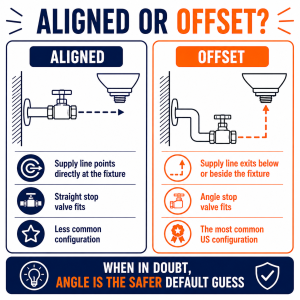
The most reliable way to determine which valve type you need is to look directly at the physical relationship between the supply line and the fixture’s connection point. Trace the direction water flows out of the wall or floor, then look at where the fixture’s own connection sits relative to that exit point. If the two are already aligned — the supply line’s direction and the fixture connection point sit on the same line — you need a straight stop valve. If the fixture’s connection point sits off to the side or above where the supply line exits, you need an angle stop valve to make that turn.
If you’re replacing an existing valve rather than installing one for the first time, this step gets much simpler: just look at what’s currently installed. An existing straight valve confirms an inline layout; an existing angle valve confirms an offset layout. Since the underlying plumbing geometry doesn’t change on its own, matching the existing valve type is almost always the correct call unless something about the installation has physically changed.
For new installations with no existing valve to reference, examine the exposed supply line stub-out directly. A stub-out pointing straight at the fixture’s intended connection point calls for a straight valve; one that exits perpendicular to, or offset from, that connection point calls for an angle valve. When in doubt, angle stop is the safer default, but a quick visual check before buying avoids an unnecessary return trip.
One thing worth understanding clearly: valve orientation and installation mechanism are two separate decisions. Both straight and angle stop valves are available in compression fittings, push-to-connect fittings, and other attachment mechanisms — the orientation choice (straight vs. angle) and the connection mechanism choice are independent of each other. Our compression fitting vs push-to-connect fitting comparison covers that separate decision in detail — it’s worth being clear this is a genuinely different question from the one this article answers. That comparison is about how the valve physically attaches to the pipe; this article is about which direction the valve’s outlet points relative to its inlet. You’ll ultimately choose both a valve orientation and a connection mechanism, and neither choice constrains the other.
Because orientation doesn’t affect installation difficulty, getting the physical process right isn’t the challenge here — getting the fit right before you start is. A straight valve and an angle valve using the same connection mechanism install with the same steps, tools, and skill level. Buy the wrong orientation and the fix isn’t a harder installation — it’s simply returning the part and buying the correct one, which is why the pre-purchase check described above is the most important step in the whole process.
Start by checking your existing valve or exposed supply line orientation, as covered above — that single check resolves this decision more reliably than any general rule. If you’re replacing a valve, match what’s already there. If you’re installing one for the first time, trace the supply line’s direction against the fixture’s connection point.
If you have no reference point at all and need a reasonable starting assumption, default to an angle stop valve. It’s the more common configuration by a wide margin for toilet and sink installations in US homes, since most supply lines are routed with some offset from the fixture connection rather than landing perfectly inline with it. Reserve the straight stop valve for situations where you’ve specifically confirmed the supply line and fixture connection are already aligned.
It’s also worth being clear about what this comparison isn’t. This is a different question from our compression fitting vs push-to-connect fitting comparison, which is about connection mechanism — how the valve attaches to the pipe — not about outlet direction. Straight versus angle is purely about which way the water turns inside the valve body, driven entirely by your installation’s physical geometry.
If you’re unsure about your supply line’s orientation, or the shut-off valve needs replacing as part of a larger repair, it’s worth having a professional take a look. Search PlumberArchive.com — the US plumber directory with 12,000+ verified local plumbers across all 50 states.
Get weekly plumbing tips, honest tool reviews and DIY guides delivered straight to your Facebook feed. We cover water shut-off valves, supply lines, and everything in between — written for US homeowners who want to make smart decisions without overspending.
Only if the supply line and fixture connection are still physically inline. Swapping in an angle valve where a straight valve fit correctly would introduce an unnecessary 90-degree turn, forcing the connector into a bend it doesn’t need to make. If the original installation genuinely called for a straight valve, replace it with another straight valve rather than switching orientation.
Not in any way that’s noticeable in normal household use. Both straight and angle stop valves are sized to handle standard residential supply line flow, and the 90-degree turn in an angle valve doesn’t meaningfully restrict flow or reduce pressure at the fixture. Orientation is a fit consideration, not a performance one.
Look at the visible flexible connector running from the existing valve to the fixture. If it runs in a straight, direct line with no bend, the valve underneath is almost certainly a straight stop. If the connector makes a turn on its way to the fixture, the valve is redirecting water at an angle — an angle stop. You typically don’t need to remove anything to tell.
Not meaningfully. Both valve types fall into the same general price tier for a given connection mechanism and material — orientation itself doesn’t add or reduce manufacturing cost. Price differences come from connection mechanism, brand, and material, not from whether the valve is straight or angled.
Straight and angle stop valves aren’t competing products — they’re the same basic shut-off hardware built for two different physical layouts. An angle stop valve is the right default for most toilet and sink installations in US homes, since most supply lines approach the fixture connection at an offset that needs a 90-degree redirect. A straight stop valve is the correct choice specifically when your supply line and fixture connection are already inline, a less common but entirely real configuration. Check your existing valve or exposed supply line before you buy, and the right answer becomes obvious rather than a guess.
Prices and ratings may change. Always check Amazon for current prices.
✍️ About This Comparison
Written by Sarah Mitchell, Home Improvement Editor at PlumbingToolsReview — specializing in helping homeowners make smart buying decisions without overspending. Learn how we test →
Utility pump vs sump pump: one is portable for occasional jobs, the other a permanent install for ongoing water. See which your basement needs.
Pipe repair clamp, tape, or epoxy — which should you use for a leaking pipe? Compare how each works, durability, and when to reach for which.
Not sure if your home has a septic tank or a sewer connection? Learn how to tell which one you have, plus the maintenance and cost differences.

