Please note: Information in this comparison is based on our research at time of writing and is general in nature. Always check specific product packaging and manufacturer instructions before purchasing or attempting a repair.
Introduction
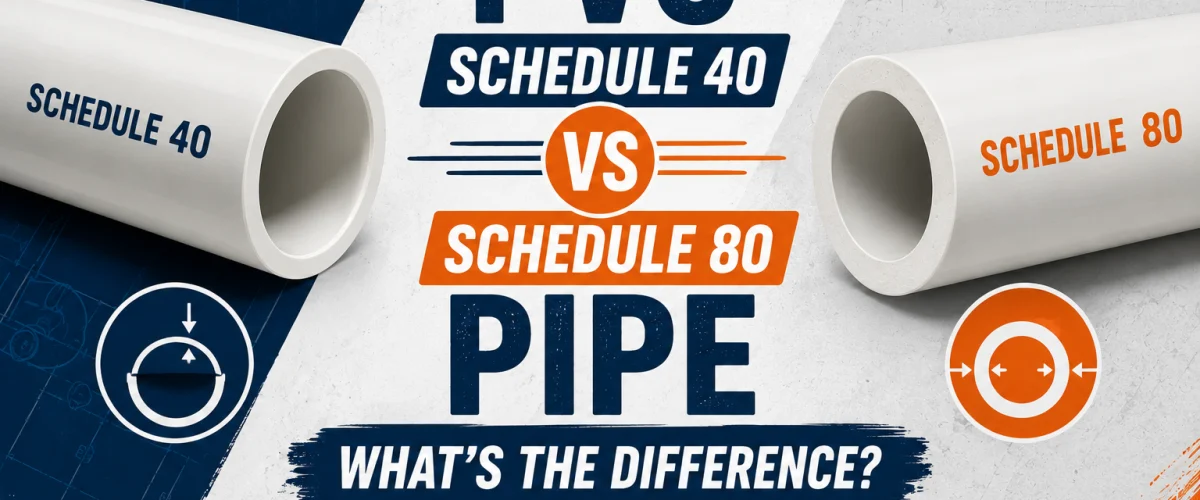
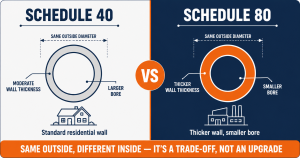
Walk into any hardware store and the PVC aisle has two obvious families: white pipe marked “Schedule 40” and heavier gray pipe marked “Schedule 80.” They share the same base plastic, and for any given nominal pipe size they share the same outside diameter, so a fitting made for one slips onto the other. The difference is wall thickness. Schedule 80 walls are thicker, which raises the pressure rating and toughens the pipe against impact — but because the outside diameter stays fixed, that thicker wall grows inward and shrinks the inside diameter, so the same nominal pipe carries less water. It also costs more per foot and weighs more. It is easy to read “80” as the bigger number and assume it is simply the better pipe. It is not a quality tier; it is a trade-off, and for the large majority of residential drain and supply work Schedule 40 is the right call.
At a Glance
PVC Schedule 40
- Wall thickness: thinner; the standard residential wall
- Inside diameter (same nominal size): larger — more bore for the same outside diameter
- Pressure rating: high, and far beyond normal household pressure (for example, roughly 450 psi for 1-inch at 73°F)
- Typical color: white (pressure and DWV); an industry convention, not a rule
- Weight: lighter per foot; easier to carry and support
- Cost: lower per foot and per fitting
- Typical residential use: nearly all drain/waste/vent, plus standard cold supply, irrigation, and pool lines
PVC Schedule 80
- Wall thickness: thicker; the wall grows inward from the same outside diameter
- Inside diameter (same nominal size): smaller — roughly 9% less bore at 1-inch, more on smaller sizes
- Pressure rating: higher than Schedule 40 in the same size (about 1.4×), a ceiling most homes never approach
- Typical color: dark gray (plumbing grade); again a convention, with exceptions
- Weight: heavier per foot, on the order of 40–50% more
- Cost: more per foot, and noticeably more per fitting
- Typical residential use: exposed risers, high-pressure pump discharge, impact-prone runs, or where code/spec requires it
Wall Thickness and Inside Diameter
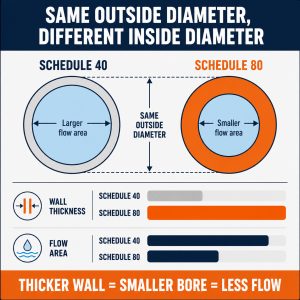
The schedule number describes wall thickness relative to pipe size, a convention carried over from an older steel-pipe system. For a given nominal pipe size, Schedule 40 and Schedule 80 PVC are made to the same outside diameter — that is exactly what lets fittings, clamps, and hangers built for one work on the other. What changes is how far the wall reaches inward.
Take 1-inch nominal PVC. Both versions have an outside diameter of about 1.315 inches. Schedule 40 has a wall around 0.133 inch, leaving an inside diameter near 1.05 inches. Schedule 80 has a wall around 0.179 inch, dropping the inside diameter to roughly 0.96 inch. Same pipe on the outside; a visibly narrower channel on the inside.
That inward growth matters more on small pipe than on large pipe. On half-inch PVC the Schedule 80 wall claims well over ten percent of the bore. On 4- or 6-inch pipe the same step costs only around six percent, because the wall is small next to the diameter. So both the flow penalty and the pressure-rating gain are proportionally largest on the smaller sizes homeowners handle most — supply lines, irrigation laterals, manifold pipe — and shrink on the large DWV pipe where the schedule question is least likely to come up in the first place.
Pressure Ratings Explained
Every length of pressure-rated PVC is stamped with a maximum pressure, given for water at 73°F. Within a size, Schedule 80 is rated higher than Schedule 40 — roughly 1.4 times — because the thicker wall resists bursting. One-inch Schedule 40 is rated in the neighborhood of 450 psi; one-inch Schedule 80, around 630 psi. Both numbers fall as pipe diameter grows: 4-inch Schedule 40 is rated closer to 220 psi.
Two things temper how much that gap means in a house. First, ordinary residential water pressure runs 40 to 80 psi, and even a well pump or an irrigation booster rarely pushes past 100 psi. A 450 psi rating already carries an enormous margin over that. Second, PVC’s rating drops sharply as temperature rises, and near 140°F it is essentially gone — which is why neither schedule is used for hot water. That job goes to CPVC; if you are choosing between the materials themselves rather than the schedule within PVC, see our PVC vs CPVC pipe comparison. Stepping from Schedule 40 to Schedule 80 raises a ceiling that most residential systems never come close to touching.
Flow Capacity
The smaller inside diameter of Schedule 80 has a direct, unavoidable cost: less flow. Water-carrying capacity depends heavily on the bore — for pressurized flow it scales roughly with the inside diameter raised to about the 2.5 power — so a 9 percent reduction in inside diameter translates into a meaningfully larger reduction in gallons per minute at a given pressure, plus higher friction loss over a long run.
In practice, a Schedule 80 line fed by the same pump delivers less water to the far end than a Schedule 40 line of the same nominal size, or it needs more pressure to move the same volume. For a short fixture supply that difference is negligible. For a long irrigation zone, a pool return, or any run that is already near the limit of what the pipe size can carry, choosing Schedule 80 without a reason can quietly cost you performance. The usual fix — going up a nominal size to recover the lost bore — brings cost and bulk of its own.
Strength and Impact Resistance
This is where Schedule 80 earns its place. The same thicker wall that shrinks the bore also makes the pipe harder to crack, crush, or punch through. Above ground and exposed — a riser coming out of the ground next to a driveway, pipe run along a garage wall at bumper height, equipment plumbing that gets stepped on or knocked with a tool — the extra wall is genuine insurance against physical damage, separate from any pressure question.
It is worth being precise about what this does and does not buy. Schedule 80 is tougher, but it is still rigid PVC: a hard enough strike still breaks it, and it is no more flexible or freeze-resistant than Schedule 40. Neither schedule tolerates sunlight well; both need paint or a wrap for long-term outdoor exposure. If the concern is purely mechanical protection in an exposed spot, a sleeve, a bollard, or simply rerouting the pipe out of harm’s way can address it just as effectively — Schedule 80 is one option there, not the only one.
Weight and Handling
More material in the wall means more weight per foot — Schedule 80 pipe runs on the order of 40 to 50 percent heavier than Schedule 40 in the same size. On a few fixture connections that is irrelevant. Across a whole system, on overhead work, or on a long run carried by hand into a trench, it adds up in fatigue and in the support the finished run needs.
Cutting and joining are similar but not identical. The same tools work — a ratchet cutter, a fine-tooth saw, a wheeled cutter — though the thicker wall takes a little more effort to get through cleanly, and a square, fully deburred end matters just as much on either schedule. Our guide on how to cut PVC pipe straight and clean covers the technique, and our roundup of the 5 best PVC pipe cutters covers the tools. Schedule 80 solvent-weld joints generally call for primer and a heavier-bodied cement; follow the directions on the can for the product you are using.
Cost Difference
Schedule 80 costs more than Schedule 40 — more per foot of pipe, and noticeably more per fitting, since fittings carry the same extra material plus lower production volume. Threaded Schedule 80 fittings, common at pumps and equipment, add more still.
For a small project the difference is minor. Across a re-pipe, an irrigation system, or a pool equipment pad it becomes a line item worth being deliberate about. Spending it where a higher pressure rating or real impact resistance is needed is money well used. Spending it across a whole system “to be safe,” on runs that a 450 psi Schedule 40 pipe would handle with room to spare, mostly buys added weight and reduced flow.
Fitting Compatibility
Because Schedule 40 and Schedule 80 share an outside diameter and the same socket dimensions at a given size, they physically mate. A Schedule 40 pipe will seat in a Schedule 80 socket fitting, and the reverse also works; a solvent-weld joint between the two will bond. Dimensionally, mixing is possible.
The catch is that a piping system is only rated to its weakest part. Run Schedule 80 pipe into Schedule 40 fittings and the whole assembly is limited to the Schedule 40 pressure rating — you have paid for Schedule 80 pipe and given up its main advantage at every joint. Going the other way, Schedule 80 fittings on Schedule 40 pipe, the pipe is still the limit. There is also a threading distinction: Schedule 80’s wall is thick enough to be threaded, while cutting threads into Schedule 40 removes so much wall that its rating is roughly halved, which is why threaded connections are typically made in Schedule 80 even on an otherwise Schedule 40 system.
Finally, an inspector may flag a mixed system, and a job specification or code section that calls out one schedule means that schedule throughout, not “close enough.” If a drawing says Schedule 80, matching fittings are part of the requirement.
Typical Residential Applications for Each
For the large majority of home plumbing, Schedule 40 is the standard and Schedule 80 never enters the picture:
- Drain, waste, and vent: essentially all residential DWV pipe is Schedule 40 PVC (or the DWV-specific version of it). These lines are not pressurized, so there is no pressure argument for Schedule 80 at all. For how PVC compares with the older drainage material, see our cast iron vs PVC drain pipe comparison.
- Cold water and irrigation: where PVC is permitted for cold supply, service lines, sprinkler mains and laterals, and well plumbing, white Schedule 40 handles normal household and irrigation pressures with a wide margin.
- Pool and spa plumbing: standard return and suction lines are typically Schedule 40 at normal operating pressures.
Schedule 80 shows up in narrower, specific situations:
- The exposed, above-grade riser of an irrigation or backflow assembly, where local code or the water utility often requires it for impact resistance.
- High-pressure pump discharge — a booster pump, a deep well, or a pool equipment pad where the pump can generate real pressure and the plumbing is exposed.
- Runs mounted where they are likely to be struck, when the owner or the code wants the heavier wall rather than a separate guard.
- Commercial and industrial work, and anywhere a project specification names it.
One aside: gray Schedule 80 electrical conduit is a separate product with its own listing and is not interchangeable with Schedule 80 pressure pipe — do not substitute one for the other.
When Schedule 80 Is Unnecessary
It is worth stating plainly: most homeowners will never have a real reason to buy Schedule 80. If your project is a drain line, a vent, a toilet or sink supply, a typical lawn irrigation zone running off house pressure, or a standard pool return, Schedule 40 is not a compromise — it is the correct pipe, and the one the rest of the system is built around.
The instinct to “upgrade” to Schedule 80 for peace of mind usually works against you. You pay more per foot and per fitting, you add weight to every run and every hanger, and you trade away inside diameter — and therefore flow — for a pressure rating your system was never going to approach. Unless a specific driver is present — a genuine high-pressure source, an exposed run that needs mechanical protection, or a code or specification that mandates it — the heavier pipe solves a problem you do not have while creating a smaller one you did not have before.
Code and Manufacturer Considerations
Local plumbing code has the final say, and it varies. Some jurisdictions do not permit PVC for interior potable water at all; some require Schedule 80 for the above-grade portion of an irrigation or backflow assembly; pool and irrigation codes may set their own requirements. The model codes set a baseline, but local amendments are what your inspector actually enforces.
Manufacturer data matters just as much. The pressure stamp on the pipe, the temperature de-rating chart, the approved primer and cement, and the cure times before a line is pressurized are all published by the maker and are specific to the product in your hands. Fittings carry their own ratings, which can be lower than the pipe’s.
Treat this article as background for understanding the trade-off, not as the authority for your project. Before you buy, confirm what your local code requires for the specific application, and follow the pipe and fitting manufacturer’s published specifications.
Which Should You Choose?
For nearly all residential work the answer is Schedule 40. It is the standard for drain, waste, and vent, it carries normal supply and irrigation pressures with a wide margin, it flows better than Schedule 80 of the same size, and it costs and weighs less. Schedule 80’s thicker wall is the right choice in a narrower set of cases: a real high-pressure source, an exposed run that has to survive impact, or a code or specification that requires it. Match the pipe to that need rather than treating the bigger number as an upgrade.
| Your Situation |
Better Choice |
| Standard residential drain, waste, and vent lines |
Schedule 40 — no pressure argument for Schedule 80 here |
| Typical lawn irrigation or sprinkler lines on house pressure |
Schedule 40 — rated far beyond normal supply pressure |
| Exposed above-ground pipe in a high-traffic spot prone to impact |
Schedule 80, or Schedule 40 with a guard or sleeve |
| High-pressure pump discharge, deep well, or pool equipment pad |
Schedule 80 — the pressure headroom is genuinely used |
| Commercial job, or any application where code or a spec names a schedule |
Whatever the code or specification requires, throughout |
| Budget-conscious standard remodel — ordinary cold supply or drainage |
Schedule 40 — correct pipe, lower cost, better flow |
None of these are absolute. If a run sits somewhere it might be hit, physical protection can come from a sleeve or a rerouted path as well as from a heavier wall; if a system genuinely sees high pressure, Schedule 80 at that section is worth it even though the rest of the house is Schedule 40. Match each part of the job to what it actually has to do.
✏️ Our Take
Schedule 40 and Schedule 80 PVC are not a good-and-better pair. They are the same plastic with different wall thickness, and each choice carries a cost. Schedule 40 is the residential default — lighter, cheaper, better-flowing, and rated well beyond what a house needs — and it is the pipe the rest of a typical system is designed around. Schedule 80 trades inside diameter, weight, and cost for a higher pressure ceiling and a tougher wall, which is worth it for high-pressure pump plumbing, exposed runs that can take a hit, or a job where code or spec calls for it. Choose Schedule 80 when the pressure or protection need is real, not as a blanket upgrade — and let local code and the manufacturer’s specs make the final call.
Prices and ratings may change. Always check Amazon for current prices.
✍️ About This Comparison
PTR Editorial Team — Product Comparisons. We compare manufacturer specifications, installation requirements, compatibility and available product documentation to help homeowners choose suitable tools and parts. How we review →