Reviews
23 Sep 2026

5 Best Natural Gas & Propane Leak Detectors (2026) — Expert Reviews
Compare 5 top natural gas & propane leak detectors for 2026 — plug-in alarms vs handheld sniffers, tested for accuracy, price and home safety.
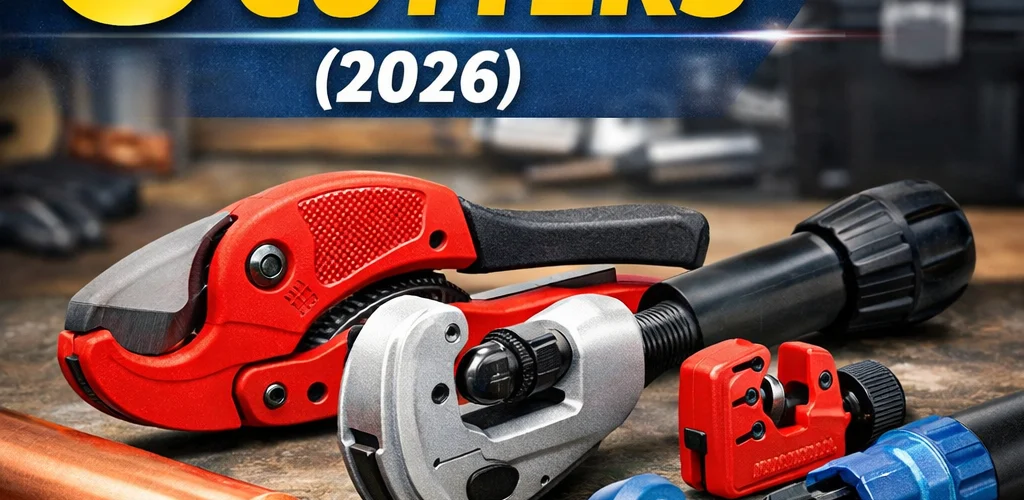
5 best pipe cutters (2026) — close-quarters, screw-feed, 2-in-1, budget, and plastic-pipe ratchet cutters compared for copper, PEX, and PVC.
Please note: Product availability and information are based on our research at time of writing and are subject to change. Always check Amazon for the latest details before purchasing.
Cutting pipe cleanly is the difference between a leak-free joint and an expensive plumbing repair — a jagged or angled cut prevents fittings from seating properly and creates weak points that fail under pressure. A good pipe cutter gives you a square, burr-free cut without the mess and effort of a hacksaw, and the right choice depends heavily on what you’re cutting and where.
We’re comparing five pipe cutters covering the realistic range a home plumbing project is likely to need — a close-quarters copper cutter for tight spaces, a screw-feed cutter for precision copper work, a 2-in-1 close-quarters cutter, a wide-range budget cutter, and a ratchet-action cutter built specifically for plastic pipe: the RIDGID 40617 Model 101, RIDGID 32920 Model 15, RIDGID 32573 Model 118, TOLESA Pipe Cutter, and RIDGID 23498 RC-1625. If a pipe is already leaking before you get to cutting, our best pipe repair kits guide covers emergency fixes.
✏️ Our Take
Pipe cutters come down to matching the tool to your pipe material and workspace. Copper tubing calls for a dedicated tubing cutter — close-quarters models handle tight spaces, while a screw-feed design gives more control on precise cuts. Plastic pipe (PEX, PVC) needs a ratchet-action cutter built for that material rather than a copper tubing cutter. If you’re working across multiple pipe materials or just want one versatile tool, a wider-range budget cutter can cover more ground, though it won’t match the precision of a purpose-built option for a specific material.
IN THIS GUIDE
| Product | Rating | Best For | Price |
|---|---|---|---|
| RIDGID 40617 Model 101 BEST OVERALL |
★★★★★ | Close-quarters fit for tight spaces, dependable copper cutting | $$ |
| RIDGID 32920 Model 15 | ★★★★★ | Precision screw-feed cutting for copper before soldering | $$ |
| RIDGID 32573 Model 118 | ★★★★★ | 2-in-1 versatility in a close-quarters body | $$ |
| TOLESA Pipe Cutter 1/8″–2″ | ★★★★★ | Widest size range, accessible price, multi-material use | $ |
| RIDGID 23498 RC-1625 | ★★★★★ | Purpose-built ratchet-action cutting for PEX and PVC | $ |
🏆 Best Overall
Close-Quarters Tubing Cutter, Copper/Brass/Aluminum, 1/4″–1-1/8″
The RIDGID 40617 Model 101 is our top pick in this lineup, and it earns that spot through pure practicality: a close-quarters design that fits into the tight spaces where most residential copper pipe actually runs — inside cabinet bases, behind appliances, along tight framing. RIDGID’s reputation as a professional-grade tool brand carries real weight here; this is the kind of tool licensed plumbers reach for, scaled down to a size any homeowner can handle confidently.
The compact body rotates around the pipe with a rolling cutting wheel, producing a clean, square cut on copper, brass, and aluminum tubing without the mess of a hacksaw. It’s built to hold up over repeated use rather than wearing out after a handful of jobs, making it a dependable default choice for most home plumbing situations — though if your project centers on plastic pipe or a wider range of materials, one of the other picks below is a better fit.
✓ Pros
Compact close-quarters design fits tight spaces standard cutters can’t reach
Backed by RIDGID’s established reputation as a professional-grade tool brand
Clean, precise cuts on copper tubing
Durable construction built to hold up over repeated use
✗ Cons
Higher price point than a basic budget cutter
Primarily suited to copper tubing rather than a wide range of pipe materials
🛒 Check Price on Amazon — $$ →
🎯 Best for Copper Pipe
Screw-Feed Tubing Cutter, 3/16″–1-1/8″
The RIDGID 32920 Model 15 is the pick for copper work where the quality of the cut matters most. Instead of a quick-rotation cutting wheel, it uses a screw-feed mechanism that advances the wheel gradually and evenly around the pipe as you turn the knob, giving you noticeably more control over the cut than a standard rotary cutter provides.
That controlled feed matters most when preparing copper for soldering, since a perfectly square, even cut is what lets a fitting seat properly and hold a tight joint. The tradeoff is a larger profile than the close-quarters models, so it’s less suited to tight spaces, and it’s purpose-built for copper rather than a universal multi-material tool — but for precision copper work, it’s backed by the same RIDGID reliability as the rest of this lineup.
✓ Pros
Screw-feed mechanism allows precise, controlled cutting depth on copper tubing
Backed by the same established RIDGID reliability as the rest of this lineup
Sturdy build designed for repeated professional-grade use
Clean cut edges that minimize the need for extra deburring
✗ Cons
Larger profile than the close-quarters models makes it less suited to tight spaces
Purpose-built for copper rather than a universal multi-material cutter
🛒 Check Price on Amazon — $$ →
⭐ Best 2-in-1
2-in-1 Close-Quarters Cutter, 1/4″–1-1/8″
The RIDGID 32573 Model 118 is the most versatile RIDGID option here, combining a close-quarters body with 2-in-1 functionality that covers more cutting scenarios than a single-purpose cutter. Rather than needing a separate tool for a second task, this design folds that added capability into one unit.
It keeps the same close-quarters profile as the Model 101, so it fits the same tight installation spaces, while adding the flexibility that makes it a practical choice for anyone who’d rather carry one tool than several. It sits at a similar price point to the single-purpose RIDGID options despite the added versatility, and it’s arguably more capability than an occasional DIY user strictly needs — but for a homeowner who wants fewer separate tools in the kit, it’s a smart trade.
✓ Pros
2-in-1 design covers more cutting scenarios with a single tool
Backed by RIDGID’s established reputation
Close-quarters profile fits tight installation spaces
Reduces the need to own multiple separate cutters for different jobs
✗ Cons
Sits at a similar price point to the single-purpose RIDGID options despite the added versatility
A specialty tool that may be more than a household needs for occasional use
🛒 Check Price on Amazon — $$ →
💰 Best Budget
Multi-Material Cutter, 1/8″–2″
The TOLESA Pipe Cutter is our budget pick, and it earns that spot with real versatility rather than just a lower price tag. Its 1/8″ to 2″ cutting range is the widest in this lineup by a significant margin, covering a broad variety of pipe diameters with a single adjustable tool.
That range makes it a genuinely accessible entry point for a household that doesn’t want to invest in multiple purpose-built cutters, and it’s straightforward to use without requiring specialty technique. It doesn’t carry the professional-grade brand reputation of the RIDGID options in this lineup, and a purpose-built cutter will likely still deliver more precision on a specific pipe type — but for one versatile tool at the lowest price point here, the TOLESA is hard to beat.
✓ Pros
Wide 1/8″–2″ size range covers a broad variety of pipe diameters with one tool
Accessible price point makes it an easy entry-level option
Straightforward to use without specialty technique
Practical for a household wanting one versatile cutter rather than several purpose-built ones
✗ Cons
Lacks the professional-grade brand reputation of the RIDGID options in this lineup
May not deliver the same precision as a purpose-built cutter on a specific pipe type
👷 Best for Plastic Pipe
Ratchet-Action Cutter, PEX/PVC, 1/8″–1-5/8″
The RIDGID 23498 RC-1625 is the specialist in this lineup, purpose-built for plastic pipe where a standard rotary tubing cutter is the wrong tool entirely. PEX, PVC, and similar plastic pipe need a blade rather than a cutting wheel — a rotary cutter tends to crush or deform plastic pipe walls instead of cutting through them cleanly.
Its ratchet-action mechanism advances a blade incrementally with each squeeze of the handle, slicing through plastic pipe cleanly and squarely without that deformation. The compact body is easy to control one-handed, and it’s backed by the same RIDGID reliability as the rest of this lineup. It’s not designed for copper or metal pipe, so it won’t replace a tubing cutter for those jobs — but for a project involving PEX or PVC, it’s a specialty tool worth owning.
✓ Pros
Ratchet-action mechanism makes clean, straightforward cuts through PEX and PVC pipe
Backed by RIDGID’s established reputation
Compact and easy to control one-handed
Accessible price point for a purpose-built plastic pipe cutter
✗ Cons
Not designed for copper or metal pipe
A specialty tool worth owning specifically if your project involves plastic plumbing
The single biggest factor in choosing a pipe cutter is knowing what material you’re actually cutting. Copper is the most common residential supply pipe, and any of the RIDGID tubing cutters in this lineup — the Model 101, Model 15, or Model 118 — handle it well, with the choice between them coming down to workspace clearance and how much precision the job calls for.
Plastic pipe is a different story entirely. PEX and PVC need a blade-based ratchet cutter like the RC-1625 above rather than a rotary tubing cutter, since a rolling cutting wheel crushes and deforms plastic pipe walls instead of slicing through them cleanly. If you’re not sure which material you’re working with, our how to identify your pipe material guide walks through telling copper, PEX, CPVC, and galvanized pipe apart before you buy a cutter.
A standard tubing cutter needs meaningful clearance to rotate fully around the pipe, which isn’t always available inside cabinet bases, behind appliances, or along tight wall framing. A close-quarters cutter, like the Model 101 or Model 118 above, is built specifically for that constraint — a smaller cutting head that can complete its rotation in a fraction of the space a standard cutter needs.
If your work is mostly in open, accessible areas, the clearance advantage of a close-quarters design matters less, and a standard cutter can still get the job done. But for the tight, awkward spaces that make up a lot of residential plumbing work, a close-quarters cutter is worth prioritizing regardless of which other features you’re comparing.
Beyond material compatibility, the cutting mechanism itself affects both speed and precision. A screw-feed cutter, like the Model 15 above, advances the cutting wheel gradually as you turn a knob, giving you fine control over the cut — the right choice when you’re preparing copper for soldering and a perfectly even, square edge matters.
A ratchet-action cutter, like the RC-1625, works differently: a blade advances incrementally with each squeeze of the handle. This mechanism is specifically suited to plastic pipe, where it produces a clean cut without the crushing or deformation a rotary wheel would cause. Neither mechanism is universally “better” — the right one depends entirely on the material you’re cutting.
If your projects consistently involve the same pipe material, a purpose-built cutter — like the Model 15 for copper precision or the RC-1625 for plastic pipe — generally delivers a better result than a general-purpose tool. But if you’re working across multiple pipe materials or diameters and don’t want to own several separate cutters, a wide-range option like the TOLESA above covers more ground with a single tool, even if it won’t match the precision of a specialist cutter on any one material.
Once your pipe is cut, having the right tool on hand for the rest of the job matters too — our pipe wrench vs adjustable wrench comparison covers the fitting side of the job, and if you’re shopping RIDGID’s close-quarters lineup specifically, our Milwaukee pipe cutter reviews are worth a look as a brand-specific alternative. And if the pipe you’re cutting is already leaking, our guide to fixing a leaking pipe walks through the full repair process.
Sometimes a job is too big for DIY. If you need a licensed plumber in your area, search PlumberArchive.com — the US plumber directory with 12,151+ verified plumbers across all 50 states.
Get weekly plumbing tips, honest tool reviews and DIY guides delivered to your Facebook feed.
Not effectively. A rotary tubing cutter designed for copper uses a cutting wheel that rolls around the pipe, and that same wheel tends to crush or deform plastic pipe rather than cutting through it cleanly. Plastic pipe like PEX or PVC needs a blade-based ratchet cutter, like the RIDGID RC-1625 above, instead. If your projects regularly involve both materials, it’s worth owning one tool for each rather than trying to make a single cutter handle both jobs well.
The core difference is how much clearance the tool needs to complete a full rotation around the pipe. A close-quarters cutter, like the RIDGID Model 101 or Model 118 above, uses a smaller cutting head that can finish its rotation in a fraction of the space a standard cutter requires, making it the practical choice for pipe runs inside cabinets, behind appliances, or along tight framing. A standard cutter isn’t worse, but it needs more open space to work in.
Yes, for copper pipe specifically — cutting with a rotary wheel leaves a small inner burr that can restrict water flow and prevent a fitting from seating fully, which risks a weak joint down the line. Some cutters, like the RIDGID Model 101 and Model 118 above, include a built-in reamer that handles this step without a separate tool. If your cutter doesn’t include one, a basic deburring tool or reamer is worth adding to your kit.
Yes — for PVC and other plastic pipe, a ratchet-action cutter is the correct tool rather than simply the preferred one. A rotary tubing cutter is built around a cutting wheel meant for metal tubing, and using it on plastic pipe tends to crush or deform the pipe wall instead of producing a clean cut. A ratchet-action cutter like the RIDGID RC-1625 above uses a blade that slices through plastic pipe cleanly and squarely, which is what makes it the specialist choice for PEX and PVC work.
For most homeowners working with copper pipe in typical residential spaces, the RIDGID 40617 Model 101 is the easiest recommendation — a close-quarters design backed by RIDGID’s professional-grade reputation, suited to the majority of home plumbing situations. If cut precision matters more than clearance, particularly when preparing copper for soldering, step up to the RIDGID Model 15 for its screw-feed control, and if you’d rather carry one tool that covers more ground, the RIDGID Model 118‘s 2-in-1 design is worth the look.
Buyers who want the widest size range at the most accessible price should consider the TOLESA Pipe Cutter, and anyone working with PEX or PVC should go straight to the RIDGID RC-1625 — a standard tubing cutter simply isn’t built for plastic pipe. For PVC specifically, our best PVC pipe cutters roundup covers the ratchet and scissor styles. Whichever you choose, matching the tool to your actual pipe material and workspace matters more than any single feature on this list.
Prices and ratings may change. Always check Amazon for current prices.
✍️ About This Review
Reviewed by James Carter, Senior Tool Reviewer at PlumbingToolsReview — 15 years of hands-on experience in residential plumbing and tool testing. Learn how we test →
Compare 5 top natural gas & propane leak detectors for 2026 — plug-in alarms vs handheld sniffers, tested for accuracy, price and home safety.
5 septic tank riser kits compared for 2026 — Tuf-Tite and Polylok risers by diameter and height, so you can bring tank access to grade level.
The 5 best sewage and effluent ejector pumps for 2026, expert-reviewed: grinder, standard solids-handling and light-duty effluent pumps compared.

