Please note: Product availability and information are based on our research at time of writing and are subject to change. Always check Amazon for the latest details before purchasing.
Introduction
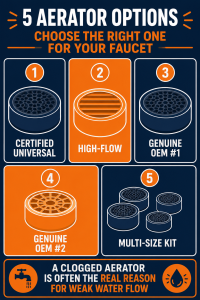
A faucet aerator is the small threaded device at the tip of a faucet spout that mixes air into the water stream — it controls how much water exits the faucet per minute and gives the flow that full, white appearance rather than a heavy, clear pour. When an aerator clogs with mineral scale, debris, or biofilm, the result is a weak, sputtering, or unevenly split stream that looks like the faucet itself is failing. In most cases the faucet is fine — it’s the aerator, and a replacement costs a fraction of a service call. This roundup covers five of the best faucet aerators available in 2026: a certified universal pick for homeowners who don’t know their brand, a high-flow option for those frustrated by low-pressure feel, genuine OEM aerators for Moen and Kohler faucets, and a complete assortment kit that covers the most common US thread sizes in a single purchase.
The most critical variable when replacing a faucet aerator is thread type — specifically whether your faucet spout has male threads (on the outside of the spout tip) or female threads (on the inside). These two configurations require opposite aerator types, and getting the wrong one means it physically won’t thread on. The second variable is thread diameter, which ranges from M16.5 to M24 for metric and 15/16 inch to 55/64 inch for standard US sizes. Neither is obvious without looking closely at the faucet or measuring the spout tip. If low pressure is affecting more than one fixture, see our guide on how to increase water pressure at home for what else to check. If the issue is a dripping faucet rather than a weak stream, our guide on how to fix a dripping faucet covers the most common causes — which are almost always in the valve cartridge, not the aerator. And if you’re not sure whether it’s the cartridge or the aerator causing a weak, splashy stream, our comparison of a faucet cartridge vs faucet aerator covers how to tell them apart before buying either part.
✏️ Our Take
A weak or splashy faucet stream is one of the most overlooked cheap fixes in the entire home — the culprit is almost always a clogged or worn aerator, not the faucet itself. Genuine OEM aerators from Moen or Kohler guarantee a perfect fit if you know your faucet brand, but a certified universal aerator or a multi-size assortment kit covers you just as well without needing to identify the exact brand first. Check your flow rate preference too — 1.2 to 1.5 GPM saves the most water, while 2.2 GPM and above feels closer to a pre-2010 faucet’s full pressure.
Quick Comparison Table
| Product |
Rating |
Best For |
Price |
Hibbent NSF/ANSI/CAN 61 Certified Faucet Aerator, CUPC Certification, 55/64″ Female Thread, Chrome
BEST OVERALL |
★★★★☆ |
Certified universal replacement, female thread, standard faucet finish |
$ |
JQK Faucet Aerator, 4.75 GPM Insert Aerators, 10 Pack
BEST HIGH-FLOW |
★★★★☆ |
Households wanting full-pressure feel, bathroom sinks, multi-pack |
$ |
Moen 116711 Eco-Performance Aerator Flow Restrictor, 1.5 GPM
BEST FOR MOEN |
★★★★★ |
Genuine OEM fit for Moen faucets, eco water-saving flow |
$ |
KOHLER Genuine Part 1278467 Service Kit, Aerator, 1.2 GPM
BEST FOR KOHLER |
★★★★★ |
Genuine OEM fit for Kohler faucets, strongest water-saving flow |
$ |
28-Pc Faucet Aerator Kit with 5 Removal Keys, M16.5/18.5/21.5/24mm
BUDGET PICK |
★★★★☆ |
Whole-home replacement kit, mixed thread sizes, includes removal tools |
$ |
Full Reviews — 5 Best Faucet Aerators
1. Hibbent NSF/ANSI/CAN 61 Certified Faucet Aerator, CUPC Certification, 55/64″ Female Thread, Chrome — Best Overall
🏆 Best Overall
The Hibbent certified aerator earns best overall on the strength of its dual certification, which most budget aerators skip entirely — NSF/ANSI/CAN 61 and CUPC certification puts real assurance behind a component that sits in direct contact with drinking water. NSF/ANSI/CAN 61 specifically covers lead and toxic material content in products that come into contact with drinking water — an aerator sits at the very last point in the water path before the stream reaches the glass. An uncertified aerator with cheap materials can contribute trace contamination at that contact point. The Hibbent’s certification removes that concern entirely, which is what separates it from uncertified alternatives at a similar price point.
The 55/64 inch female thread is the most common spout thread size on US standard kitchen and bathroom faucets, so it fits the majority of faucets most homeowners encounter without needing a separate adapter. Female thread means the threads are cut on the inside of the aerator body, which screws onto the male threaded exterior of the spout tip. If your faucet has a recessed tip where threads are visible on the inside of the spout opening, you need a male-thread aerator instead — confirm your spout configuration before ordering. The chrome finish matches the widest range of standard faucet finishes without the premium of specialty options. For homeowners with a persistent weak stream even after a fresh aerator, worn faucet cartridges are often the next thing to check.
- Certified universal design is a safe default when you don’t know your faucet’s exact brand
- NSF/ANSI/CAN 61 and CUPC certification provides genuine drinking water safety assurance
- Chrome finish matches the widest range of standard faucet finishes
- Female thread design fits the most common US faucet spout configuration
✓ Pros
Certified universal design is a safe default when you don’t know your faucet’s exact brand
NSF/ANSI/CAN 61 and CUPC certification gives genuine drinking water safety assurance most budget aerators lack
Chrome finish matches the widest range of standard faucet finishes
Female thread design fits the most common US faucet spout configuration
✗ Cons
Female thread only — won’t fit male thread spouts without a separate adapter
Certification comes at a slight price premium over uncertified alternatives
💡 Tip: To remove a stubborn aerator, wrap the spout tip in a cloth to protect the finish, then use slip-joint pliers or an aerator key to break the thread seal — turn counter-clockwise to loosen. Soaking the spout tip in a bag of white vinegar tied around the faucet overnight dissolves mineral deposits binding the threads, and is far preferable to forcing with a wrench if it’s stuck solid.
🛒 Check Price on Amazon — $ →
2. JQK Faucet Aerator, 4.75 GPM Insert Aerators, 10 Pack — Best High-Flow
⭐ Best High-Flow
★★★★☆
Best High-Flow Pick
The JQK 4.75 GPM insert aerator addresses the most common complaint about modern water-saving aerators: the pressure feels weak. Standard WaterSense-certified aerators run at 1.5 to 2.2 GPM, which feels noticeably reduced to households used to pre-2010 faucets that operated at 2.5 GPM or higher. The JQK’s 4.75 GPM flow rate restores the full-pressure feel that water-saving aerators deliberately restrict — this isn’t a choice about conservation versus waste so much as a deliberate decision to prioritise a natural-feeling stream in situations where restricted flow creates a genuine usability problem. This is a genuine homeowner preference rather than a niche application — anyone frustrated by the feel of a water-saving aerator notices the difference immediately.
The insert design is the key practical detail — this isn’t a threaded-shell aerator that replaces the whole tip fitting; it’s a disc insert that drops into the existing aerator housing, replacing only the flow restrictor screen. This means fit depends on your existing aerator housing accepting the insert dimensions, which the product describes as suitable for standard bathroom sink faucets. The 10-pack is the genuine value proposition: enough inserts to equip every bathroom sink in the home in a single purchase, with spares for future replacements. Confirm the insert dimensions match your existing aerator housing before ordering — if your faucet doesn’t have a housing that accepts this insert style, a full threaded replacement aerator is the right approach instead.
- Disc-insert design swaps only the flow restrictor without replacing the whole aerator housing
- 4.75 GPM flow rate suits households frustrated by weak water-saving aerators
- 10-pack means enough spares to outfit an entire home
- Straightforward insert design fits without extra adapters
✓ Pros
Disc-insert design swaps only the flow restrictor without replacing the whole aerator housing
4.75 GPM flow rate suits households frustrated by weak water-saving aerators
10-pack means enough spares to outfit an entire home
Straightforward insert design fits without extra adapters
✗ Cons
Higher flow rate uses more water than standard 1.5–2.2 GPM aerators
Bathroom sink specific — confirm fit before using on a kitchen faucet
💡 Tip: Insert-style aerators sit inside the existing aerator housing. Unscrew the current aerator, remove the old insert and mesh screen, rinse the housing, then drop the new insert in with the flat face toward the faucet (or follow the flow arrow if marked). If the stream looks off-centre after installation, the insert has seated at an angle — disassemble and reseat it flat before reinstalling.
🛒 Check Price on Amazon — $ →
3. Moen 116711 Eco-Performance Aerator Flow Restrictor, 1.5 GPM — Best for Moen Faucets
🎯 Best for Moen Faucets
★★★★★
Best for Moen Faucets
For homeowners with Moen faucets, the Moen 116711 is the straightforward answer — it’s the genuine OEM aerator insert manufactured by Moen to the same specification as the aerator that shipped with the faucet from the factory. The five-star rating reflects what genuine OEM parts consistently deliver: no guesswork on thread sizing, no compatibility ambiguity, no return because aftermarket dimensions were close but not quite right. A Moen aerator on a Moen faucet installs in under a minute, threads on correctly the first time, and delivers exactly the flow and stream pattern the faucet was designed to produce. It’s the aerator Moen owners reach for instead of gambling on a universal alternative that may be close but not quite right.
The 1.5 GPM eco-performance designation places this at the water-saving end of the flow spectrum — it meets WaterSense criteria and balances conservation with adequate rinsing pressure for most household bathroom tasks. The aerator compensates for the reduced volume by injecting air to keep the stream looking full rather than thin. The limitation is scope: this is a Moen-specific part by design, and it won’t thread correctly onto non-Moen spout tips. If your faucet is losing pressure even after an aerator swap, the faucet cartridge behind the aerator is the next thing to assess.
- Air-injection design keeps the reduced-volume stream looking full rather than thin
- Moen’s own eco-performance design guarantees correct fit and factory-spec flow on Moen faucets
- 1.5 GPM balances water savings with usable pressure
- Genuine part removes any aftermarket compatibility guesswork
✓ Pros
Air-injection design keeps the reduced-volume stream looking full rather than thin
Moen’s own eco-performance design guarantees correct fit and factory-spec flow on Moen faucets
1.5 GPM balances water savings with usable pressure
Genuine part removes any aftermarket compatibility guesswork
✗ Cons
Designed specifically for Moen faucets — not a universal fit for other brands
1.5 GPM may feel low-flow to households used to higher output
💡 Tip: Part number 116711 covers Moen’s standard eco-performance insert used across a wide range of their kitchen and bathroom faucet lines. If you’re unsure this is the correct insert for your specific Moen model, check the faucet model number against Moen’s online parts catalog — it lists the correct replacement aerator by faucet model and confirms compatibility before you order.
🛒 Check Price on Amazon — $ →
4. KOHLER Genuine Part 1278467 Service Kit, Aerator, 1.2 GPM — Best for Kohler Faucets
💰 Best for Kohler Faucets
★★★★★
Best for Kohler Faucets
The KOHLER 1278467 service kit earns best for Kohler faucets on the same reasoning as the Moen pick above — a genuine OEM service kit with the correct thread specification and factory-spec flow rate is the most reliable path back to the original performance Kohler designed. It’s the part Kohler owners reach for when performance drops, since a genuine service kit is the most direct path back to factory-spec flow. The five-star rating tells the same story: correct fit the first time, factory-spec flow on installation, no returns for dimensional mismatch. The 1.2 GPM flow rate makes this the strongest water-saving aerator in this roundup — well below the standard 2.2 GPM, which translates to meaningful water and water-heating savings over time in households where bathroom faucets run frequently throughout the day.
The service kit format means this package includes everything needed for a complete aerator replacement — insert, housing components, and required washers or O-rings are included rather than sold separately. Kohler’s aerator assembly uses specific internal geometry that aftermarket sellers often simplify, which can result in a stream pattern subtly off from what the faucet was designed to produce. The limitation is strict brand specificity: this is a Kohler part engineered for Kohler faucets, and ordering it for anything else is a guaranteed mismatch. Before ordering, confirm your Kohler faucet’s model number uses this aerator specification — Kohler’s parts catalog cross-references aerator service kits to specific faucet models.
- Service kit format includes the housing components and O-rings needed for a complete replacement
- Factory service kit guarantees correct thread and flow specification for Kohler faucets
- 1.2 GPM offers strong water savings for eco-conscious households
- Genuine OEM sourcing avoids returns from mismatched aftermarket parts
✓ Pros
Service kit format includes the housing components and O-rings needed for a complete replacement
Factory service kit guarantees correct thread and flow specification for Kohler faucets
1.2 GPM offers strong water savings for eco-conscious households
Genuine OEM sourcing avoids returns from mismatched aftermarket parts
✗ Cons
Kohler-specific fitment only
1.2 GPM is noticeably lower flow than standard 2.2 GPM aerators
💡 Tip: Kohler aerator service kits are sold by faucet model rather than as a universal part. Before ordering, find your faucet’s model number on the original box, the Kohler website registration portal, or a sticker on the underside of the faucet body accessible from under the sink. Cross-referencing the model confirms this service kit is the correct one before the package arrives.
🛒 Check Price on Amazon — $ →
5. 28-Pc Faucet Aerator Kit with 5 Removal Keys, M16.5/18.5/21.5/24mm — Budget Pick
👷 Budget Pick
The 28-piece assortment kit earns its budget pick designation by solving a problem no other aerator in this roundup can: what to do when you don’t know what thread size your faucets use, or when you’re replacing aerators across multiple faucets of different brands in a single session. Buying one kit and confirming the correct size at the faucet is simply the most practical way to handle that uncertainty without extra research beforehand. The 28-piece count covers four of the most common metric thread sizes (M16.5, M18.5, M21.5, and M24), which account for the overwhelming majority of US residential faucet spouts from both domestic and imported brand lines.
The inclusion of five removal keys is the practical differentiator that makes this the best value per aerator in this roundup. Recessed cache aerators — the type hidden inside the spout rather than visible at the tip — require a specific key tool to access and reinstall. Most homeowners ordering a standard aerator don’t discover their faucet has a recessed cache style until they’re already mid-job with no tool to continue. Having five keys in the kit means cache aerators aren’t a problem, and with five in the package, one can be left in a junk drawer for future use without depleting the supply. The trade-off is construction quality on some sizes: the assortment includes plastic-bodied aerators alongside brass-shell ones, and the mixed format requires sorting through pieces to find the right match for each faucet.
- Removes the guesswork of ordering a single aerator size sight unseen
- Covers 4 of the most common US thread sizes so one purchase outfits an entire home regardless of faucet brand
- Includes 5 removal keys so no separate tool purchase needed
- Genuinely the best value per aerator in this roundup
✓ Pros
Removes the guesswork of ordering a single aerator size sight unseen
Covers 4 of the most common US thread sizes so one purchase outfits an entire home regardless of faucet brand
Includes 5 removal keys so no separate tool purchase needed
Genuinely the best value per aerator in this roundup
✗ Cons
Mixed assortment means sorting through pieces to find the right size for each faucet
Basic plastic construction on some sizes compared to brass-shell premium options
💡 Tip: To identify the correct aerator size from the kit, remove the existing aerator and thread each candidate size onto the spout by hand first — never with a tool until you’ve confirmed thread engagement. A size that doesn’t match won’t catch the threads at all or will feel loose and wobbly. Thread slowly clockwise until you feel consistent resistance, then snug with pliers. Label the matched spare aerators from the kit and store them under the sink — the size is already sorted for the next replacement.
🛒 Check Price on Amazon — $ →
Buying Guide — Choosing the Right Faucet Aerator
Male vs Female Thread — How to Tell Which You Have
The first question to answer before buying any faucet aerator is whether your spout tip has male threads or female threads — these are opposite configurations that require opposite aerator types, and getting it wrong means the aerator physically won’t install. Male-threaded spouts have threads on the outside of the spout tip, visible when you look at the end of the faucet from slightly below. Female-threaded spouts have threads on the inside of the spout opening — the end of the spout looks like a smooth ring from outside, but threads are cut into the inner wall.
A male-threaded spout accepts a female-threaded aerator that screws over it like a cap. A female-threaded spout accepts a male-threaded aerator that screws into it like a bolt. The best way to confirm is to remove your current aerator — unscrew it counter-clockwise — and look at the remaining spout. If the threads are on the outside of the spout tip, it’s male-threaded and needs a female aerator (like the Hibbent certified pick in this roundup). If the threads are on the inside of the spout opening, it’s female-threaded and needs a male aerator. Some adapters exist to convert between the two, but a direct match is always the simpler and more reliable installation. Adapters add a potential leak point at every joint and aren’t the right long-term fix.
Flow Rate Explained — 1.2 GPM vs 1.5 GPM vs 2.2 GPM and Above
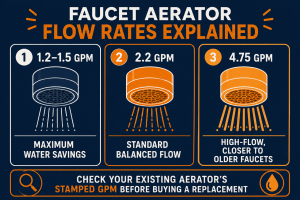
GPM stands for gallons per minute — how much water the aerator allows through the faucet per minute of use. Federal standards set the maximum at 2.2 GPM for bathroom faucets sold in the US as of 2016, but WaterSense-certified aerators push that down to 1.5 GPM or lower. The practical difference in daily use is noticeable: a 1.2 GPM aerator like the KOHLER 1278467 fills a glass or rinses hands with a stream that’s markedly thinner than a 2.2 GPM aerator, even though the aerator injects air to keep the stream looking full. The JQK 4.75 GPM insert feels closer to a wide-open pre-2010 faucet — full pressure, almost no restriction.
For kitchen faucets used for filling pots, rinsing produce, and heavy-duty dish work, flow rate matters more than at a bathroom sink — a 1.2 GPM aerator in a kitchen can noticeably slow those tasks. For bathroom sinks used primarily for hand washing and face rinsing, the difference between 1.5 GPM and 2.2 GPM is far less significant in practice. The energy savings argument also applies: hot water that doesn’t exit the faucet doesn’t need to be heated. A household running bathroom faucets at 1.2 GPM instead of 2.2 GPM will see a measurable reduction in both water and water-heating costs, with the savings scaling to the number of daily uses across all faucets in the home. If low pressure is already a concern, our guide on how to increase water pressure at home covers whether the supply side — rather than the aerator — is the actual limiting factor.
Genuine OEM vs Universal Aerators
Genuine OEM aerators — the Moen 116711 and KOHLER 1278467 in this roundup — are manufactured by the faucet brand to fit their specific faucet models. Universal aerators like the Hibbent certified pick are designed to cover a wide range of faucets by conforming to standard thread sizes and diameters. The trade-off is straightforward: OEM parts guarantee a fit if you know your faucet brand and model, while universal parts require verifying thread type and diameter before ordering but work across brands. If you’ve removed your existing aerator and it’s visibly a Moen or Kohler part (brand marks are usually stamped on the screen housing face), the OEM replacement is the path of least resistance. If you don’t know the brand, or the existing aerator has no visible brand markings, a correctly sized universal aerator is entirely appropriate.
One area where OEM aerators have a clear advantage is on faucets with non-standard internal housing geometry. Some Moen and Kohler designs use a cache aerator style where the screen assembly is recessed inside the spout tip and requires a specific key tool to access — the 28-piece assortment kit in this roundup includes five such removal keys precisely because this scenario is common enough to warrant including them. For straightforward external-thread spout tips, the OEM vs universal distinction matters less: a correctly sized universal aerator will seat, seal, and flow correctly on any faucet with standard thread geometry, regardless of brand. The key word is correctly sized — an aerator that threads on but uses the wrong diameter will have a gap at the seat and drip from the base of the aerator tip even when tightened.
US Regional Context — Hard Water and Aerator Replacement Frequency
In hard water states like Arizona, Texas, Nevada and parts of California, mineral deposits clog the fine mesh screen inside an aerator far faster than in soft water regions — what looks like a faucet losing pressure is often just a buildup-clogged aerator. Homeowners in these areas should plan to clean or replace aerators every 6 to 12 months rather than waiting for years between replacements.
The cleaning step is worth trying before replacement: unscrew the aerator, disassemble the mesh screen from the housing, soak both pieces in undiluted white vinegar for several hours or overnight, then rinse thoroughly under running water. In moderate hard water areas, this restores flow to near-original performance. In very hard water areas like Phoenix, Las Vegas, or San Antonio, heavy calcium and lime scale can block the mesh so thoroughly that soaking isn’t enough — replacement is the faster fix. The 28-piece assortment kit earns particular value in hard water households because it provides enough replacement aerators to swap out at every sink in the home on a regular maintenance schedule without individual reorders each time.
Need a Professional Plumber?
Faucet aerator replacement is one of the simplest DIY plumbing tasks — no tools beyond an aerator key or pliers, no shutting off the water supply, and the whole job typically takes under five minutes per faucet. But if a faucet loses pressure even after a fresh aerator, or if you’re seeing leaks at the spout base, around the handle, or beneath the sink, the issue is inside the faucet body — cartridge failure, worn O-rings, or corroded seat rings — and benefits from a professional assessment. A licensed plumber can diagnose whether repair or full replacement makes sense based on faucet age and parts availability.
Find a licensed plumber in your area at PlumberArchive.com — the US plumber directory with 12,151+ verified local plumbers across all 50 states.
Find a trusted plumber near you → PlumberArchive.com
Follow Us on Facebook
Get weekly plumbing tips, honest tool reviews and DIY maintenance guides delivered straight to your Facebook feed. We cover faucet maintenance, aerator replacement, water pressure, and everything in between — written for US homeowners who want to handle more themselves.
Follow PlumbingToolsReview on Facebook →
Frequently Asked Questions
Q: How do I know if my faucet aerator needs replacing?
The clearest signs are a noticeably weaker stream than usual, a sputtering or uneven spray pattern, or visible discoloration in the water immediately after turning on the faucet. A partially blocked aerator mesh causes a split or off-centre stream — water exits unevenly because some mesh perforations are fully blocked while others still flow. Remove the aerator and look at the screen under good light: white or grey mineral deposits on the mesh face, or visible debris trapped against the screen, confirm the aerator is the cause. In hard water areas, the mesh can also become mechanically distorted from heavy scale buildup that soaking alone can’t fully reverse. If the stream improves noticeably after removing the aerator and running water through just the bare spout, the aerator is confirmed as the restriction point — cleaning or replacing it will restore full flow.
Q: What’s the difference between GPM ratings on faucet aerators?
GPM (gallons per minute) is the volume of water the aerator allows through the faucet per minute. A 1.2 GPM aerator is the most water-saving option — appropriate for bathroom sinks where the primary task is hand washing. A 1.5 GPM aerator is the WaterSense standard that brands like Moen specify for their eco-performance lines — it balances savings with usable pressure. A 2.2 GPM aerator is the federal maximum for bathroom faucets and delivers a stream that feels noticeably fuller than the 1.5 GPM option. Flow rates above 2.2 GPM — like the 4.75 GPM JQK insert — deliver a pre-restriction pressure feel that some households strongly prefer, at the cost of higher water use. The right choice depends on the task: bathroom hand-washing works well at 1.2–1.5 GPM; kitchen rinsing and filling tasks benefit from 2.2 GPM or above. If your home already has pressure challenges, our guide on how to increase water pressure at home walks through the diagnostic steps to identify the actual restriction point.
Q: How do I know what size aerator my faucet needs?
The simplest method is to remove your existing aerator and measure its outer diameter with a ruler or caliper, or bring it to the hardware store for a physical match. Standard US aerator sizes in metric are M16.5 (small — older or imported faucets), M18.5, M21.5, and M24 (large — common on kitchen faucets). As a rough field guide: a US quarter (24.26mm) is close to M24, a nickel (21.21mm) is close to M21.5, and a penny (19.05mm) falls between M18.5 and M21.5. This coin method is approximate rather than precise, which is why the 28-piece assortment kit is popular — buying a kit with all four common sizes lets you confirm the match at the faucet rather than making a single-size bet before the product arrives. If you have a Moen or Kohler faucet and know the model number, the brand’s parts catalog cross-references the correct aerator to your specific model — the most definitive match available.
Q: Will a low-flow aerator reduce my water pressure?
A low-flow aerator reduces the volume of water exiting the faucet per minute (GPM), but it doesn’t directly reduce the line pressure behind the aerator — those are two different things. The supply pressure in your pipes is set by the utility and your pressure reducing valve; the aerator controls how much of that pressure is converted into flow volume at the spout. In practice, a 1.2 GPM aerator does feel like reduced pressure because the stream is thinner and fills containers more slowly — but the flow should be steady and consistent, not weak or sputtering. Sputtering or an uneven stream is a sign of a blocked aerator rather than a low-flow one. If your faucet feels weak even after installing a new aerator, the cause is typically supply-side: low inlet pressure, a partially closed shutoff valve under the sink, or a clogged supply hose. Our guide on how to increase water pressure at home walks through the diagnostic steps to identify the actual restriction point.
Conclusion — Which Faucet Aerator Should You Buy?
For the majority of US homeowners replacing a worn or clogged standard faucet aerator, the Hibbent NSF/ANSI/CAN 61 Certified Aerator is the clear best overall — the dual NSF and CUPC certification provides drinking water safety assurance that most budget alternatives skip, and the chrome 55/64 inch female thread covers the most common US faucet spout configuration. If you want to restore a full-pressure feel to a bathroom faucet and water savings aren’t the priority, the JQK 4.75 GPM 10-Pack is the right call — the higher flow rate resolves the weak-stream complaint directly, and the 10-pack format means spares for every bathroom sink in the home in a single purchase.
For Moen faucet owners, the Moen 116711 Eco-Performance Aerator is the definitive pick — a genuine OEM part that threads on correctly the first time, delivers factory-spec 1.5 GPM eco flow, and carries a five-star rating that reflects exactly that kind of no-surprise installation experience. The KOHLER Genuine Part 1278467 Service Kit offers the same logic for Kohler faucet owners at an even lower 1.2 GPM flow rate — the strongest water savings in this roundup, sourced from the manufacturer who engineered the faucet it’s replacing parts on.
For homeowners tackling multiple faucets at once, or anyone who doesn’t know their faucet thread size and doesn’t want to find out after a single-size order arrives, the 28-Pc Faucet Aerator Kit with 5 Removal Keys is the most practical purchase in this roundup — it covers all four common US thread sizes, includes the removal keys needed for recessed cache aerators, and delivers the best per-aerator value of any option here. Whatever you choose, confirm thread type (male vs female) and diameter before ordering — that one step is what separates a five-minute fix from an unnecessary return.
✍️ About This Review
PTR Editorial Team — Product Reviews. We compare manufacturer specifications, installation requirements, compatibility and available product documentation to help homeowners choose suitable tools and parts. How we review →