
Guides
23 Nov 2026

Boiler Keeps Switching On and Off? Understanding Short Cycling
Boiler keeps switching on and off? See how short cycling differs from normal cycling, a thermostat ending its call, or a fault, and what to check safely.
Water-based radiant floor not warming up? See why a floor can feel cool or respond slowly, what can cause it, and what to check safely.
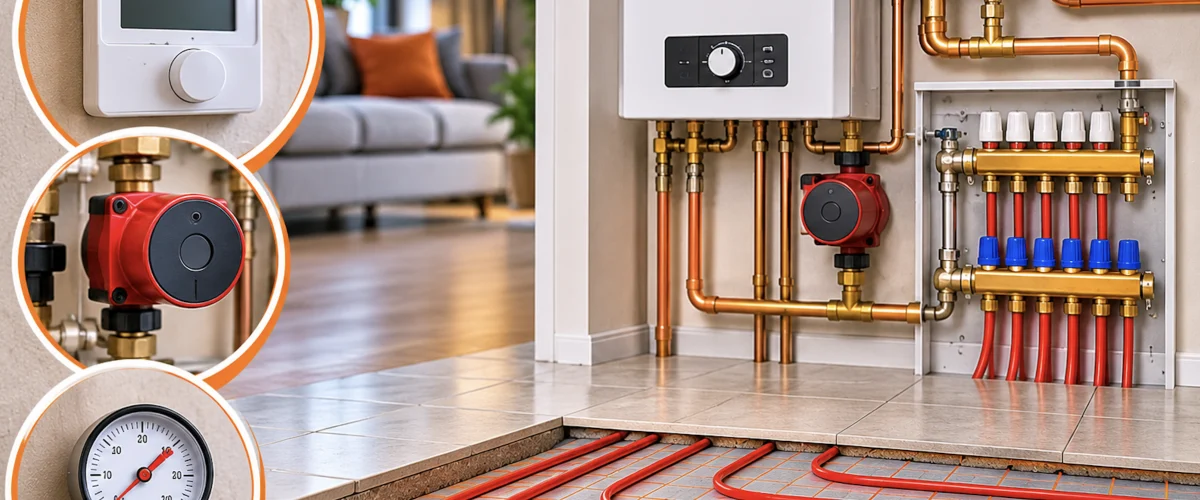
Please note: This is general information about water-based radiant floor heating, not a diagnosis of your system. Your equipment’s own instructions come first, and a heating professional should handle anything involving electrical controls, pumps, valves, manifolds, boiler settings or pressurised hot water.
This guide is about water-based (hydronic) radiant floor heating, where a boiler or another suitable heat source sends warm water through tubing in or under the floor. It does not cover electric floor heating, which has different parts and different faults, or steam, baseboards or radiant wall and ceiling panels. Floors are built in different ways and controlled in different ways, so this guide describes ideas and never asks you to identify sensors, actuators or other components. Your installer can tell you how your system is built and controlled.
The short answer: “not warming up” can mean three different things: the floor doesn’t feel as warm as you expect, the room isn’t reaching its set temperature, or the floor is slow to respond. Some radiant floors respond slowly and some respond faster, depending on how they are built, and a thermostat may sense the room air, the floor, or both. This guide helps you sort out which pattern you have, lists possibilities heating professionals work through, and keeps your own checks to what is safe to see from a distance.
✏️ Our Take
IN THIS GUIDE
A radiant floor’s thermostat can sense the room air, the floor, or both. tekmar’s 2002 control essay explains the consequence: with an air sensor the room air is held at its setpoint, so the floor may feel warm in some conditions and cool in others; with a floor sensor the floor temperature is held, and the room air may run warmer or cooler. REHAU’s thermostat sheet adds that operating with only a floor sensor can lead to over- or under-heating of the space. Those are two manufacturers’ descriptions of their own kinds of control. Yours may differ, and your installer knows which approach your system uses.
How quickly a radiant floor responds depends on how it is built. Uponor’s planner page describes high-mass radiant systems, typically built into concrete, as very slow to reach the desired temperature and as continuing to give off heat after the input stops, and low-mass systems as responding quickly. A 2005 Uponor control brochure sorts floors into the same two groups: embedded in concrete, sand-cement or screed (large thermal mass, slow acting) and attached to the underside of a wood subfloor, suspended in the joist space or sandwiched between the subfloor and the surface (relatively low mass, faster than a high-mass floor). The tekmar essay describes a slow-responding system as one with a long delay between the thermostat calling and a temperature change being sensed.
So a floor can be working normally and still take a while to respond, and how long depends on the construction; this guide gives no typical times. What points toward a different problem is a room that never gets there. If you already have readings or observations over time, compare them, and note whether the room eventually reaches its set temperature and what schedule or setback was in use. You don’t need to collect more before contacting a professional.
Warmup’s hydronic troubleshooting sheet (2017, UK) separates three situations: no heat to any zone, some zones not getting warm, and a zone that takes a long time to heat up, each with its own list of possibilities. That is a useful way to describe what you see. If every zone is affected, think about what they share. If one zone is affected, think about that zone’s thermostat, controls and flow. If only part of a floor is affected, Caleffi’s radiant checklist asks about things that cover or insulate the floor, air at the manifold, and flow in each circuit. Our guide to one heating zone that stays cold explains the general difference between a call for heat and heat arriving; it isn’t specific to radiant floors.
Treat these as clues, not diagnoses. Each row fits several causes.
| What you notice | What it could suggest | What to note |
|---|---|---|
| The floor feels cool, but the room reaches its set temperature | This can be how a system that holds the room air at its setpoint behaves, since the floor may feel cooler in some conditions. It isn’t necessarily a fault. | Whether the room reaches its set temperature, and when the floor feels cool. |
| The room is slow to warm after a schedule change or a cold spell | Response depends on how the floor is built, and some floors respond slowly. Slowness alone doesn’t show a fault. | The schedule or setback in use, and whether the room eventually reaches its setpoint. |
| The thermostat is calling, but the room never reaches its set temperature | Anywhere along the chain: sensing or limits, controls, flow, water temperature, or the floor itself. These look alike from the room. | Any readings or observations over time, any thermostat message, and which zones are affected. |
| One zone stays cold while the others warm | That zone’s thermostat, controls or flow, or something it shares with the others. | Which zone, and its thermostat settings and messages. |
| Every zone is cold | Something the zones share: settings, the heat source or circulation. | Thermostat settings and messages, and any message on the boiler’s display. |
| One area of the floor is cooler than the rest | Something covering or insulating that area, air or flow in that circuit, or how the tubing was installed there. | Which area, when it started, and any recent flooring, rugs, furniture or repair. |
These follow the order of the control chain, not how likely each is; none of the documents we read ranks them. They are possibilities a professional works through, not a checklist for you.
Caleffi’s troubleshooting guide begins with thermostats: whether they are set to heat, whether a schedule or setback is in effect, and whether a battery-powered model shows a low-battery indicator. REHAU’s sheet, for example, describes a “reduced” mode for night and vacation periods. As the tekmar essay explains, the type of sensor also changes what the floor and the room do.
Some thermostats can limit the floor temperature. The tekmar essay says floor sensors are also used to limit the maximum floor temperature to protect coverings or other flooring, and REHAU’s sheet describes its own thermostat flashing an indicator when the floor sensor has reached a limit before the room has reached its setpoint. That is how that thermostat behaves; others may behave differently or show nothing. If your thermostat shows a message you don’t recognise, note it exactly and tell a professional.
Radiant zones are often opened and closed by small motorised actuators that respond to the thermostat. Caleffi notes that actuators with thermal motors can be slow to open fully, and that if power reaches one that doesn’t open, the actuator is the likely fault. Warmup’s sheet lists a faulty actuator and thermostats controlling the wrong circuits among the reasons some zones don’t warm. Checking either takes a professional.
Warmup’s sheet lists an incorrectly balanced manifold among the causes of a zone that takes a long time to warm up, and a heat source or circulator not operating correctly among the causes of no heat in any zone. Its detailed checks for a slow zone are things an installer verifies: that the circulator is operating while the zone’s thermostat is asking for heat, that the zone’s isolating cap and actuator are fully open, and that the flow gauge is balanced correctly. Those are checks, not faults in themselves. Caleffi’s flow checklist adds partly shut valves and a mixing valve with low flow capacity as causes of insufficient flow, and says to check flow in each active circuit. Flow meters, valves and balancing are for a professional, and a single observation doesn’t establish the cause.
Caleffi says too much air stops circulators providing proper flow, with gurgling or swishing as a clue, and lists air at the manifold among its radiant checks. Removing it is a job for a professional; our guide to purging air from a radiant floor loop explains what that involves and why air isn’t always the cause.
Warmup’s sheet lists a flow temperature set too low among the reasons a zone takes a long time to warm up. Where and how the supply temperature is controlled depends on the system, and changing it is a job for a professional.
Whatever sits on the floor adds resistance to the heat moving up from the tubing. Caleffi’s emitter guidance says the resistance of the finish floor affects how much heat the floor gives off and how warm the water needs to be, and its radiant checklist asks whether the floor is covered by rugs, carpet padding or other objects and whether there is insulation beneath. That doesn’t mean every rug is a problem: how much a covering matters depends on the floor’s design and on the covering. Warmup’s sheet also notes that some rooms and floor finishes have higher heat losses and take longer to heat.
Trouble that began after filling, draining, repairs, new flooring or a thermostat replacement is useful history. Caleffi lists unnecessary draining and refilling among the reasons air keeps returning to a system, and Warmup lists thermostats controlling the wrong circuits as a possibility. Note what was done and when.
From a safe, accessible position, you can note four things:
If the boiler shows a pressure message, note it exactly; our guide to boiler pressure that keeps dropping explains what such a message can mean. None of these observations confirms water flow, the floor’s surface temperature or the state of any actuator, and a boiler that is running or making noise doesn’t show that warm water is reaching the floor.
If a thermostat or the boiler shows a fault message, or there is a leak, a burning smell or any urgent symptom, don’t wait to see whether it passes: use the box below. Don’t touch hot pipes, remove covers, test wiring, operate manifold valves, adjust flow meters, change mixing controls, or top up or purge the system. Those jobs belong to a professional.
Get professional help
Contact a heating professional if the room persistently fails to reach its set temperature, one zone or one area stays cold, a thermostat or the boiler shows a fault or lockout message, you see a leak, or you notice an electrical or burning smell. Don’t keep resetting a lockout.
A gas smell or a carbon monoxide alarm is an emergency, not troubleshooting. CPSC says that if you smell gas you should leave your home immediately and contact local gas authorities from outside, without operating lights or phones before leaving. CPSC also says that if a carbon monoxide alarm sounds you should get outside to fresh air, call 911 or the fire department, and not re-enter until emergency responders give permission.
Tell them: whether the whole house, one zone or one area is affected; the thermostat’s settings, schedule and any messages; what the room temperature has done over time, if you have noticed; whether the floor ever warmed as expected; any recent work, new flooring or rugs; any message on the boiler’s display; and anything your installer has said about how the floor is built and controlled.
There’s no single answer. Manufacturers describe floors embedded in concrete or screed as slow acting and floors attached to or between the subfloor as faster, so it depends on how yours is built. Compare your system with itself, how it behaved last winter and how it behaves now, and report anything that has changed, along with the schedule you use.
If the thermostat holds the room air at its setpoint, tekmar’s essay says the floor may feel warm at some times and cooler at others. That can be how that kind of control behaves. If the room itself isn’t reaching its set temperature, treat it as underheating and see the possibilities above.
Coverings add resistance to the heat leaving the floor, and Caleffi’s radiant checklist asks about rugs and carpet padding. Whether a particular covering matters depends on the floor’s design and on the covering, so a rug alone doesn’t mean a fault. If the trouble began with new flooring or rugs, tell the professional.
Purging uses manifold valves and a controlled water supply, and procedures differ between manufacturers, so it is a job for a professional. Our guide to purging air from a radiant floor loop explains what is involved.
Decide whether the floor feels cool, the room is under its set temperature, or the response is slow. Note the thermostat’s settings, schedule and any message, use any readings or observations you already have, and write down recent changes and which areas are affected. Then give a heating professional those notes and ask for a diagnosis before you buy a part or change any setting.
✍️ About This Guide
Reviewed by Jerry McCann, a plumbing contributor at PlumbingToolsReview, covering pipework, hot-water boilers and hydronic heating. How we review →
Boiler keeps switching on and off? See how short cycling differs from normal cycling, a thermostat ending its call, or a fault, and what to check safely.
Boiler running but one heating zone cold? See how a call for heat differs from heat arriving, what valves, pumps or air can mean, and what to check safely.
Boiler pressure keeps dropping? Learn how to compare cold readings, what patterns can point to, and what to report to a heating professional.

