
Guides
19 Nov 2026

How to Purge Air From a Radiant Floor Heating Loop
Radiant floor loop not heating? Learn what purging air involves, how to tell whether air is the cause, and when to call a heating professional.
What a compression sleeve puller is for, what its maker documents about 1/2 in (5/8 in OD) fit, and what to check before you choose one.
Please note: Information in this guide is based on manufacturer documents and product pages we read on 9 November 2026 and is subject to change. Always check the maker’s current instructions for your exact tool and replacement fitting, and ask a plumber if you are unsure.
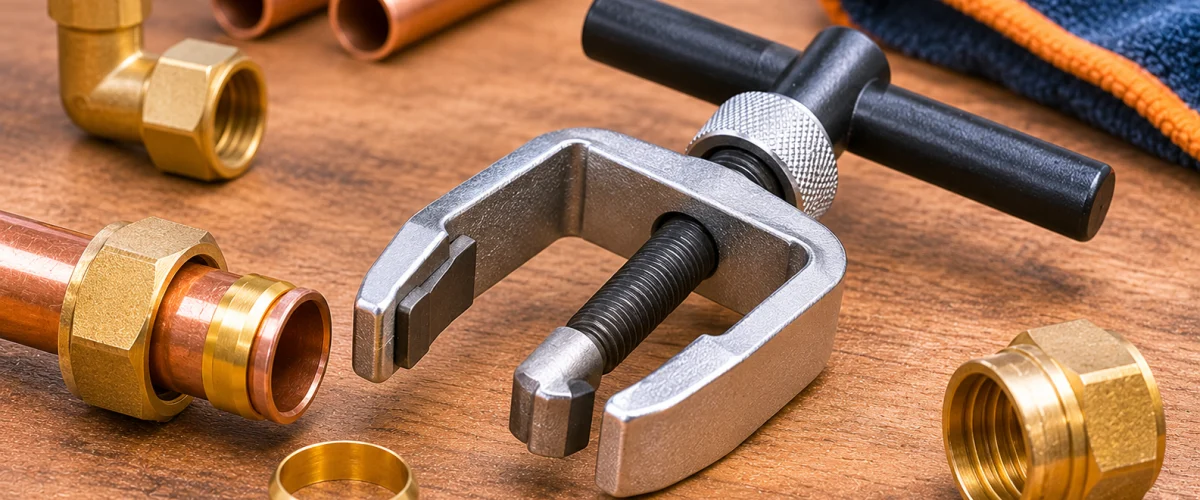
When a compression stop or fitting is taken off a copper pipe, its brass sleeve (also called a ferrule or compression ring) can stay behind on the pipe. A compression sleeve puller is a specialty hand tool sold for that situation. This guide explains what such a tool is for, what its maker documents about fit, and what to check before you choose one.
The documented example here is the Superior Tool 3943, the only puller whose manufacturer documents we could read. This is not a survey of puller types or products, and it does not compare tools. It also does not give a removal sequence: Superior’s published instructions are brief, and we have not added to them. If you are replacing the valve itself, our guide to replacing an angle stop valve covers that job.
The points below come from Superior Tool’s package, catalog page and product data. They are the maker’s statements, not our findings; we have not used the tool.
Copper water tube is sold by a nominal size that is not its measured outside diameter (OD). Manufacturers pair the two. SharkBite’s Max installation guide lists 1/2 in nominal tube with a 5/8 in OD, Husky’s 1/2 in tube cutter sheet lists a 1/2 in nominal capacity and a 5/8 in OD, and Superior’s puller wording, 1/2 in (5/8 in O.D.), uses the same pairing. So “1/2 in” on this puller means pipe that measures 5/8 in across the outside.
Stop valve makers label inlets the same way: one stop in our angle stop valve roundup is listed as 1/2 in nominal (5/8 in OD) compression. Other sizes are a different matter. Some stops in that roundup also have a 3/8 in OD compression connection, and nothing we read says the 3943 suits that size.
Superior’s pages leave several things open. Treat each as unknown rather than assuming an answer.
This section is our own editorial advice, not manufacturer statements.
If you cannot confirm the size or type of the pipe, cannot judge its condition, or cannot meet the replacement fitting’s requirements, a plumber is a safer next step than improvising.
If the pipe size, type or condition cannot be confirmed, a plumber can check it before you buy a tool or change anything.
To look for local plumbers, you can search PlumberArchive.com, a plumber directory.
These are the manufacturer documents this guide draws on, read on 9 November 2026. Each covers only the product it names. Superior Tool’s product page and instruction sheet were read as archived copies, captured on 16 January 2025 and 21 May 2025, and are listed with the original addresses.
✍️ About This Guide
PTR Editorial Team — Plumbing Guides. We compare manufacturer specifications, installation requirements, compatibility and available product documentation to help homeowners choose suitable tools and parts. How we review →
Radiant floor loop not heating? Learn what purging air involves, how to tell whether air is the cause, and when to call a heating professional.
Boiler running but baseboards still cold? Check thermostat settings, affected zones and common circulation problems—and know when to call a professional.
Learn how to find and use a manual bleeder on a hot-water baseboard heater, and what to do if the heater has no bleeder or stays cold.

