Reviews
23 Sep 2026

5 Best Natural Gas & Propane Leak Detectors (2026) — Expert Reviews
Compare 5 top natural gas & propane leak detectors for 2026 — plug-in alarms vs handheld sniffers, tested for accuracy, price and home safety.
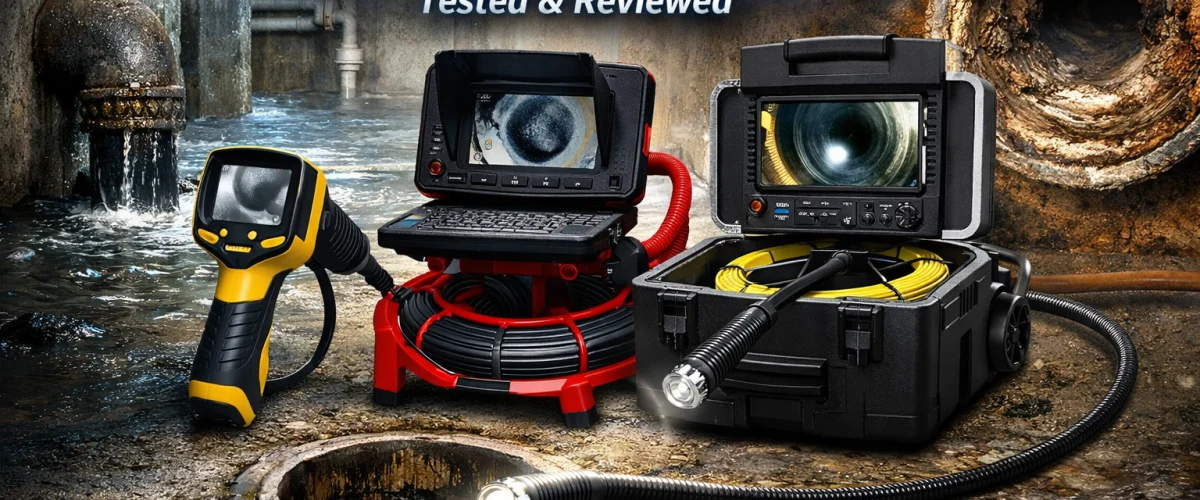
5 best drain cameras tested and reviewed for 2026. Compare sewer camera specs, cable lengths and prices to find the right pipe inspection camera for your home.
Please note: Product availability and information are based on our research at time of writing and are subject to change. Always check Amazon for the latest details before purchasing.
A blocked or slow drain is one thing — not knowing why it’s blocked is the real problem. Calling a plumber blind for a diagnostic visit alone can add a meaningful cost before any repair even starts. A drain camera lets you look inside your pipes yourself in minutes, confirming whether it’s a simple grease build-up you can shift with a drain unblocker, a stubborn clog that needs a drain snake, or a cracked pipe that genuinely needs a plumber.
When shopping for a drain inspection camera, the key factors are cable length, screen connectivity, waterproof rating, and whether it records footage. We reviewed five models across a wide price range — from budget endoscopes to a professional DVR sewer camera.
At a Glance
| Best Overall | DEPSTECH Dual Lens Industrial Endoscope |
| Best Budget Pick | Endoscope Camera 4.3″ IPS 1920P |
| Cable Length Range | 6.5 feet (precision inspection) to 100 feet (main sewer lines) |
| Price Range | $ – $$$$ |
✏️ Our Take
A drain camera’s whole job is turning a guess into a diagnosis — instead of wondering whether you’re dealing with a simple clog or a cracked pipe, you can see it directly. Cable length is the single most important spec: 16–16.5ft covers virtually every household drain, while only a 100ft cable reaches a main sewer line. A built-in screen makes one-handed use under a sink much easier, and DVR recording matters if you ever need to document damage for an insurance claim. Most homeowners are well served by a standard household endoscope; only landlords or anyone facing a suspected main line problem need a professional-grade sewer camera.
IN THIS GUIDE
| Product | Rating | Best For | Cable Length | Price |
|---|---|---|---|---|
| DEPSTECH Dual Lens Industrial Endoscope BEST OVERALL |
★★★★★ | Overall use — dual-lens inspection, broad device compatibility | 16.4 ft | $$ |
| Endoscope Camera 4.3″ IPS 1920P | ★★★★★ | Budget buyers who want a built-in screen | 16.5 ft | $ |
| Acoath Two-Way Articulating Borescope | ★★★★★ | Precision inspection of pipe joints and bends | 6.5 ft | $$$ |
| Daxiongmao Endoscope Camera 16.5ft | ★★★★★ | First-time buyers, straightforward setup | 16.5 ft | $ |
| 2026 7″ Sewer Camera HD1080P DVR 32GB | ★★★★★ | Main sewer lines and contractor-grade documentation | 100 ft | $$$$ |
🏆 Best Overall
Dual Lens Design
The DEPSTECH Dual Lens Industrial Endoscope earns its place as our top pick thanks to its dual-lens design — a feature you simply don’t find at this price point. A forward-facing lens handles straight-ahead inspection while the side-view lens examines pipe walls without repositioning the camera.
DEPSTECH is one of the more established names in consumer endoscope cameras, and strong buyer demand and an extensive review history back up that reputation. It connects via USB and USB-C to Android, Windows, and Mac, eliminating the need for a separate screen, and the 1920×1080 resolution delivers crisp footage — more than enough to identify a blockage, grease build-up, root intrusion, or cracked joint.
✓ Pros
Strong buyer demand and an extensive review history confirm dependable performance for a dual-lens design you don’t typically find at this price point
Forward and side-view lenses let you inspect pipe walls without repositioning the camera
Works across Android, Windows, and Mac via USB/USB-C, with an IP67-rated head safe in standing water
✗ Cons
No built-in screen — needs a phone or laptop to view footage
Not compatible with iPhone due to Apple’s Lightning/MFi restrictions
🛒 Check Price on Amazon — $$ →
💰 Best Budget
Built-In 4.3″ Screen
This 4.3-inch IPS endoscope is the best value drain inspection camera in this lineup. Strong buyer demand and a well-reviewed track record back up the pick. The screen is genuinely bright and sharp — no phone or laptop needed, which is far quicker when you’re crouching under a sink. The 1920P resolution is impressively high for this price, delivering enough detail to identify debris, corrosion, or blockages.
The 16.5ft semi-rigid cable handles most household drain runs comfortably, and the 8-LED adjustable lighting ensures clear visibility in completely dark pipe interiors — a dependable pipe inspection camera that outperforms its price tag.
✓ Pros
Strong buyer demand and a well-reviewed track record confirm dependable performance at the lowest price tier here
Built-in 4.3″ IPS screen means fully self-contained use, no phone or laptop needed
1920P resolution and 8 adjustable LEDs deliver clear footage even at this price tier
✗ Cons
16.5ft cable — insufficient for main sewer lines
No DVR recording — view only
🎯 Best Mid-Range / Precision Control
Two-Way Articulating
The Acoath Two-Way Articulating Borescope is the only pipe inspection camera in this lineup with a steerable camera head — and that changes everything. Using a joystick-style control, you can angle the camera tip up to 180° in two directions, letting you look around bends, peer into T-junctions, and inspect pipe sides with precision a fixed-lens camera can’t match.
It’s the mid-range pick here, but the two-way articulation justifies the premium for anyone doing thorough inspections rather than a quick peek. The IPS monitor delivers bright, sharp imagery, and the IP67-rated head handles wet drain environments without concern. If the camera reveals the trap itself is corroded or cracked rather than just clogged, our P-trap kits review covers replacement options.
✓ Pros
Steerable articulating head — unique in this lineup for precise directional inspection
Inspects pipe joints and bends other cameras miss, thanks to the 180° steerable tip
IPS screen means no phone is needed for a bright, sharp picture
✗ Cons
Shorter 6.5ft cable — not suited to deep drain runs
Higher price tier than the basic endoscopes in this lineup
🛒 Check Price on Amazon — $$$ →
👷 Best for Beginners
Plug-and-Play USB-C
The Daxiongmao 16.5ft Endoscope Camera is the no-fuss pick for homeowners who want a straightforward pipe inspection camera that just works, right out of the box. Strong buyer demand backs up its reputation as a reliable first camera. The 16.5ft cable is the perfect household length — long enough to reach the trap and drain run without the bulk of a professional-grade reel. Setup is plug-and-play via USB-C on Android devices.
The 1080P camera head with adjustable LED lighting gives a clean, usable picture inside your pipes, and the IP67 waterproof rating means it handles wet drains without issue. See our guide to how to unclog a drain without chemicals to get the most from your inspection results.
✓ Pros
Strong buyer demand and an extensive track record of real-world use
Simple plug-and-play setup — no app needed on Android
Great entry-level price for a first drain camera
✗ Cons
Android only — no iPhone support
No built-in screen — needs your phone
⭐ Best Premium / Pro-Grade
DVR Recording + 32GB
This 2026 7-inch Sewer Camera is in a different league from the other models here — a professional-grade inspection system with a 100ft cable, HD1080P resolution, built-in DVR recording, and 32GB of storage. The 7-inch IPS monitor is large enough to share on-site with a plumber, and the DVR capability lets you record and review footage afterwards — essential for documenting pipe damage for an insurance claim.
The 100ft steel-armored cable is designed for main sewer lines, not just sink traps — it navigates full-bore drain runs and underground pipework household endoscopes cannot reach. If you’re a landlord, property investor, or serious DIYer who needs to inspect main drain lines, this delivers professional results without the professional call-out cost.
✓ Pros
100ft cable reaches main sewer lines other models in this lineup can’t touch
DVR recording to 32GB onboard storage — no phone needed to save footage
7″ IPS screen makes it easy to share footage on-site with a plumber or contractor
✗ Cons
Highest price tier in this lineup
Heavier and bulkier than household endoscopes
🛒 Check Price on Amazon — $$$$ →
A drain camera’s two display options are a built-in screen or phone connectivity. Built-in screens — like the 4.3″ IPS on the budget pick and the 7″ on the premium sewer camera — mean the unit is fully self-contained, no phone, no app needed. For resolution, 1080P is the sweet spot for home use, sharp enough to clearly identify debris, corrosion, and pipe damage without the cost of 4K, which offers diminishing returns inside a dark drain pipe.
Cable length is the single most important spec to get right. For household sink drains, shower traps, and bath drain runs, 16–16.5ft is the right length — it reaches the trap and several feet beyond it. For main sewer lines running from your home to the street, you need 50–100ft of cable — only the premium DVR sewer camera here covers that. The articulating Acoath model at 6.5ft suits short-reach inspection of traps, T-junctions, and wall cavities, where flexibility matters more than length. When in doubt, choose more cable rather than less.
Every drain camera in this roundup carries either IP67 or IP68 waterproofing on the camera head. IP67 means the camera can be submerged in up to 1 meter of water for 30 minutes — more than sufficient for most household inspections. IP68 goes further, rated for deeper submersion for longer periods, useful for a blocked drain or submerged inspection chamber. The cable body itself is water-resistant but not submersible — only the camera head at the tip is rated for immersion.
Basic endoscopes display a live feed only — you view what the camera sees but cannot save footage. DVR-capable sewer cameras record video and photos directly to onboard storage, letting you review it later, share it with a plumber, or document pipe damage for insurance purposes. If you’re only checking for a simple blockage, DVR is a nice-to-have; for ongoing drain problems or potential structural damage, it becomes essential.
Some endoscopes use WiFi to stream footage to your phone’s camera app, while others connect directly via USB or USB-C. WiFi models offer convenience but can suffer from signal lag in thick-walled areas. USB/USB-C models are more reliable and work in basements where WiFi is weak — a good reason to lean wired if a slow basement floor drain is what sent you shopping in the first place. For a completely phone-free experience, choose a model with a built-in screen instead.
Drain cameras have become increasingly common in US homes as DIY plumbing diagnostics go mainstream, particularly among landlords, property investors, and homeowners in older housing stock where clay or cast iron sewer lines are more prone to root intrusion and cracking over time. In regions with mature tree cover, checking for root intrusion is one of the most common reasons homeowners reach for a longer-cable sewer camera rather than a household endoscope.
Sometimes a drain camera reveals something beyond DIY repair — a cracked main sewer line, a collapsed pipe section, or significant root intrusion. If you need a licensed plumber in your area, search PlumberArchive.com — the US plumber directory with 12,151+ verified plumbers across all 50 states.
Get weekly plumbing tips, honest tool reviews and DIY guides delivered to your Facebook feed.
For most household drains — sinks, showers, baths, and toilets — a camera head of 5.5mm to 8.5mm in diameter works in standard 1.5″ to 4″ drain pipes. A 16–16.5ft cable is the right length for household drain runs. You only need a longer cable if you’re inspecting the main sewer line between your home and the street — see the 7″ DVR Sewer Camera option here, since household endoscopes won’t have the reach.
You can absolutely use a drain camera yourself — that’s exactly what they’re designed for. Pushing the cable down a drain and feeding it through to the blockage requires no special training. The skill is in interpreting what you see: grease coating looks different from solid debris, which looks different from root intrusion. Use your footage alongside our guide to how to unclog a drain without chemicals to decide whether to DIY or call a plumber.
Budget endoscopes typically come with 16–16.5ft cables, covering sink traps, shower runs, and bath drain pipes. Mid-range and articulating models may have shorter cables (6–10ft) focused on precision over reach. Professional-grade sewer cameras like the DVR model here come with 100ft cables designed to reach main drain lines and outdoor chambers — the same reach you’d want for tracking down a recurring basement floor drain backup. Once you’ve located the blockage, our best drain snakes guide covers tools to clear it.
Both are dust-tight and waterproof, but they differ in submersion depth and duration. IP67 is rated for submersion up to 1 meter for up to 30 minutes — more than sufficient for household drains with standing water. IP68 is rated for deeper submersion for longer periods. Both ratings are adequate for household work; IP68 becomes relevant when inspecting heavily flooded pipes or outdoor underground chambers for an extended run.
For most homeowners, the DEPSTECH Dual Lens Industrial Endoscope is the best drain camera for the money — dual-lens design, strong buyer demand, and broad device compatibility. To spend less and keep things simple, the Endoscope Camera 4.3″ IPS is well reviewed and includes a built-in screen, the best budget pick by a clear margin. A camera finds the clog; our electric vs manual drain snake comparison covers what clears it.
Once you know what’s inside your pipes, you’re better placed to choose the right fix. For blockages you can see on camera, check our best drain snakes guide, or our best drain unblockers guide if a chemical treatment is the better approach. A drain camera and a drain snake together cover virtually every blocked pipe situation a homeowner is likely to face.
Prices and ratings may change. Always check Amazon for current prices.
✍️ About This Review
Reviewed by James Carter, Senior Tool Reviewer at PlumbingToolsReview — 15 years of hands-on experience in residential plumbing and tool testing. Learn how we test →
Compare 5 top natural gas & propane leak detectors for 2026 — plug-in alarms vs handheld sniffers, tested for accuracy, price and home safety.
5 septic tank riser kits compared for 2026 — Tuf-Tite and Polylok risers by diameter and height, so you can bring tank access to grade level.
The 5 best sewage and effluent ejector pumps for 2026, expert-reviewed: grinder, standard solids-handling and light-duty effluent pumps compared.

